
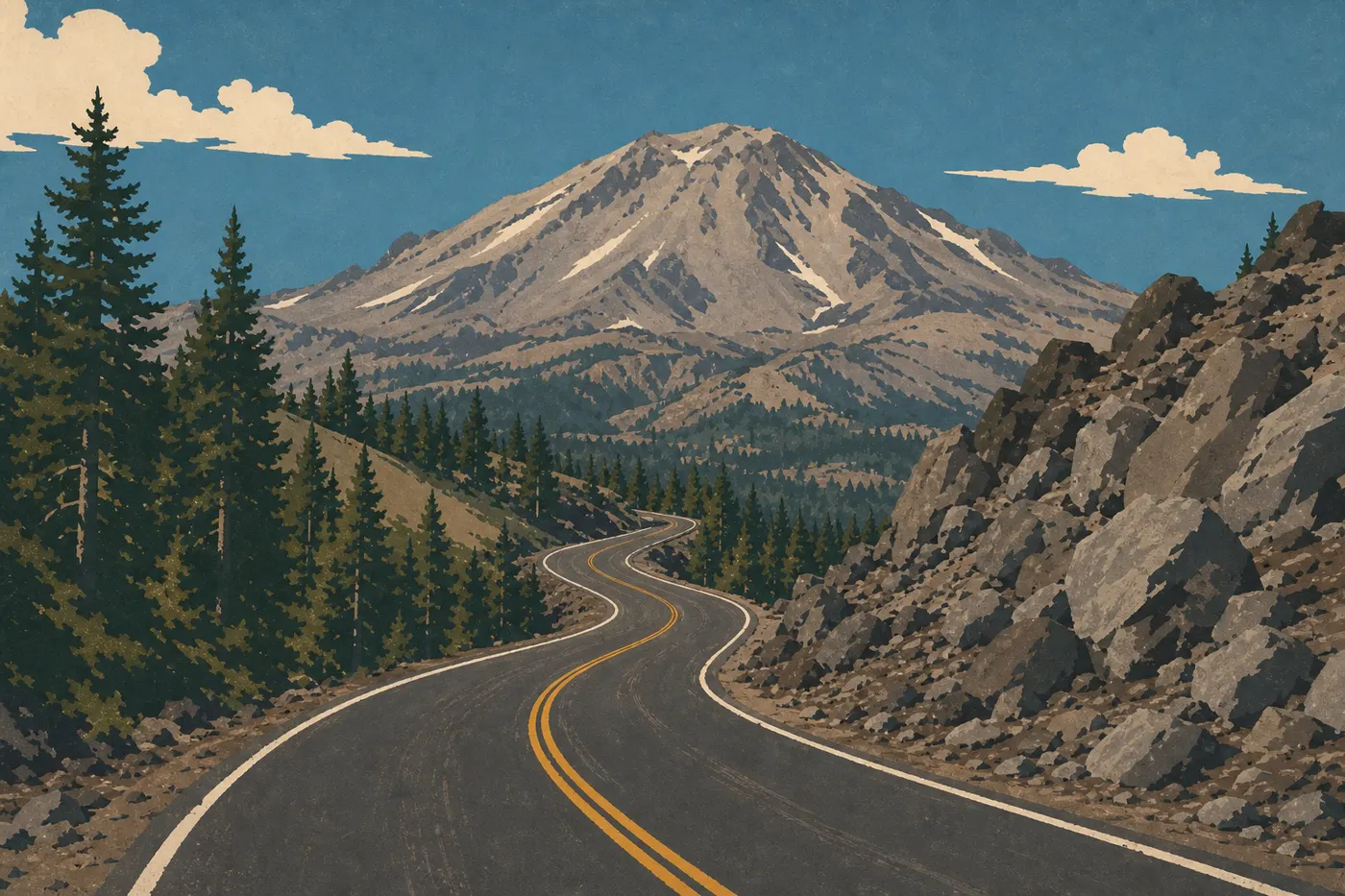
Lassen Volcanic Itinerary: What to See in 1, 2, or 3 Days
You can see almost all of Lassen Volcanic National Park along a single route: Highway 89, which crosses the park from northwest to southwest for about 31 miles. Two full days cover the essentials (the volcanic corridor, Bumpass Hell, Lassen Peak, and Manzanita Lake); a third day opens up remote areas such as Cinder Cone and Warner Valley. Even with less than a day, the park is worth the trip if you keep moving.
How Much Time Do You Need to Visit Lassen Volcanic?
1 day: realistic if you're coming from Redding or Red Bluff and leaving that evening. You can see Sulphur Works, Bumpass Hell, and Manzanita Lake without rushing, plus Lassen Peak if you're in good enough shape.
2 days: the ideal format for adding Kings Creek Falls, Chaos Crags, and a night in the park. Stay overnight, enjoy the quiet evening, and take in the morning light.
3 days: the choice for curious travelers who want to go beyond the main road and explore either Cinder Cone (northeast) or Warner Valley (southeast), two areas that rushed visitors rarely reach.
Beyond that, the park offers less crowded trails and good conditions for backcountry camping, but the number of new discoveries per day starts to drop on day four. Our complete guide to Lassen Volcanic covers all the sites.
Access, Entrances, and Getting Around the Park
The park has two main entrances to the central corridor: the northwest entrance (Manzanita Lake, the natural starting point from Sacramento or the Bay Area) and the southwest entrance (Kohm Yah-mah-nee Visitor Center, the natural starting point from Los Angeles). The Butte Lake and Warner Valley entrances require partly unpaved roads that close in winter and sometimes remain closed into June. There is no shuttle or public transportation in the park, so you'll need a car. The main road, Highway 89, is generally closed from November through May and sometimes into June. Check conditions on the NPS website before planning your arrival.
For detailed approach routes from Redding, Red Bluff, or Los Angeles, see the Getting to Lassen Volcanic guide.
The entrance fee is $30 per vehicle, valid for 7 days. The park's annual pass costs $55, and the America the Beautiful pass ($80 per year) is accepted.
Lassen Volcanic's Areas
The Main Corridor (Northwest / Southwest)
This is the backbone of any itinerary. Highway 89 connects Manzanita Lake with the Kohm Yah-mah-nee Visitor Center and passes the major sites: Sulphur Works, Bumpass Hell, the Lassen Peak trailhead, Kings Creek Falls, and Chaos Crags. This corridor contains 80% of what the park has to offer, and you can drive it in either direction.
The northwest area, around Manzanita Lake, is the gentlest: a volcanic lake ringed by conifer forests, a well-equipped campground, and a peaceful evening atmosphere. Around Sulphur Works and the Kohm Yah-mah-nee Visitor Center, the southwest area smells more strongly of sulfur, a sign that magma isn't far below.
Cinder Cone Area (Northeast)
Cinder Cone is a nearly intact, reddish volcanic cone rising from a pine forest near the Butte Lake entrance. It's off the main corridor, and getting there takes about 1 hr 15 min from Manzanita Lake on partly unpaved roads. The hike is about 4 miles round-trip, with 820 feet of elevation gain, and takes 2.5 to 3 hours. It leads through a landscape of volcanic ash, craters, and Painted Dunes, expanses of oxidized ash in rust and orange tones, unlike anything else in the park.
Warner Valley (Southeast)
Warner Valley is the park's wildest area. You reach it from the town of Chester via about 15.5 miles of unpaved road. The area includes Drakesbad Guest Ranch, tucked-away hydrothermal springs, and trails that attract almost no one even in peak season. Save it for day three or plan a dedicated visit.
Day-by-Day Itinerary
Day 1: The Volcanic Corridor from End to End
Start at the southwest entrance, at the Kohm Yah-mah-nee Visitor Center, which opens at 9 a.m. during the season. Pick up a paper map and check trail conditions with the rangers.
Sulphur Works (0.3 miles from the parking lot, 20 min): your first stop and first big surprise. Fumaroles hiss beside the road, and mud boils in ocher-colored craters. Lassen Peak's most recent eruptions took place between 1914 and 1917. Sulphur Works is a reminder that the volcanic system is still active.
Bumpass Hell (3.1 miles round-trip, about 2.5 hours with breaks): the park's largest hydrothermal area. The trail slopes gently down into a basin dotted with hot springs, turquoise acidic pools, and hissing geysers. Stay on the wooden boardwalks at all times. The ground's crust is thin in places, and a fall can cause serious burns. Start early, before 9 a.m., to avoid the midday crowds.
Lassen Peak (trailhead in the middle of the park, 5 miles round-trip, about 1,970 feet of elevation gain, 3 to 4 hours): if you're in good shape and the sky is clear, the climb to the summit, at 10,457 feet, rewards you with 360-degree views across Northern California. The trail generally opens in July once the snow has melted. Start before 10 a.m. to avoid afternoon thunderstorms. Outside July through September, check with the park for current conditions.
End the day by heading down to Manzanita Lake. Late-afternoon light on the lake with Lassen Peak in the background is the park's iconic photo opportunity.
Day 2: Kings Creek, Chaos Crags, and the Surrounding Area
This second day covers the sites Day 1 leaves out at a more relaxed pace.
Kings Creek Falls (about 3.1 miles round-trip, 510 feet of elevation gain, 2 hours): the trail descends through the forest alongside a mountain stream to a waterfall about 50 feet high. It's ideal early in the morning, before the groups arrive. Our Hiking page lists difficulty variations from the same trailhead.
Hot Rock (roadside stop, 15 min): a several-foot-wide block of basalt deposited beside the road by the 1915 lava flow. It's a short, tangible geology lesson.
Chaos Crags and Chaos Jumbles (northwest area, 1.2-mile loop, 45 min): lava domes and an avalanche debris field dating back a few centuries. The contrast between the rocky spires and the lush forest is striking.
Have lunch at the Manzanita Lake campground, then walk around the lake (1.6 miles, flat, 45 min) to finish the day with sunset over the water.
Day 3: Cinder Cone or Warner Valley
There are two options, depending on how much you want to see.
Option A, Cinder Cone: head toward the Butte Lake entrance, 1 hr 15 min from Manzanita Lake. The hike climbs loose volcanic ash to the crater rim, with views of the Painted Dunes below. Allow 3 hours of hiking and 1 hour of driving round-trip. It's a full day without being exhausting.
Option B, Warner Valley: from Chester, 1 hour from the southwest entrance, make your way to Drakesbad and the Drake Lake Trail, 3.4 miles round-trip. Expect marshy meadows, warm springs, and near-guaranteed solitude. If you prefer quiet wilderness to spectacular geology, Option B is the clear choice.
Variations Based on How Much Time You Have
1 day (express): stick to the southwest corridor. Sulphur Works in the morning, Bumpass Hell midmorning, lunch in the parking lot, Lassen Peak in the afternoon if the weather is favorable and you're up for it, and Manzanita Lake in the evening. If you're crossing the park from south to north, or the other way around, check that the main road is open before planning your route.
2 days (classic): follow the Day 1 and Day 2 programs above. Stay in the park, at the Manzanita Lake campground or Southwest Walk-in, to enjoy the starry sky.
3 days (in-depth): add Cinder Cone or Warner Valley on day three. This is the format we recommend for seeing Lassen without feeling rushed.
Regional road trip extension: Lassen Volcanic pairs naturally with Mount Shasta, 2 hours northwest of Redding, and farther on, Crater Lake in Oregon, about 4 hours north. Our Volcanic Cascades Road Trip and Northern California Region guides cover these combinations.
Itinerary Map
The NPS publishes an official Unigrid map in PDF format. You can pick it up at the entrance stations or download it from the park's website. It shows all parking lots, trailheads, drinking-water points, and camping areas. Download it before entering the park. Cell service is almost nonexistent along most of Highway 89.
Our Map page offers an annotated version with the itinerary's day-by-day stops.
Where to Stay Along the Itinerary
Manzanita Lake Campground on the northwest side and the campgrounds in the southwest area, including Summerland, are the most convenient options for staying in the main corridor. Butte Lake and Warner Valley have more isolated campgrounds, which should be reserved several weeks ahead during peak season. Lodging at Drakesbad in Warner Valley must be reserved months in advance.
The nearest service towns are Chester to the south, about 31 miles from the southwest entrance, and Redding to the northwest, about 1 hr 15 min from the north entrance. Our Where to Stay guide and Camping guide cover every option, including opening dates and prices.
Extend Your Trip: What to See Around Lassen Volcanic
To the northwest, Mount Shasta and its snow-covered volcano dominate the horizon, a 2-hour drive away. One extra day is enough to admire it from town or hike at its base. To the north, Crater Lake in Oregon fits into a 4- to 5-day road trip along the Cascade Range's volcanic arc. Our Northern California Region and Cascades Road Trip guides cover these extensions.
The Ideal Itinerary for Your Time
You have 1 day: focus on the southwest corridor, including Sulphur Works, Bumpass Hell, and Lassen Peak. Leave before 8 a.m. so you can have Bumpass Hell to yourself and still have time for the climb.
You have 2 days: add the Day 2 program, including Kings Creek, Chaos Crags, and Manzanita Lake, and stay in the park. This is the option we recommend first.
You have 3 days: choose Cinder Cone, for raw volcanic scenery, or Warner Valley, for quiet wilderness, depending on what you're in the mood for. Both are worth the trip.
Frequently Asked Questions
How many days do you need to visit Lassen Volcanic?
Two full days are enough to visit Lassen Volcanic and cover the main sites along the central corridor, including Bumpass Hell, Lassen Peak, and Manzanita Lake. You'll need a third day to explore Cinder Cone or Warner Valley.
What route should you take through Lassen Volcanic?
Whatever itinerary you choose at Lassen Volcanic, it revolves around Highway 89. Start at the southwest entrance with Sulphur Works and Bumpass Hell, climb Lassen Peak midway through, and finish at Manzanita Lake in the northwest. You can drive this route in either direction.
Can you drive across Lassen Volcanic?
Yes. Highway 89 connects the northwest entrance at Manzanita Lake with the southwest entrance at the Kohm Yah-mah-nee Visitor Center over about 31 miles. The road is generally closed from November through May because of snow. Check conditions before you leave.
How much does it cost to enter Lassen Volcanic?
The entrance fee for Lassen Volcanic is $30 per private vehicle, valid for 7 days. The park's annual pass costs $55, and the America the Beautiful pass ($80 per year) is accepted. For entrance fees and annual pass prices, see the National Parks Fees and Passes page.
What's the best time to visit Lassen Volcanic?
The best time to visit Lassen Volcanic is from July through September. The main road is open, high-elevation trails are clear of snow, and daytime temperatures are pleasant, around 86°F at lower elevations and much cooler near the summit. Our When to Visit guide breaks down conditions month by month.
Is Lassen Volcanic worth the trip?
Lassen Volcanic is well worth the trip, especially for travelers who've already visited Yellowstone and are looking for a less crowded volcanic park. Bumpass Hell and Cinder Cone offer unique geothermal scenery. The park's most recent eruptions took place between 1914 and 1917, making Lassen one of the most recently active volcanoes in the continental United States.
What's the best town to stay in near Lassen Volcanic?
Chester, to the south, is the closest service town to the southwest entrance, about 31 miles away. Redding, to the northwest, has more hotels and restaurants but is 1 hr 15 min from the north entrance. Our Where to Stay guide compares the two options and their price ranges.