
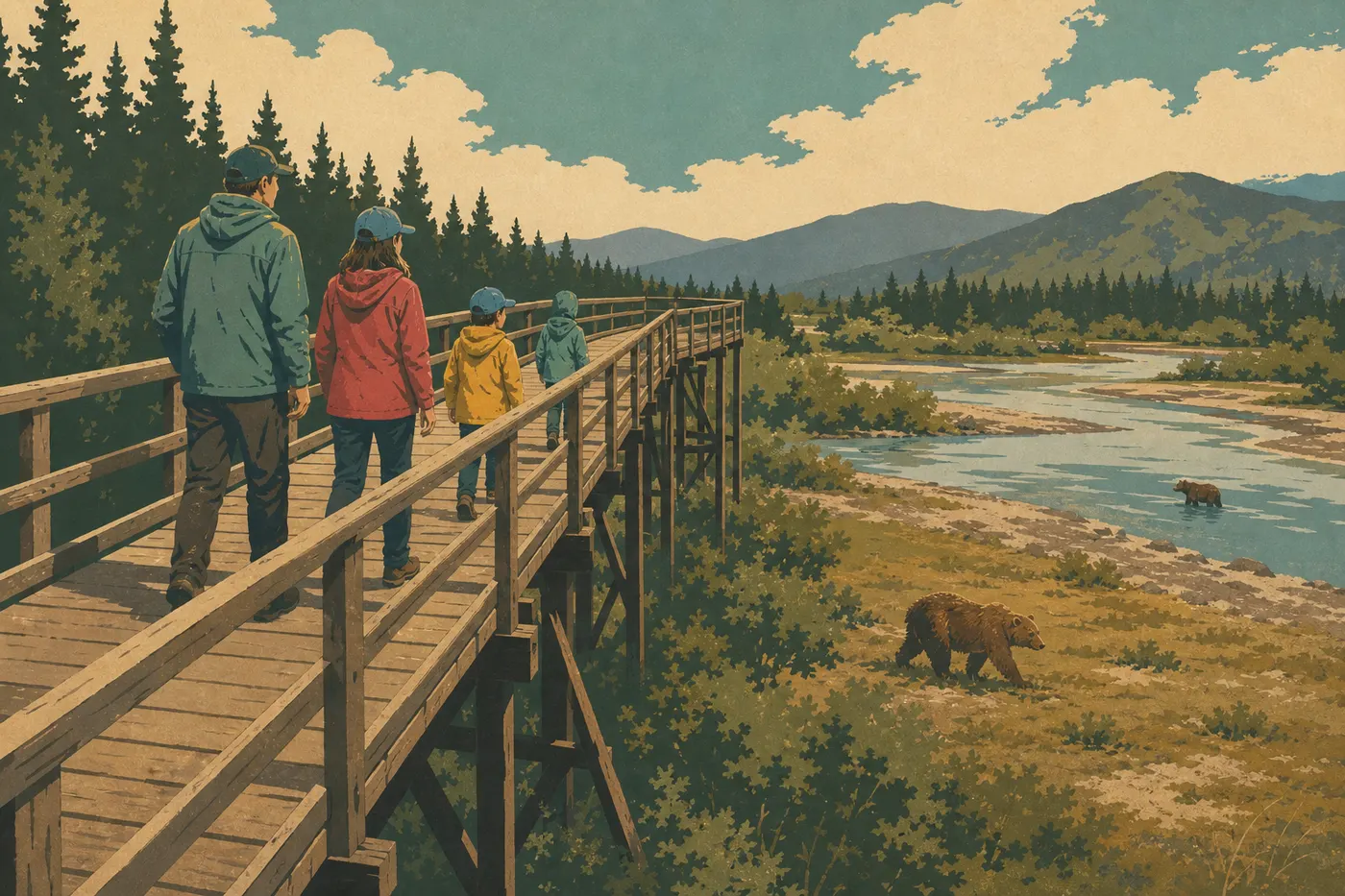
Katmai with Kids: What to Do and How to Plan Your Trip
Watching a grizzly catch a salmon in midair from 65 feet away, standing on a wooden platform in the middle of Alaska with no barrier or glass between you and the animal, is not the first experience most families pack into a vacation. And yet, for kids old enough to take it in, it is one of the most powerful encounters with nature on the continent.
Is Katmai a good fit for families? Yes, starting around age 8 to 10. For younger kids, the logistics of small-plane flights, undeveloped terrain, and changing weather, along with the safety rules around bears, can make the trip exhausting for parents. By age 10, kids can get the full experience and still talk about it 20 years later.
Why Visit Katmai with Kids
Katmai does not have playgrounds or scenic trails with benches every 500 yards. What it does have is Brooks Falls in July, with dozens of brown bears gathered at the base of a waterfall to catch salmon, visible from a platform just a few yards away. No zoo or screen can replicate it.
The park is also compact for visitors. The heart of the experience, including Brooks Camp, Brooks Falls, and the Valley of Ten Thousand Smokes, is easy to follow on a map. There is no road network to decipher for hours. You set down your bags and follow the plan.
Finally, Katmai offers a real-world nature lesson. Kids leave with a concrete understanding of an ecosystem, not a textbook definition. They can watch the salmon-bear-forest food chain unfold right in front of them.
Is Katmai Good for Kids? What Age Is Best
Our recommendation is at least age 8, with an attentive adult close by at all times. By ages 10 to 12, kids understand bear-safety rules, can walk without complaining over muddy ground, and get the most out of the wildlife viewing.
We do not recommend the trip for children under 5. The issue is not that the danger is unacceptable, since the developed areas of Brooks Camp are well managed. The logistics are the problem: a commercial flight to King Salmon, followed by a floatplane or small propeller plane to camp, no strollers on the trails, cold and wet weather even in summer, and long waits on the platforms. A baby or toddler will be miserable. So will the parents.
Physical accessibility: The trails between Brooks Camp and Brooks Falls are not technical, but they are natural paths with mud, roots, and slippery boardwalks after rain. This stretch has no infrastructure suitable for strollers or wheelchairs.
When to Visit as a Family (The Easiest Season with Kids)
July is the ideal window, especially the first half of the month. It is the peak of the sockeye salmon run, so bears gather at Brooks Falls in exceptional numbers. The days are long, as you would expect in Alaska, and temperatures range from 50 to 59°F. That feels cold if you are coming from the South, but it is perfectly manageable with the right layers.
August works well, too. The bears are feeding in preparation for hibernation and remain highly active. Weather can be rougher toward the end of the season.
May and June are best avoided with young children. The weather is often rainy, bears are less predictable in their movements, and transportation logistics are more complicated.
To choose your exact dates, our Weather page and When to Visit guide break down the week-by-week variations.
How Many Days Should You Plan for a Family Trip
Two nights at Brooks Camp, or three days on site, is the minimum for enjoying the bears without feeling rushed. Spend one full day at Brooks Falls, going early in the morning and again in the late afternoon when the bears are most active, a half-day on the bus excursion to the Valley of Ten Thousand Smokes, and some free time at Naknek Lake beach.
With kids, do not try to cram everything in. Travel fatigue is real: a commercial flight from Anchorage to King Salmon, followed by a floatplane flight, then the first look around camp. Planning a half-day to decompress after arrival is always a good idea.
Our Itinerary & Trip Length guide offers age-appropriate itineraries based on your kids' ages and the total length of your Alaska trip.
What to Do in Katmai with Kids: Our Picks
The list of family activities is shorter than at Yellowstone, but every experience carries real weight.
Watch Bears at Brooks Falls
This is the main reason to come. The viewing platform is reached by an approximately 1.2-mile trail from Brooks Camp. In July, bears position themselves at the top of the falls to catch salmon in midair. It is not unusual to see 15 to 20 at the same time.
Kids can easily stay interested for one or two hours, despite what you might expect. Bring lightweight binoculars for younger children. Being able to see the details makes all the difference.
Naknek Lake Beach
Two minutes from camp, this sandy beach is a valuable breather with kids. You can collect pebbles, watch shorebirds, and sometimes see a bear moving along the distant shoreline. There are no beach amenities, but it is a welcome pause between viewing sessions.
The Valley of Ten Thousand Smokes Excursion
A bus leaves Brooks Camp for the volcanic valley created by the 1912 eruption of Novarupta. The approximately 28-mile ride crosses a moonscape of ash and rock. At the destination, you will see Ukak Falls and a view across the valley from Baked Mountain.
For kids who are curious about geology, this is the perfect complement to the bears. For younger children or kids who do not like to walk much, the bus ride itself makes the outing worthwhile.
Our Things to Do guide lists all the activities available in the park.
Easy Family Hikes (Short and with Little Elevation Gain)
Katmai is not a park built around structured hiking. Its marked trails are concentrated around Brooks Camp.
Brooks Falls Trail (1.2 miles round-trip, easy): The park's main trail connects camp with the viewing platforms. The ground is flat to gently rolling, with a crossing over Brooks River. It works for kids as young as 6 to 8, as long as everyone follows the bear-safety rules carefully.
Naknek Lake Beach Walk (0.6 miles, very easy): Ideal for little kids or a break between viewing sessions. The terrain is open, with views of the lake and minimal risk of a close bear encounter.
Guided nature walks with rangers: The Brooks Camp staff occasionally leads guided nature outings for families. Ask at the visitor contact station when you arrive.
Katmai's backcountry hikes, away from developed areas, are unmarked wilderness expeditions with no infrastructure. They are for experienced adults with full gear. Our Hiking page covers these advanced options.
The Junior Ranger Program
The National Park Service Junior Ranger program is available at Katmai. Kids pick up an activity booklet at the Brooks Camp visitor contact station and complete age-appropriate activities, including observing and describing bears, taking notes on lake wildlife, and answering questions about the 1912 volcanic eruption.
Once they finish the booklet, they take the Junior Ranger pledge in front of a ranger and receive their official badge. It is a great thread to follow throughout the visit, keeping kids focused on what they are seeing instead of their next meal.
The booklet is free and available in English. If your kids do not speak the language, the activities are visual and hands-on enough to work with an on-the-spot translation.
Staying Safe with Kids
Katmai is a wilderness park where brown bears roam free. Safety is not an optional chapter. It is what makes the visit possible.
Safe distance: Away from managed viewing platforms, stay at least 165 feet from any bear. On the platforms, rangers manage the situation, and the bears are accustomed to people in these specific areas. Never yell, run, or make sudden movements. Explain these rules to your kids before you arrive, not when you are standing in front of a bear.
Bear spray: Bear spray is strongly recommended outside the developed areas of Brooks Camp. Learn how to use it before your trip. It is not appropriate for very young children who cannot hold it or activate the mechanism under pressure.
Food and odors: Store all food in the designated metal food lockers or in the communal kitchen. Do not leave food or wrappers in tents or in kids' pockets while viewing bears.
Weather: Between the Pacific Ocean and the Bering Sea, conditions can shift from calm to cold rain in an hour. Bring waterproof clothing for everyone in the family, thermal layers, and waterproof closed-toe shoes. Our Practical Information, Rules & Safety page lists the gear recommended by rangers.
Group discipline: On the trails, no child should walk ahead of or behind the group. Bears use the same paths as visitors. Talking out loud while walking, clapping, or whistling lets bears know you are there and helps prevent surprise encounters.
Where to Stay with Your Family (In and Around the Park)
There are few lodging options inside the park, and they book far in advance. For July, that often means more than a year ahead.
Brooks Camp Campground: The park campground is within walking distance of Brooks Falls. Campsites are assigned by lottery through the National Park Service reservation system. The experience is authentic, but it takes careful planning with kids. You will share a communal kitchen and need to store food strictly in the bear lockers.
Private lodges: Several lodges offer all-inclusive packages with guided bear viewing. They are more comfortable for families, with meals served and equipment provided. The tradeoff is a high per-person, per-night rate. These properties are aimed at families with a substantial travel budget.
Our Where to Stay guide and our Hotels & Lodges page cover all the options, capacities, and booking windows.
Meals and Breaks with Kids
Brooks Camp has a dining room at Brooks Lodge that is open to campers and lodge guests. Meals are simple and filling, with soups, hot dishes, and sandwiches. There is no formal kids' menu, but the kitchen can accommodate families.
One thing you need to know is that there is no grocery store in Katmai or King Salmon. Bring snacks and other provisions for your entire stay. Energy bars, dried fruit, and applesauce pouches work well for breaks on the viewing platforms, as long as you finish everything before approaching an area frequented by bears.
Our Where to Eat page covers dining options in King Salmon, the main transit point, and places to resupply before entering the park.
Family Budget
Katmai is one of the most expensive American national parks to visit, not because of entrance fees, but because of the air travel.
From Anchorage, you first fly commercially to King Salmon, a flight of about one hour, then take a floatplane or small propeller plane to Brooks Camp for another 30 minutes. These flights are charged per person, including children as soon as they occupy a seat. Costs add up quickly for a family of four.
The America the Beautiful pass, valid for one year throughout the U.S. national park system, still makes sense if you are visiting other parks during your Alaska trip or elsewhere in the country. Our Fees & Passes page explains entrance fees, passes, and pricing rules for young visitors.
Plan Katmai well in advance, with a transportation and lodging budget significantly higher than that of a typical road-accessible park. This is not a spur-of-the-moment trip.
Add-On Destinations Near Katmai for Families
Katmai fits naturally into a larger Alaska trip.
Anchorage is the essential starting point. The Alaska Native Heritage Center and the Anchorage Museum give kids useful cultural and historical context before or after the park.
Kenai Fjords National Park is accessible by car or boat from Seward, 3 hours south of Anchorage. Whales, sea otters, glaciers, and seals offer a striking contrast to Katmai's land-based wilderness, and the park is more accessible for children under 8.
Denali National Park is another Alaska option with more developed visitor infrastructure, a range of family hikes, and a chance to see the highest peak in North America.
Our Region section and our Alaska Road Trip page provide guidance on combined itineraries and logical stops based on the length of your trip.
Is Katmai Worth It for a Family?
Yes, without hesitation, as long as you set the right expectations.
Katmai is not a comfort-focused park. It is an experience-focused park. For a family with kids age 10 and up, watching dozens of brown bears fish at the base of a waterfall in a remote corner of Alaska is a memory you cannot buy anywhere else. The trip is demanding, expensive, and weather-dependent. But it is rare, real, and meaningful.
If your kids are old enough, curious enough, and eager to go, do not put it off.
Frequently Asked Questions
Is Katmai suitable for families with young children?
Katmai works for families, but not for very young children. We recommend a minimum age of 8, ideally 10, so kids can follow bear-safety rules and get the most out of the viewing.
Is Katmai worth the trip for a family?
Katmai is worth the trip for families looking for an authentic wilderness experience. Watching brown bears fish at Brooks Falls is an unmatched experience, and kids age 8 to 10 and up take it in with remarkable intensity.
What is the best time to visit Katmai with kids?
The best time for a family visit is July, at the peak of the sockeye salmon run. Bears are easiest to see at Brooks Falls, and temperatures are the mildest of the year. Our When to Visit guide breaks down the week-by-week variations.
What is there to do in Katmai with kids?
The main family activities at Katmai are watching bears at Brooks Falls, taking the bus excursion to the Valley of Ten Thousand Smokes, going on short walks around Brooks Camp, and completing the Junior Ranger program. Our Things to Do guide lists all the options available in the park.
How long does it take to visit Katmai with kids?
Plan on at least two nights at Brooks Camp, or three days on site. That leaves a full day for bear viewing and a half-day for the Valley of Ten Thousand Smokes, without rushing. Our Itinerary & Trip Length guide offers age-appropriate itineraries.