

U.S. Time Zones: the 6 Zones, the Time Difference with Paris, and Arizona
Six time zones, two periods when France and the U.S. change clocks on different dates, and an Arizona exception to know before your road trip.
By David Sanchez · · 9 min read
The United States spans six official time zones, from New York to Honolulu. The time difference with Paris is not fixed: twice a year, France and the U.S. change clocks on different weekends, and New York can be 5 hours behind Paris instead of 6 for three weeks. In Arizona, the Navajo Nation observes daylight saving time while the rest of the state does not, a trap that even experienced travelers miss on a Southwest road trip.
The 6 U.S. time zones, from the East Coast to Hawaii
The forty-eight contiguous states span four time zones. Alaska and Hawaii add two more, for six in total. The difference between the East Coast and the West Coast is three hours: when it is noon in New York, it is 9 a.m. in Los Angeles.
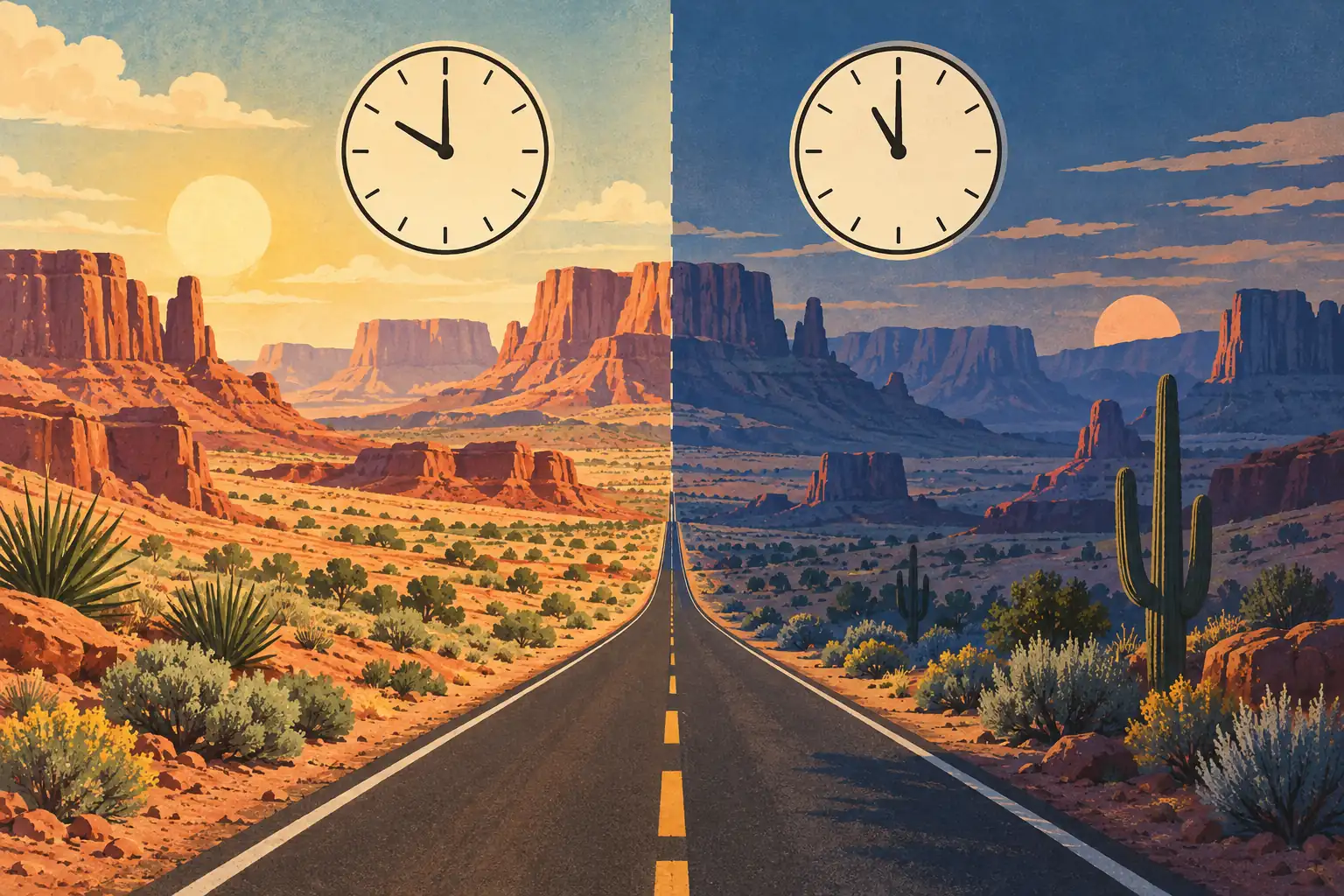
The system was standardized on November 18, 1883, when American railroads adopted a national system to coordinate their schedules. Before then, each city kept its own solar time. Today, a motorhome road trip crossing the United States from east to west can involve as many as three time changes.
| Time zone | Representative cities | Paris time difference in winter | Paris time difference in summer |
|---|---|---|---|
| Eastern (ET) | New York, Miami | -6 h | -6 h |
| Central (CT) | Chicago, Dallas | -7 h | -7 h |
| Mountain (MT) | Denver, Salt Lake City | -8 h | -8 h |
| Pacific (PT) | Los Angeles, Las Vegas | -9 h | -9 h |
| Alaska (AKT) | Anchorage | -10 h | -10 h |
| Hawaii (HST) | Honolulu | -11 h | -12 h* |
*HST is permanent: the -12-hour difference applies when Paris is on daylight saving time (UTC+2).
The time difference between France and the U.S.: watch for the two periods when the clocks are out of sync
France and the United States do not switch to daylight saving time on the same weekend. In 2026, the U.S. changes clocks on March 8 (the second Sunday in March), and France does so on March 29 (the last Sunday in March). In the fall, France returns to standard time on October 25, while the U.S. does so on November 1.
These calendar differences create two periods every year. From March 8 through March 28, 2026, the U.S. is already on daylight saving time while Paris is still on UTC+1: New York is 5 hours behind Paris instead of the usual 6. From October 25 through October 31, 2026, Paris has returned to UTC+1 but the U.S. is still on daylight saving time, creating the same one-hour shift. If you plan calls with family in France, mark these weeks on your calendar. The dates change from year to year, but the pattern remains the same.
Los Angeles (Pacific Time) and Salt Lake City (Mountain Time) follow the same changes as their respective time zones.
| City | Winter (Jan. 1 to Mar. 7) | Spring out of sync (Mar. 8 to 28) | Summer (Mar. 29 to Oct. 24) | Fall out of sync (Oct. 25 to 31) |
|---|---|---|---|---|
| New York | -6 h | -5 h | -6 h | -5 h |
| Chicago | -7 h | -6 h | -7 h | -6 h |
| Denver | -8 h | -7 h | -8 h | -7 h |
| Los Angeles | -9 h | -8 h | -9 h | -8 h |
| Anchorage | -10 h | -9 h | -10 h | -9 h |
| Honolulu | -11 h | -11 h | -12 h | -11 h |
Arizona's exception: the state without daylight saving time, except on Navajo land
Arizona is the only contiguous state that does not observe daylight saving time. It remains on Mountain Standard Time (MST, UTC-7) year-round.
Las Vegas and Phoenix in summer. In July, Las Vegas (Nevada, Pacific Daylight Time = UTC-7) and Phoenix (Arizona, MST = UTC-7) show the same time. But Nevada changed its clocks in March, while Arizona did not. This is a case of the cities having the "same time difference in practice," not being in the "same time zone": Nevada is on Pacific Time, while Arizona is on Mountain Time. In winter, Las Vegas returns to PST (UTC-8), one hour behind Phoenix. This directly affects visitors to the Grand Canyon traveling through Las Vegas: in July the two cities are synchronized, but not in December.
Navajo Nation. Within Arizona, the Navajo Nation observes daylight saving time (MDT, UTC-6 in summer). Monument Valley and Canyon de Chelly follow Navajo time. In July, the Navajo Nation is 1 hour ahead of Phoenix. One exception is worth noting: Antelope Canyon and the town of Page are located on Navajo land, but tour operators and businesses in Page list their hours in Arizona time (MST) year-round. Arriving from Flagstaff and assuming that all the land to the north follows MDT is a common mistake.
Hopi Reservation. Enclosed within the Navajo Nation, the Hopi Reservation does not observe daylight saving time (permanent MST, UTC-7). In summer, crossing the Hopi Reservation and then the neighboring Navajo Nation means changing your clock twice within a few dozen miles.
National parks spanning a time-zone change
The hours listed on nps.gov are always in local time at the main entrance. A park that opens "starting at 6 a.m." opens at 6 a.m. in its own time zone, not in the time zone of your starting point.
The most common example is the Grand Canyon, Zion, and Bryce Canyon loop. The Grand Canyon is in Arizona (MST, UTC-7). Zion and Bryce Canyon are in Utah (MDT, UTC-6 in summer). From late March through late October, crossing the Arizona-Utah border means moving your clock forward one hour. Leaving the Grand Canyon at 7 a.m. MST in July means arriving at the Zion entrance with your clock showing 8 a.m.: that hour needs to be built into your day's plans.
Yellowstone (Wyoming) and Mesa Verde (Colorado) share Mountain Time with Utah in summer, so there is no time difference on a Rockies road trip. The useful habit is still to leave your phone set to automatic time and check the local time before planning an early-morning hike.
AM/PM, jet lag, and your phone: three practical points
AM/PM format. The United States uses a 12-hour clock. 12 AM = midnight (the start of the day), while 12 PM = noon. A reservation on recreation.gov listed as "12:00 AM" means midnight, not noon. This is a classic mistake during the first few days of a trip, especially with park entrance tickets.
Jet lag. Paris to New York is generally a 6-hour time difference; Paris to Los Angeles is 9 hours. A road trip from east to west can make the adjustment easier: days feel longer as you travel west, which helps reduce fatigue. To manage calls to France at reasonable times, our article on phone service and payments in the United States covers SIM and eSIM options.
Your phone on a road trip. Your smartphone switches automatically to the local carrier's time zone as soon as it connects to the network. The exception is Navajo territory in Arizona, where coverage can alternate between MDT (Navajo towers) and MST (standard Arizona towers) depending on your location. In border areas, check manually before setting out at dawn.
Our take: 5 time zones without surprises, but Arizona deserves your attention
Couples on a California/Nevada road trip. Pacific Time from start to finish, 9 hours behind Paris in summer. Your phone handles the change automatically. No special scheduling concerns.
Arizona/Utah loop (Grand Canyon, Zion, Bryce). Keep the +1 hour in mind when entering Utah in summer. Leaving the Grand Canyon at 7 a.m. MST in July means it is already 8 a.m. at the Zion entrance: budget that hour into your day's plans.
Families who regularly call France. Remember the two 2026 periods: March 8 through March 28 and October 25 through October 31, when New York is 5 hours behind Paris instead of the usual 6. These dates vary from year to year.
What we do not recommend. Arriving at Monument Valley or Canyon de Chelly without checking the local Navajo time: in summer, the Navajo Nation is on UTC-6 (MDT), 1 hour ahead of Phoenix (MST). Antelope Canyon and Page are different: these sites operate on Arizona time (MST) year-round, even though they are geographically located on Navajo land. Some travel apps and printed guidebooks still confuse the two situations.
Frequently asked questions
Do Las Vegas and Phoenix have the same time in summer?
In 2026, Las Vegas switches to PDT on March 8 and returns to PST on November 1. Throughout that period, Las Vegas (PDT = UTC-7) and Phoenix (Arizona, permanent MST = UTC-7) show the same time. The dates vary from year to year, but the logic remains the same. In winter, Phoenix (MST, UTC-7) is 1 hour ahead of Las Vegas (PST, UTC-8).
Are national park hours given in local time?
The hours listed on nps.gov are in the local time of the park's main entrance. For a park in Arizona (MST), Utah (MDT in summer), or California (PDT in summer), the listed time is the time zone where the entrance is located.
Does my phone change time automatically when I cross several states?
Yes, as soon as it connects to the local carrier's network. The exception is Navajo Nation territory in Arizona, where coverage can switch between MDT and MST depending on the cell tower it picks up. In border areas, it is best to check manually.
What time is it in Honolulu when it is 2 p.m. in Paris?
In winter (Paris UTC+1): 3 a.m. in Honolulu (2 p.m. minus an 11-hour difference). In summer (Paris UTC+2): 2 a.m. in Honolulu (2 p.m. minus a 12-hour difference).