

What to Do in Los Angeles: The Essentials Before Heading to the Parks
Griffith Observatory, Santa Monica, Venice, Getty Center: the neighborhoods worth visiting, what's free, and where to stay for your road trip.
By Jocelyn Pion · · 21 min read
What should you do in Los Angeles when the city stretches more than 31 miles from east to west and time is tight? LA is not a European capital: you explore it by neighborhood, usually by car, constantly watching for traffic and knowing that crossing the city can take two hours. We have organized it for you: the places truly worth seeing, what's free (more than you might think), which neighborhood to choose based on your next stop, and how to continue from LA toward Joshua Tree Desert, the Channel Islands, or giant sequoia forests.
Los Angeles, a city to organize by area
The Los Angeles metropolitan area has about 18 million residents and stretches for more than 62 miles. Visitors expecting a compact city like Paris or Amsterdam are quickly disappointed: the neighborhoods worth seeing are spread out, with no obvious downtown center, and connected by freeways that fill up twice a day with clockwork precision.
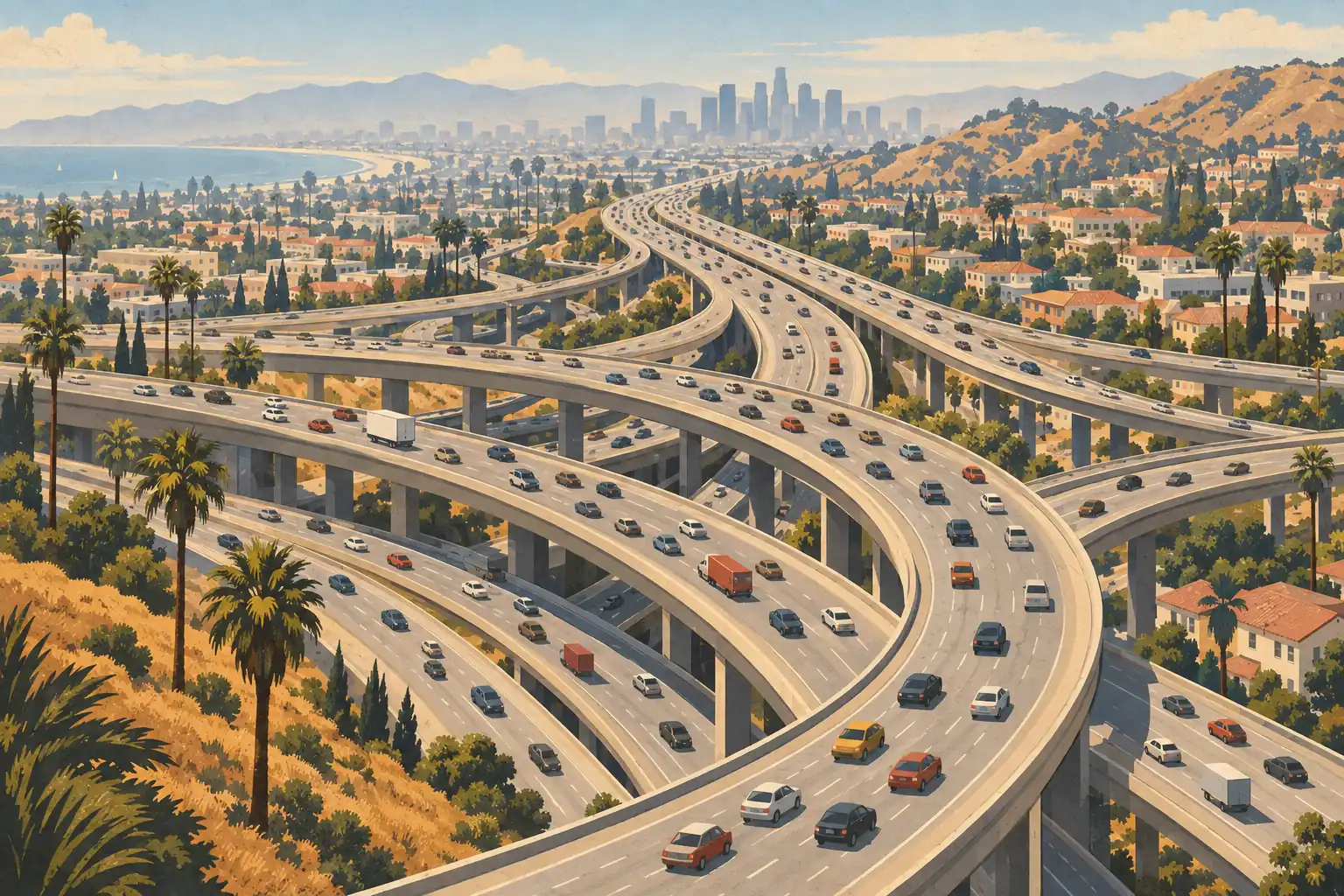
The approach that works is to group visits by geographic area and never try to cross the city twice in one day. Three broad areas contain most of what people come here to see. The West Side brings together Santa Monica, Venice, and the Getty Center: half a day on the coast, then a 20-minute drive to Brentwood. The Hollywood Hills and Los Feliz are home to Griffith Observatory, the first approaches to the Hollywood Sign, and Hollywood Boulevard. Downtown and the Arts District, to the east, offer a different view of the city: skyline, street art, and direct access to I-10 for those heading to the desert parks the next morning.
Allow 1.5 to 2 hours between these areas depending on traffic, sometimes longer during rush hour. Our rule is simple: don't combine the West Side and Downtown on the same day unless you're willing to sacrifice an hour of sightseeing on the altar of the freeway. Planning Los Angeles starts with planning your drives.
How many days should you plan for Los Angeles?
The question comes up in every road trip discussion. Here's how we think about it by travel style.
Two days are enough to cover the sights that justify a stop: Griffith Observatory early in the morning for a clear view, Hollywood Boulevard in an hour before the crowds arrive, Santa Monica and Venice in the afternoon, and the Getty Center at opening time on the second day. It's tight but coherent, as long as you respect the geographic layout and don't improvise your drives.
Three days offer the ideal pace for a first visit. Add Downtown and the Arts District, walk around Beverly Hills, and spend half a day at the beach in Malibu, north of Santa Monica along the coast, or at Manhattan Beach to the south. The third day also leaves time to wander through the Venice canals or stroll along Abbot Kinney without watching the clock.
Four to five days let you go further: movie studios, nightlife on Sunset Boulevard, and trips outside the city. This is the right format for travelers making Los Angeles a destination in its own right rather than a stop before the parks.
Road trip advice: two well-organized days are enough before hitting the road. Leaving early on the third morning, before 6:30 a.m., ensures you can get out of the metro area without traffic. Distances to the parks are calculated without traffic; crossing Los Angeles during rush hour can add an hour to an hour and a half to the estimated drive, in any direction.
Hollywood: the symbol, with your eyes open
Everyone passes through Hollywood. It is also where the most predictable disappointments are concentrated for visitors arriving with high expectations.
The Walk of Fame runs along Hollywood Boulevard for several blocks: more than 2,800 stars on the sidewalk (2,857 recorded in September 2026), honoring everyone from major movie figures to radio and music stars. Spectacular early in the morning, when the boulevard is almost empty, the walk quickly becomes crowded with street vendors and costumed characters asking for a tip for a photo. Arriving before 8 a.m. radically changes the experience.
TCL Chinese Theatre and Dolby Theatre are worth a stop for their facades and, at TCL, the handprints and footprints set in concrete outside the entrance. Interior tours cost extra and many visitors find them disappointing; the outside is more than enough.
Hollywood Boulevard at night is best avoided. The atmosphere is not dangerous, but tourist traps dominate and the experience bears little resemblance to the image projected by American movies.
The real alternative is to head up to Griffith Observatory or hike Brush Canyon to get closer to the sign. You can barely see the Hollywood Sign from the boulevard: you need to gain elevation. The sign was a 1923 advertisement for a housing development called "Hollywoodland" and was designated a Los Angeles city historic landmark in 1973. What began as a real estate sales pitch became the icon of a global industry. The real history is more interesting than the myth.
Our recommendation: spend no more than an hour on the boulevard, preferably in the morning, then head to Griffith. Hollywood makes more sense from up there than from its sidewalks.
Griffith Observatory and the hike to the Hollywood Sign
Griffith Observatory offers a view of the skyline and ocean that few free sites in the city can match. The Art Deco building perched in the Hollywood Hills offers views of the skyline, the ocean on clear days, and the Hollywood Sign less than 2.5 miles to the west. This is the site we recommend above all others, ahead of the studios and Beverly Hills.
Admission to the building and outdoor exhibits is free. Planetarium shows cost extra and should be booked ahead on the observatory's website. To avoid the crowds, two time slots work well: weekday opening time (the observatory is closed on Mondays, and opens at noon) or weekends from 10 a.m., or late afternoon after 5 p.m. for sunset over the city and Los Angeles's first lights. The observatory parking lot fills up on weekend mornings; the shuttle from the bottom of the park, available on weekends only, avoids the line of cars on the winding road.
Brush Canyon Trail is the only way to get within about 165 feet of the Hollywood Sign. From the Canyon Drive trailhead near Bronson Canyon Park, the trail is about 6.1 miles round trip with 1,050 feet of elevation gain, or two to three hours of hiking at an average pace. The trail is free, but parking in the residential area below is limited and monitored: arrive early or park a few blocks farther away. Bring water, a hat, and closed-toe shoes; the trail is rocky and exposed to the sun. The sign is surrounded by fences and cameras. You cannot get within a few yards of it, but the view of Los Angeles from the summit fully justifies the effort.
The combination of Griffith Observatory for the panoramic view, followed or preceded by the Brush Canyon hike, makes a coherent half-day outing with no admission costs, ideal in the middle of the week.
Santa Monica and Venice Beach: the coast within reach
Santa Monica and Venice can be visited in the same half-day, connected by a roughly 25-mile coastal bike path that follows the ocean from Will Rogers State Beach to Torrance Beach. On foot, it is about 2.5 miles from Santa Monica Pier to the Venice canals along the Boardwalk, an easy hour with a few stops.
Santa Monica Pier: the city landmark, with Pacific Park and its Ferris wheel, is free to enter. An hour is enough to walk around and look out over the ocean from the end of the pier. Third Street Promenade, a pedestrian street five minutes from the pier, is pleasant in the evening, with restaurants, street musicians, and shops open late. You don't come here for local authenticity, but the nighttime atmosphere is enjoyable.
Venice Boardwalk: a few miles south, the mood changes completely. The outdoor gyms at Muscle Beach, skaters weaving between pedestrians, street performers, and murals on the ground and walls give Venice a distinct identity with no real equivalent in Los Angeles. It's noisy, colorful, and sometimes surprising; it's also one of the few places where the city shows itself without a filter or tourist staging.
The Venice canals, dug in 1905 by developer Abbot Kinney to evoke his interpretation of Venice, are a 20-minute walk from the Boardwalk. The contrast is striking: less noise, bridges over the water, ducks, carefully maintained house facades, and gardens spilling onto the banks. The neighborhood has been deeply transformed by rising real estate prices since the 2000s, but the canals themselves remain accessible and peaceful, away from the noise of the Boardwalk. A 30- to 45-minute walk is enough to see them all. Abbot Kinney Boulevard, the shopping street named after the founder, deserves a coffee or meal break: independent boutiques, quiet patios, and the feel of a residential neighborhood that has managed to stay true to itself despite tourism.
Bikes are available to rent in Santa Monica near the pier. An hour on the coastal path gives you a view of Los Angeles that a car cannot provide.
The Getty Center: the free museum that surprises visitors
The Getty Center is one of Southern California's most visited art museums, and admission is free. That alone makes it a must for a trip focused on getting the best value for your money.
The European collection spans several centuries and artistic movements: Leonardo da Vinci, Rembrandt, Monet, Van Gogh, Gauguin, Cézanne, and Klimt. It has real depth without being encyclopedic, and the galleries remain human in scale. But the outdoor spaces often surprise visitors most: gardens designed by artist Robert Irwin, with a stream winding down to a basin flanked by an azalea maze, and the building itself, designed by Richard Meier, white and perched on the hill above Brentwood. The view of Los Angeles from the terraces in the evening before closing is worth the detour on its own.
The only catch is parking: about $25 per vehicle (in 2026), subject to change (check getty.edu before you go). The no-extra-cost alternative is MTA bus line 761 from Sunset Boulevard. A free tram then runs from the parking area to the top of the site, with unobstructed views of the city and Santa Monica Bay.
Our recommendation: arrive at opening time (10 a.m.) and allow two to three hours. On weekdays, attendance is noticeably lower than on weekends. For planning your day, the Getty is in Brentwood, between Santa Monica and Hollywood, so it combines naturally with a morning on the coast.
Downtown, the Arts District, and Beverly Hills: three different moods
These three neighborhoods have nothing in common, but each offers something the coast and hills do not.
Downtown: Angels Flight Railway, the funicular connecting Hill Street and Bunker Hill in two minutes for $1.50 per ride, is worth a look. City Hall and its white tower are open to visitors free of charge. Rooftop bars at high-rise hotels offer skyline views unavailable from street level. In the evening, the central streets come alive around Grand Central Market, a food hall open since 1917 that remains busy with about 40 shops and restaurants.
Arts District: east of Downtown, along converted industrial streets, street art is everywhere. This is not an open-air gallery in the institutional sense, but an accumulation of commissioned murals, monumental portraits, and tags documenting a rapidly changing neighborhood. It is also a good base in the morning before taking I-10 east: at 7:30 a.m., the streets are quiet and the freeway is not yet backed up.
Beverly Hills: you can walk Rodeo Drive without spending a dollar, taking in the store architecture and atmosphere. Beverly Gardens Park, with its rose bushes and fountain lit up in the evening, is the greenest and quietest place in the area. Greystone Mansion opens its gardens for free on weekdays: about 18.5 acres of grounds, the former home of 1920s oil magnate Edward Doheny's family, and the setting for a dozen movies and TV shows. Drive along Sunset Boulevard in the evening for the atmosphere, not to stop, but for the feeling of cruising along a name you've heard your whole life.
Movie studios: Paramount, Warner, Universal
Movie studios divide travelers. For some, they are the soul of Los Angeles; for those without a particular passion for the industry or the franchises involved, they are a half-day that could have been spent elsewhere.
Paramount Pictures (5555 Melrose Avenue) is the only major studio still in Hollywood, operating since 1912 on a site of about 62 acres. Two-hour guided tours depart every 30 minutes between 9 a.m. and 3:30 p.m. (minimum age 10). You pass working sets, costume warehouses, and stages that are open depending on the current production. This is the tour that comes closest to showing how a studio really operates. Times and prices may change depending on current productions; check paramountstudiotour.com before booking.
Warner Bros. in Burbank focuses on American television series and the Harry Potter and DC Comics universes. The studio tour is well produced and especially suited to families with children or fans of these franchises. The drive from Hollywood takes about 30 minutes without traffic.
Universal Studios Hollywood is more theme park than studio tour. Harry Potter, Jurassic Park, The Simpsons, Fast & Furious: allow a full day and a substantial ticket budget. It is the best option with children or for a complete themed day.
For a two- or three-day stay without a specific reason to go (being a franchise fan or traveling with children), skip it: Griffith, Venice, and the Getty offer a view of Los Angeles that the studios cannot.
What can you do in Los Angeles without spending a dollar?
Los Angeles has earned its reputation as an expensive city when it comes to lodging and restaurants. For attractions, however, the city offers a list of free activities that few American destinations can match. Here's what you can do without opening your wallet.
| Place | Free | Note |
|---|---|---|
| Griffith Observatory | Yes | Planetarium shows cost extra |
| Getty Center | Yes (museum) | Parking about $25 (in 2026), bus alternative |
| Beaches (Santa Monica, Venice, Malibu) | Yes | Beachfront parking costs extra |
| Walk of Fame | Yes | Best before 8 a.m. |
| Venice canals | Yes | 30- to 45-minute walk |
| Hollywood Sign hike (Brush Canyon) | Yes | About 6.1 miles, bring water |
| Beverly Gardens Park | Yes | Roses, fountain, Beverly Hills |
| Arts District (street art) | Yes | Explore on foot |
| Greystone Mansion (gardens) | Yes | Weekdays |
| Grand Central Market | Yes (entry) | Food and meals cost extra |
Parking remains the expense to watch: the Getty lot, beach parking, and meters in Beverly Hills. The bike option from Santa Monica or the subway is enough to reach several of these places without additional fees.
One point for the rest of your trip: national parks accessible from Los Angeles charge admission. Fees vary by park; an America the Beautiful pass covers all federal parks for one year and pays for itself starting with the second park you visit.
Where to stay in Los Angeles based on your next stop
The question of where to stay in LA deserves some thought: your choice of neighborhood directly affects the next morning's drive, especially if you plan an early departure for a national park.
Heading to Joshua Tree (I-10 east): Downtown or Silver Lake. Leaving from Santa Monica at 6 a.m. means crossing the entire city eastward before even reaching the freeway. From Downtown, you are on I-10 within 10 minutes.
Heading to the Channel Islands (US-101 north toward Ventura): Santa Monica or West Hollywood. You can reach US-101 north quickly from these neighborhoods, and before 7 a.m. the 101 stays clear all the way to Ventura.
Staying without an immediate road trip: the choice depends on whether the coast or the classic sights matters more. Santa Monica puts beaches, canals, and the bike path within walking distance. Hollywood puts the Walk of Fame and routes to Griffith within a 20-minute walk. For budget travelers, Downtown is consistently more affordable than Santa Monica or Beverly Hills, with lodging ranging from hostels to upscale boutique hotels.
General advice: whichever neighborhood you choose, leaving before 6:30 a.m. lets you get out of Los Angeles without traffic in any direction. After 7:30 a.m. on weekdays, I-405 and I-10 become unpredictable and drive times can triple.
To rent a car upon arrival at LAX and organize your departure the next morning, rental agencies at the terminal are accessible by shuttle from the baggage claim halls: there are no counters inside the terminals themselves.
How to get around Los Angeles
For travelers planning a road trip to the national parks, a car is essential. It lets you reach the parks, organize your days by area, and avoid relying on schedules in a city where distances are measured in minutes on the freeway rather than miles.
The subway is useful in two situations: Hollywood, via the B Line (Hollywood/Highland station), and Downtown. The E Line serves Santa Monica, making it possible to avoid the coastal parking headache on weekends. Outside these corridors, the network does a poor job of covering Venice, Beverly Hills, and the hills. The LA Metro system covers much of the metropolitan area, with extensions planned for 2028; check the route at metro.net. The fare cap is $5 per day or $18 per week as a guideline (updated fares at taptogo.net).
Biking is practical almost exclusively on the coastal path between Santa Monica and Venice, and possibly farther south. Rentals are available in Santa Monica near the pier, by the hour or day.
Uber and Lyft are useful at night, when moving the car and finding a parking spot become a hassle. Fares increase on Friday and Saturday nights starting at 9 p.m.
Times to avoid: I-405 and I-10 between 7 and 10 a.m., and between 4 and 7 p.m. on weekdays. Check Google Maps or Waze before every drive; a theoretical 30-minute trip can triple depending on incidents.
For a two- or three-day stay, combining a car with the coastal subway covers the essentials: a car for cross-town drives and departures toward the parks, and the E Line for the coast on weekends when parking lots fill up.
For choosing your arrival airport in the American West, one article compares LAX with the region's other hubs based on your itinerary.
Los Angeles as a starting point: Joshua Tree, Channel Islands, Sequoia
From Los Angeles, three national parks are accessible without turning the trip into a logistical expedition.
Joshua Tree, about 2.5 hours from Downtown
The route follows I-10 east from Downtown or Silver Lake. Exit at Indio or Palm Springs depending on which entrance you choose in the park. Leaving before 7 a.m. is recommended: the Los Angeles suburbs can easily add an hour to the morning drive. Joshua Tree National Park offers three things the city does not: monzogranite rock formations to climb or walk beside, forests of Joshua trees (tree-like yuccas found mainly in the Mojave Desert), and some of the darkest night skies in Southern California. The season runs from October through May; in summer, temperatures in the park can exceed 104°F. A day trip from LA is possible, while two days with a night there let you enjoy stargazing and avoid an exhausting round trip.
Channel Islands, US-101 north to Ventura, then by boat
The route follows US-101 north from Downtown, about 1.5 hours to Ventura without traffic, longer during rush hour. From Ventura Harbor, Island Packers, the NPS concessioner for crossings, runs boats to the islands (one to two hours depending on the island). The Channel Islands are an archipelago of five islands managed by the NPS, among the least known in the national park system. Santa Cruz Island is one of the easiest to reach: hiking along coastal trails, sea kayaking beneath the cliffs, diving among kelp forests, and sea lion colonies on the rocks. A day trip is possible with an early start from Ventura; camping on the island gives you a night with no visible artificial light on the horizon.
Sequoia, CA-99 north then CA-198 east, about 4 to 5 hours
From Los Angeles, take CA-99 north to the turnoff for Visalia, then CA-198 east to the Ash Mountain entrance. Sequoia and Kings Canyon National Park is home to the General Sherman Tree in the Giant Forest area, described by the NPS as the largest known living tree by volume. The Congress Trail, a roughly 2-mile loop, connects the main giant sequoias with no significant elevation gain. The round trip from Los Angeles in one day is possible but exhausting; at least one night there is recommended so you do not spend half your trip in the car.
For all these parks, drive times assume clear freeways with no traffic. Crossing Los Angeles can add one to one and a half hours during rush hour, in any direction: allowing extra time prevents unpleasant surprises.
Los Angeles before the big departure
The sights truly worth your time can be covered in two focused days: Griffith Observatory for the view and Art Deco building, Santa Monica and Venice for the coast and canals, Hollywood Boulevard for an hour in the morning, and the Getty Center at opening time. This itinerary keeps attraction costs low; most of the spending goes toward lodging and restaurants.
What changes the way a road trip traveler sees Los Angeles is its geographic position. LA is not just a destination: it is also a logistical base for heading toward the desert, the islands, or the giant sequoias. Joshua Tree is 2.5 hours away, the Channel Islands are 1.5 hours from Ventura plus the boat ride, and Sequoia is 4 to 5 hours by car.
The next leg begins on I-10 at 6 a.m., before Los Angeles wakes up. Your American West road trip often starts here.
Frequently asked questions
How many days do you need to visit Los Angeles?
Two days let you cover the must-see sites: Griffith Observatory, Santa Monica and Venice, and Hollywood in the morning. Three to four days provide the ideal pace for adding the Getty Center, Downtown, and a movie studio. Beyond five days, you start exploring the surrounding area or nearby national parks.
Free things to do in Los Angeles: what can you see without spending anything?
Los Angeles offers more free activities than its reputation suggests. Admission to the Getty Center is free (parking costs extra, with a bus alternative). The beaches, Walk of Fame, Venice canals, Griffith Observatory, and Brush Canyon hike to the Hollywood Sign cost nothing. The complete table appears in the dedicated section.
Can you visit a national park from Los Angeles?
Three national parks are accessible from LA. Joshua Tree is about a 2.5-hour drive via I-10 east and can be visited in one day. The Channel Islands are reached in 1.5 hours from Ventura via US-101 north, then by boat. Sequoia is a 4- to 5-hour drive and requires at least one night there.
Which neighborhood should you choose for a stay in Los Angeles?
It depends on your next stop. For a departure toward Joshua Tree on I-10 east, Downtown or Silver Lake shorten the morning drive. For the Channel Islands via US-101 north, Santa Monica or West Hollywood are better located. To stay close to the classic sights, Hollywood and Santa Monica cover most visits on foot.
How can you avoid traffic jams in Los Angeles?
The rule is simple: avoid I-405 and I-10 between 7 and 10 a.m. and between 4 and 7 p.m. on weekdays. To leave LA toward a national park, depart before 6:30 a.m. or after 8 p.m. Real-time navigation is essential; drive times can double or even triple during rush hour.