
Phones, payments, and tipping in the United States: what to sort out before you leave
eSIMs, fee-free cards, sales tax, and tipping: everything to arrange before a trip to the United States and its national parks.
By David Sanchez · · 5 min read
In the United States, prices are displayed before tax, restaurant staff rely on tips, and your phone may stop working as soon as you enter a national park. These three realities surprise European travelers on their first trip. A few simple preparations before boarding take care of everything once and for all.
SIM card or eSIM: staying connected even in the parks
Most French phone plans offer a paid "Europe + USA" option that is rarely worthwhile for more than a week. For a stay of two weeks or longer, a local SIM card or eSIM is much more affordable, costing roughly $20 to $40 for 10 to 15 GB.
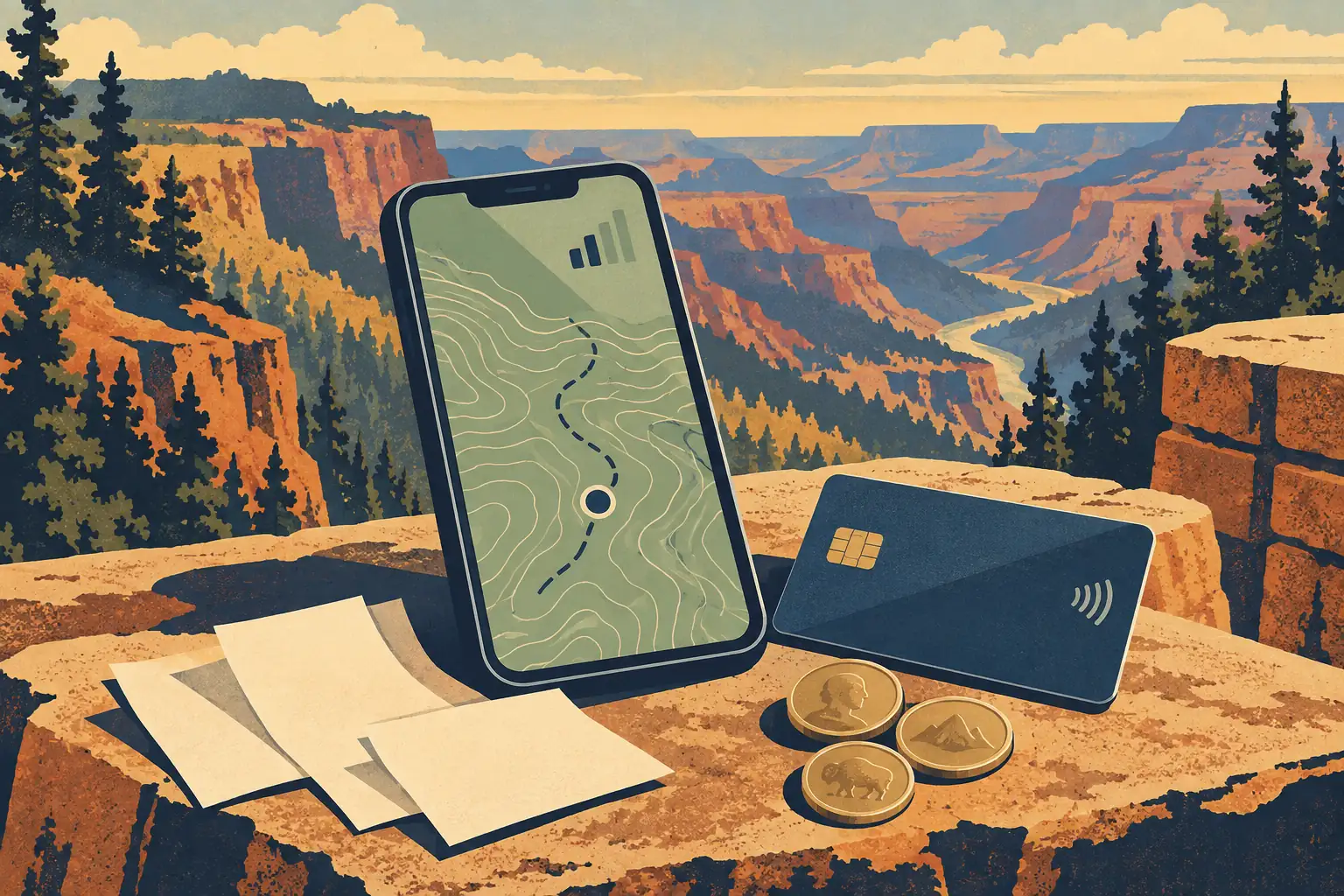
The three major US carriers are AT&T, T-Mobile, and Verizon. In the national parks, T-Mobile provides better coverage in rural areas and along Western corridors than its competitors. That said, no carrier offers continuous coverage inside the parks. In Yellowstone, the Grand Canyon, or Zion, service disappears as soon as you leave the visitor areas.
The essential precaution is to download offline maps for your route (Google Maps, Maps.me) before entering a park. Do the same with official NPS PDFs if you are planning hikes. An eSIM can be activated in just a few minutes through your chosen carrier's app, ideally before boarding your flight from France.
Fee-free bank card: the basic rule
Card payments are accepted everywhere in the United States, including small stores and visitor center cafeterias. Contactless payments (tap to pay) have become widespread since 2020 and work on nearly all newer terminals.
The problem with standard French bank cards is the foreign-exchange fee, often 1.5% to 3% per transaction. On a road trip through the American West, the accumulated amount can be significant. Cards with no foreign transaction fees (Boursorama, Fortuneo, N26, Revolut) eliminate this charge and have become standard for frequent travelers.
If your card does not offer this benefit, remember to notify your bank before you leave to avoid a precautionary block while abroad.
ATMs and cash: when cash is still useful
Cash is not essential, but it remains useful for cash tips, some local markets, rural parking lots, and activities offered by independent guides.
ATMs generally charge $3 to $5 per withdrawal. To keep those costs down:
- Prefer ATMs belonging to major banks (Chase, Bank of America, Wells Fargo) over independent machines in convenience stores or gas stations.
- Always decline the ATM's offer to convert the amount into euros. This option, known as DCC, uses an unfavorable exchange rate. Always choose to withdraw in USD.
Keeping about $100 in small bills in your wallet covers the vast majority of situations.
Sales tax: the displayed price is never the final price
Unlike in Europe, US prices are displayed before tax. Sales tax is added at checkout and varies by state, county, and sometimes city.
| State (example) | Approximate rate |
|---|---|
| Oregon, Montana | 0% |
| California | 7.25% to 10.5% |
| Nevada | 6.85% to 8.5% |
| Utah | 4.85% to 8.7% |
| Florida | 6% to 8% |
A meal listed at $18 actually costs $19.50 to $20 in California. For a hotel, tax can exceed 15% depending on the city, once the local lodging tax is included. This is automatic and non-negotiable, so build an 8% to 12% margin into your daily budget and you will never be caught off guard.
Tipping: who to tip, how much, and who does not get a tip
In the United States, tipping is not an optional bonus in service jobs. Servers' wages are legally very low because tips make up a central part of their income. Refusing to tip without a valid reason at a restaurant is considered rude.
| Situation | Usual amount |
|---|---|
| Sit-down restaurant | 18% to 20% (15% minimum) |
| Bar | $1 to $2 per drink |
| Taxi or Uber | 15% to 20% |
| Hotel housekeeper | $2 to $5 per night |
| Guide or activity | $10 to $20, or 15% to 20% |
| Valet | $2 to $5 |
The payment terminal often offers buttons for 18%, 20%, or 22%. The "Custom" option lets you enter a different amount if you would rather calculate it yourself.
You do not tip at fast-food restaurants, self-service cafeterias, grocery stores, or regular retail shops. Even if the screen asks: decline without hesitation, it is perfectly normal.
For hotel housekeepers, leave the tip each morning rather than at the end of your stay. The person cleaning your room may change from one day to the next, and a tip left at departure does not necessarily go to the people who worked earlier in your stay.
Once these habits are in place, your "unexpected expenses" budget becomes much smaller. All that remains is to choose your national parks pass and finalize your itinerary: the day-to-day logistics are now taken care of.