

Gas Prices in the United States: Gallons, State-by-State Differences, and Road Trip Budget
Gas prices, gallons-to-liters conversion, paying at the pump with a French card, and fuel budgeting for a 15-day road trip through the American West.
By David Sanchez · · 8 min read
At an average national price of $4.003 per gallon according to AAA on July 20, 2026, or about $1.06 per liter and $0.93 at the July 2026 exchange rate, gas in the United States costs roughly half as much as in France. A U.S. gallon equals 3.785 liters: the unit changes, but the budget remains manageable. Here is the conversion, the right fuel grade, how to pay at the pump with a French card, and how to calculate the fuel budget for a 15-day loop through the West.
Gas prices in the United States in 2026: conversion and reference figures
The national price of regular (87-octane unleaded) was $4.003 per gallon according to AAA on July 20, 2026. The 2026 range is wide: around $3 per gallon in January, peaking at about $4.56 in late May after a conflict with Iran that began in late February 2026, then returning to $4 in July.
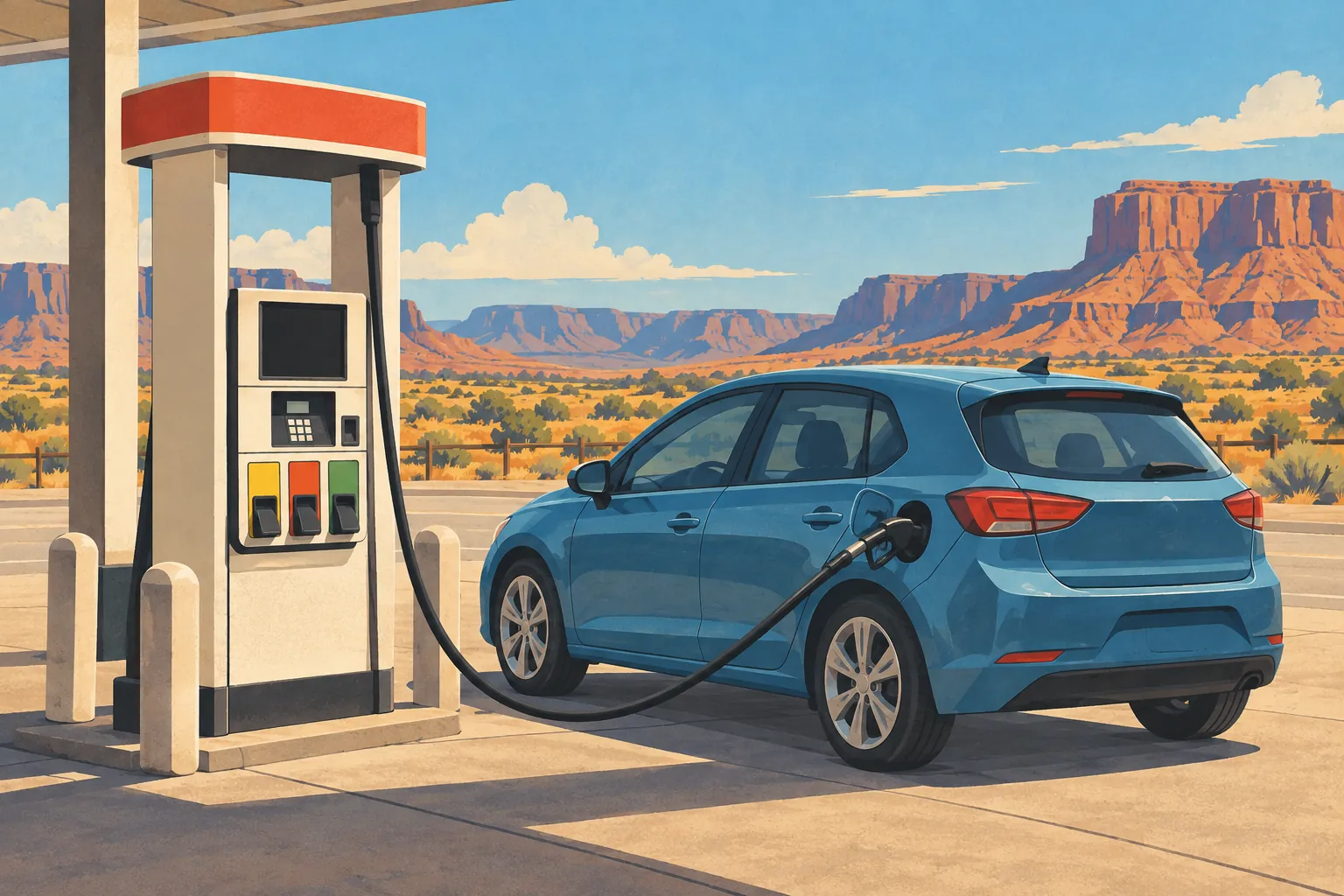
Quick conversion: 1 gallon = 3.785 liters. 10 gallons = 37.85 liters, and 15 gallons = 56.78 liters. At the July 2026 exchange rate, a 13.2-gallon fill-up costs about $53 in the United States versus about $114 in France. The difference comes down to taxes: taxes account for about 16.5% of the pump price in the United States (S&P Energy, March 2026), compared with 50% to 60% in Europe. The federal tax has been set at 18.40 cents per gallon since 1993.
Diesel stood at $5.11 per gallon in early July 2026, crossing $6 per gallon for the first time on September 11, 2026, before reaching a peak of $6.53 per gallon on September 22 (AAA). Nearly all rental cars run on gasoline; diesel is limited to RVs and some utility vehicles.
To keep the cost of every fill-up down, a no-foreign-transaction-fee bank card is essential.
Regular, mid-grade, or premium: which fuel should you choose for a rental car?
Regular (87 octane) is roughly equivalent to French 95-octane unleaded. It works for nearly every rental vehicle: subcompacts, sedans, and compact SUVs. Mid-grade (89 octane) costs about 10 to 20 cents more per gallon and offers no benefit for these vehicles.
Premium (91 to 93 octane) adds 20 to 30 cents per gallon. It is only necessary if the manufacturer specifies it, which applies to a few high-end SUVs and luxury vehicles. Over 15 days and ten fill-ups, using premium without a reason wastes $15 to $25.
Simple check: the sticker inside the fuel door indicates the required grade. Take a photo of it when you pick up the car. For help choosing the vehicle itself, see our guide to renting a car in the United States.
Paying at the pump with a European bank card
The gas station terminal asks for a ZIP code, a five-digit U.S. postal code, to authorize the card. A French card does not have one, so the transaction is declined when you pay directly at the pump.
Recommended solution: pay inside. Go into the store, give the pump number and the amount you want, or ask for “fill it up.” Pay by card or cash, and the pump will then be activated for that exact amount.
Apple Pay and Google Pay work on some newer terminals at major chains (Shell, BP, Chevron). No ZIP code is required, but compatibility is not universal. The code “00000” works on a few older terminals, with no guarantee, so it should not be your primary strategy.
Prefer a credit card to a debit card: stations often place a $100 to $150 preauthorization hold on debit cards, which can temporarily freeze part of your balance.
Gas prices by state and stations in national parks
Differences between states (July 2026 estimates, based on AAA/EIA)
| State | Approx. regular price | Difference vs. national average |
|---|---|---|
| California | ~$5.50/gallon | +37% |
| Nevada | ~$4.60/gallon | +15% |
| Oregon | ~$4.55/gallon | +14% |
| Arizona | ~$4.20/gallon | +5% |
| Utah | ~$4.10/gallon (est.) | +2% |
| Colorado | ~$3.95/gallon (est.) | -1% |
| Texas | ~$3.55/gallon | -11% |
California is consistently the most expensive state, with specific environmental taxes and high refining costs. The gap between California and Texas reaches nearly $2 per gallon. For real-time station-by-station prices, GasBuddy (a free app) is the standard reference.
Stations in the parks. Death Valley has three stations (Stovepipe Wells, Furnace Creek, and Panamint Springs), often 20% to 30% more expensive than Beatty, Nevada. Bryce Canyon has no station inside the park: the Sinclair station in Bryce Canyon City, 1.9 miles from the entrance, is the closest, followed by Tropic, 6.8 miles away, or Panguitch, about 25 miles away. Canyonlands has none either: Moab is the logistical base for the Island in the Sky district, about 31 miles away; the Needles district gets its fuel in Monticello, about 50 miles away.
General rule: never enter a park with less than half a tank if the next town is more than 50 miles away.
Fuel budget for a 15-day road trip through the West
A classic loop through Utah, Arizona, Nevada, and Southern California covers between 1,864 and 2,485 miles. Our 15-day itinerary through the West provides a precise estimate for each leg.
Estimated budget (average price $4.00 per gallon, July 2026 exchange rate)
| Vehicle | Distance | Fuel | Cost USD | Cost USD equivalent |
|---|---|---|---|---|
| Compact car | 1,864 miles | ~71 gal. | ~$285 | ~$284 |
| Compact SUV | 2,175 miles | ~102 gal. | ~$407 | ~$409 |
| Large SUV | 2,175 miles | ~129 gal. | ~$518 | ~$517 |
| RV | 2,485 miles | ~190 gal. | ~$761 | ~$761 |
If the itinerary includes a significant stretch in California (about $5.50 per gallon), add 35% to 40% for that section, or $28 to $102 depending on the length of the trip and the vehicle. For an RV road trip, this fuel expense should be included from the first budget estimate. Update these figures before departure at gasprices.aaa.com or through GasBuddy.
Our take: an affordable budget, with logistics that require planning
Gas is not the expense to worry about on an American road trip. At $4 per gallon in July 2026, a 15-day loop costs two to three times less than an equivalent trip in France.
Couple in a rental compact car: budget $273 to $318 for 1,864 miles. There is no trade-off to make; the budget remains comfortable even when including the California portion.
Family in a compact SUV: $375 to $455. Moderate compared with the total cost of a transatlantic trip, without cutting back on other expenses.
RV: $705 to $853. Include it when comparing rental companies; the savings on lodging partly offset the cost.
What we advise against: putting premium fuel in a standard subcompact ($15 to $25 with no technical benefit over 15 days) and entering an isolated area such as Death Valley or Canyonlands without a full tank.
Our most cost-effective tip: fill up on I-15 in Nevada before entering California. The structural difference of 80 to 90 cents per gallon between the two states makes the stop worthwhile on its own.
Frequently asked questions
How much does a gallon of gas cost in the United States in 2026?
The average price of a gallon of regular was $4.003 according to AAA on July 20, 2026, or about $1.06 per liter. Prices range from about $3.55 per gallon in Texas to $5.50 per gallon in California.
How can I pay at the pump with a French card in the United States?
Paying directly at the pump requires a U.S. ZIP code, which your French card does not have. The simplest solution is to pay inside before pumping: give the pump number and the amount you want, or ask for “fill it up.”
Is gas really cheaper in the United States than in France?
Yes, it costs about half as much. At $1.06 per liter, a 13.2-gallon fill-up costs about $53 in the United States versus about $114 in France in July 2026, thanks to significantly lower taxes (16.5% of the pump price versus 50% to 60% in Europe).
Should I use premium fuel in a rental car?
No, in almost every case. Regular (87 octane) corresponds to French 95-octane unleaded and is suitable for standard rental vehicles. Check the sticker inside the fuel door to confirm the grade required for the rental vehicle.