
How to Choose Your Next Road Trip Destination
Six practical questions to help you choose your next road trip destination, from real trip length and season to driving, budget, scenery, and city time.
By Erika Müller · · 5 min read
Choosing a road trip destination often means balancing a wish list with the limits of your calendar. Six practical questions are enough to narrow that list down to one or two serious options. We will go through them in order, with specific examples and numbers.
How many days do you really have?
The time you have available, including flights, is the first filter. With 10 full days on the ground, Iceland is still doable: the entire Ring Road, about 800 miles, can be completed in 7 to 8 days at a reasonable pace. New Zealand, on the other hand, can feel disappointing in less than 14 days: distances within the country are substantial, and connecting flights from Europe can eat up two travel days.
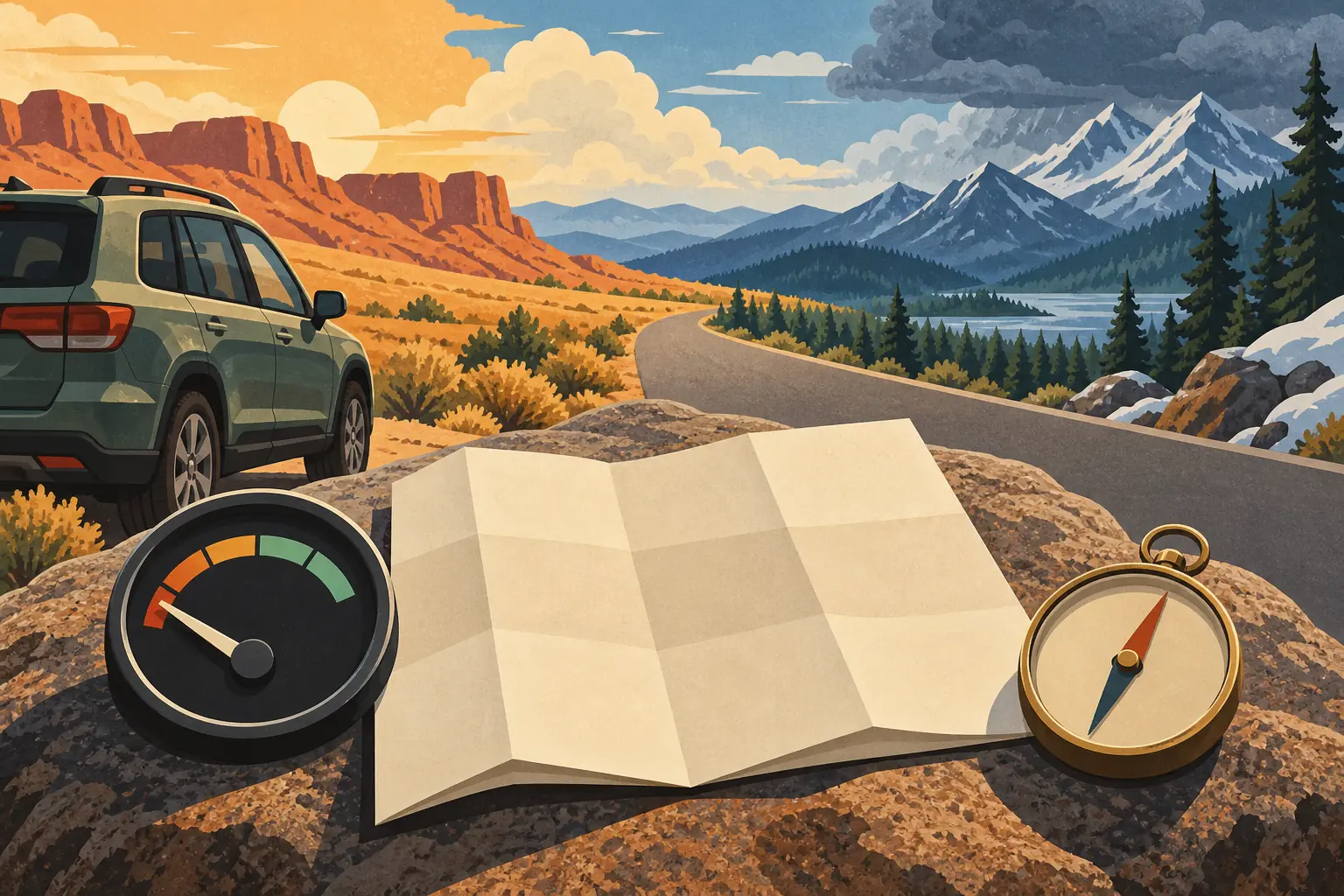
The American West is more flexible. 15 days are enough for a relaxed Nevada-Utah-Arizona loop, while 3 weeks let you take in the Pacific Coast and the Rockies. A practical rule: subtract transit days, allow for one quiet night after you arrive, and do not schedule a driving leg on your departure day.
Which season fits your travel window?
The season can change everything, sometimes more than the destination itself. Scotland is bright and beautiful in May and September, with fewer visitors and low-angle light, but genuinely unpleasant in July and August because of the midges and crowds on the NC500. Norway breaks down into two distinct seasons: fjords from June through August, and northern lights from October through March. Mountain roads there are closed from November through May.
Portugal works well for driving almost year-round. The Alentejo and Algarve remain pleasant from March through November, with a welcome dip in visitor numbers in May and October. In the United States, the Southwest is difficult to visit in July and August: Moab regularly climbs above 104°F during that time.
Are you comfortable driving locally?
Driving on the left is a real factor. Scotland, New Zealand, and Ireland all require a serious adjustment during the first two days. Scotland's single-track roads, with their passing places, call for patience and a fair amount of confidence. In Norway, underwater tunnels and ferries create a different rhythm, but traffic still drives on the right.
In the United States, the distances between gas stations often surprise Europeans. On some stretches of Highway 101 in Oregon, you may not find a gas station for 50 to 60 miles. Making a habit of filling up as soon as the gauge drops below half a tank can prevent some very stressful moments.
What fuel and lodging budget should you plan for?
Iceland is the most expensive destination on this list: fuel costs about $9.50 per gallon there (2024), and a decent place to stay starts at roughly $130 to $165 per night. New Zealand is comparable, with the benefit of a well-developed campground network, where a night costs about $12 to $18.
Norway is expensive when it comes to hotels, but wild camping under the right-to-roam principle, or allemannsretten, is legal and free. Portugal and Scotland are the most affordable destinations: it is easy to find lodging for $65 to $90 outside the high season. For American parks, the America the Beautiful annual pass, about $80 pays for itself starting with your third park. Camping in national parks generally costs around $20 to $35 per night.
What kind of scenery excites you?
The question may seem obvious, but it quickly separates the destinations. Red deserts and sandstone arches: the American West, especially Utah and Arizona, has no equal at this scale. Glaciers and active volcanoes in a compact country: Iceland. Fjords: Norway is the natural choice. Moorlands, lochs, and coastal cliffs: Scotland. Warm light, vineyards, and oceanfront scenery: Portugal.
One piece of advice: do not try to combine everything in a single trip. A successful road trip has visual coherence. Two or three main landscape types are enough to build an itinerary that works, in every sense of the word.
Untamed nature or cities along the way?
A park such as Denali or Death Valley has little to offer if you prefer wandering through indoor markets and neighborhood restaurants. Conversely, a required stop in a major city can disrupt the rhythm of a trip focused on deep wilderness.
The American West combines both with ease. Our itineraries often start in Las Vegas or Los Angeles, two cities with direct connections from Paris-Charles-de-Gaulle, before quickly branching out toward the parks. Norway and Iceland are not especially compatible with a packed urban itinerary. Portugal and Scotland, by contrast, make it easy to combine capital cities, such as Lisbon and Edinburgh, with country roads.
Once you have answered these six questions honestly, the list of destinations tends to narrow itself down. What remains matches what you are genuinely ready to do, rather than the idea you had of it from your couch.