

A New England Fall Road Trip: Follow the Colors from Boston to Acadia
Plan a New England fall road trip from Boston through Vermont's forests to Acadia's shores, with time for scenic drives, hiking, and changing weather.
By Jocelyn Pion · · 11 min read
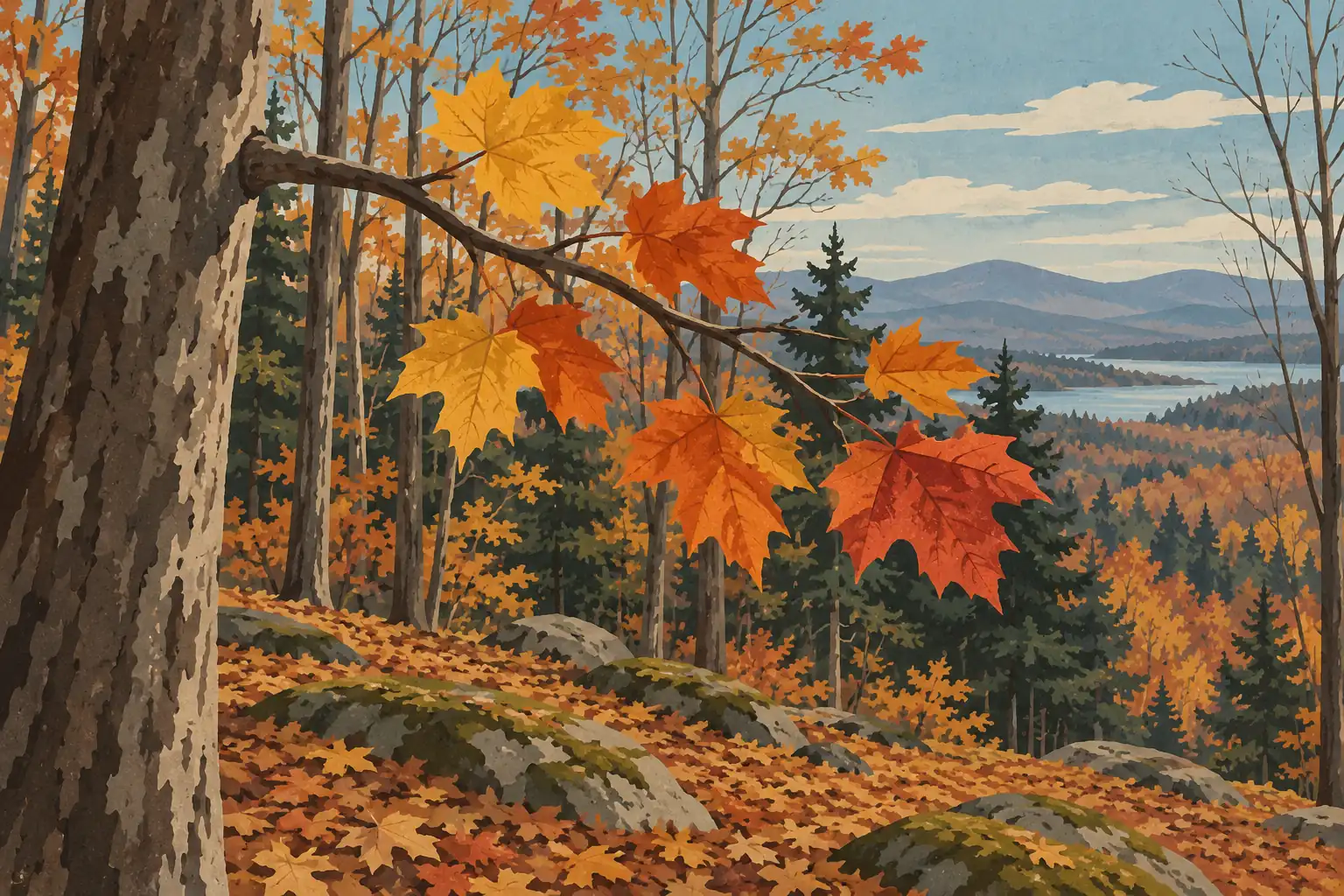
Red maples surrounding a village give way to dark pines above a rocky coast: fall looks different at every stop. New England lies in the northeastern United States, between the Atlantic Ocean and the Canadian border. Our suggested route connects Boston, Vermont, the White Mountains, and Acadia, leaving time to hike and adjust your outings to the weather.
Where is New England, between Boston and the Canadian border?
New England consists of six states: Maine, Massachusetts, New Hampshire, Vermont, Rhode Island, and Connecticut. It is a historical and geographic region, not a state. It lies east of New York State, which is not part of New England.
To the north, Vermont, New Hampshire, and Maine border Canada. To the east and south, the Atlantic coast is shaped by bays, capes, and estuaries. In between are forested mountains, agricultural valleys, and cities.
Boston, the capital of Massachusetts, is the starting point for this itinerary. The city offers an introduction to American Revolutionary history before you head into the region's natural areas. It is not an administrative capital for New England.
The name New England appeared on a map published by English explorer John Smith in 1616. That colonial name did not mark the beginning of the region's history. Indigenous peoples lived on these lands long before Europeans arrived and continue to live here today.
The Wabanaki nations, in particular, have longstanding and ongoing ties to Maine and the lands of Acadia. In Boston, sites associated with the American Revolution illuminate another period: the colonies' break with the British Crown. These histories intersect, but each has its own story.
When should you go for fall foliage, without counting on a warm spell?
An Indian summer is a spell of warm fall weather following a cold period, often the first frosts. The term does not refer to changing leaves or a guaranteed season. You can enjoy beautiful foliage in chilly weather without experiencing that warm spell.
Shorter days help trigger seasonal changes in trees. Chlorophyll breaks down, revealing yellow and orange pigments, among others. Other pigments, responsible for red shades, can develop in fall. Tree species also shape the palette: maples can turn red, while birches and poplars contribute yellows.
Latitude and elevation affect the timing. Northern areas and higher elevations tend to change before milder valleys and some coastal areas. Drought, temperatures, wind, and rain can shift or shorten the display, however.
| Area | What to look for | Seasonal pattern | How to stay flexible |
|---|---|---|---|
| Vermont | Maples, villages, and agricultural valleys | Northern areas and higher elevations generally change before southern valleys | Keep both valley and mountain options open |
| White Mountains | Forested slopes and scenic roads | Higher elevations can lose their leaves before valley floors | Plan a walk at a lower elevation |
| Maine coast and Acadia | Deciduous trees, evergreens, and ocean views | Timing can differ from inland areas | Alternate between shoreline and forest |
For fall colors, consider a window from late September through October, without booking around a promise of peak foliage on a specific date. Check official foliage reports as your departure approaches. Current observations are more useful than a date repeated from one fall to the next.
Keep one day flexible and have an indoor option, such as a museum in Boston or Portland. A pleasant afternoon on the coast tells you little about conditions in the mountains.
When choosing a destination by season, also consider the kinds of walks you enjoy. Our guidance on when to visit Acadia covers the coastal portion of the trip in more detail.
What route should you follow from Boston to Acadia in 14 days?
Our itinerary allows 14 days and 13 nights, with several nights in each natural area. This gives you full days to explore between drives. It does not assume that every stop will reach peak foliage at the same time.
The route runs in this order: Boston, Stowe in Vermont, Lincoln in the White Mountains, Mount Desert Island, Portland, and back to Boston.
| Days | Stop | Nights | Purpose |
|---|---|---|---|
| 1 to 2 | Boston | Two | Arrival, walking, and history |
| 3 to 5 | Vermont, around Stowe | Three | Villages, maples, and walks |
| 6 to 8 | White Mountains, around Lincoln | Three | Forests, a scenic drive, and mountain landscapes |
| 9 to 11 | Acadia and Mount Desert Island | Three | Trails, shorelines, and flexibility for weather |
| 12 to 13 | Portland and the Maine coast | Two | A gradual return toward Boston |
| 14 | Boston | Zero | Departure, depending on your flight time |
Spend your first stop in Boston exploring on foot. The Freedom Trail connects sites associated with colonial and Revolutionary history, among other periods. Choose a few places to visit instead of trying to go inside every building. You can wait until you leave for Vermont to pick up your rental car.
Stowe makes a good base in northern Vermont, with a village setting amid forested hills. Set aside one day for walks and another for exploring the surrounding area, following the colors you find. Maple products also offer a taste of regional culture. Sap is collected in late winter and early spring, so a fall visit will not let you see that seasonal work in action.
Continue to Lincoln, New Hampshire. This base gives you access to the western end of the Kancamagus Highway. Allow a day for the drive, including stops and a walk, so you can experience more than the view through the windshield.
The drive from the White Mountains to Acadia deserves a full travel day. We advise against adding a summit visit or a long hike when you arrive. On Mount Desert Island, the next two days give you time to divide your outings between the coast and the trails according to the weather.
Portland then provides a transition back toward Boston. Stroll along the waterfront and choose a coastal stop without turning the return journey into a lighthouse checklist. On the final day, allow enough time to return the car and reach the airport for your flight.
Distances depend on your accommodations and chosen roads. Calculate driving times using your final addresses, and add time for breaks. For rental agreements and insurance, see our advice on renting a car in the United States.
With 10 days, leave out Vermont instead of shortening every stop. Cape Cod, Rhode Island, and Connecticut are better suited to a separate route focused farther south and along the coast.
Forests, mountains, and Acadia: which outings should you choose?
Vermont's forests. Around Stowe, choose local walks that suit the weather. Green Mountain National Forest lies farther south, in central and southwestern Vermont. It can replace Stowe as your base if you prefer to focus on its trails. Avoid adding it as an extra round trip.
A national forest is managed by the federal Forest Service, a state park by its respective state, and Acadia by the National Park Service. Admission fees and rules therefore differ. Check the requirements for the specific place you plan to visit.
The White Mountains. The Kancamagus Highway passes through forests worth getting out of the car to explore. Choose stops and walks before setting out, then adjust them to trail conditions. Wet roots and rock slabs can slow your pace. Mount Washington is a separate option, dependent on weather and whether access routes are open. We advise against making it an essential stop.
Acadia, where forest meets ocean. The heart of the park lies on Mount Desert Island, near Bar Harbor. Cadillac Mountain offers views of islands and bays when skies are clear enough.
For a family outing, choose a section of the historic carriage roads around Eagle Lake. Set the distance according to your group's stamina and check the elevation profile: these paths are not all flat.
At Jordan Pond, the western shore includes rocks and boardwalk sections. The NPS describes it as considerably more difficult than the eastern shore, especially for young children. Do not assume that the full loop is an easy walk all the way around. Our guide to visiting Acadia National Park can help you choose outings that match your comfort level.
Acadia's landscapes are also part of the living history of the Wabanaki peoples. NPS cultural resources provide context for their presence, which extends well beyond the period before the park was established. In natural areas, keep your distance from wildlife and never feed animals.
Acadia access: reservations and fall closures
Acadia's entrance fee and the vehicle reservation for Cadillac Summit Road are two separate requirements. In 2026, vehicle reservations were required from May 20 through October 25. That requirement applied to this road, not the entire park.
After October 25, 2026, the end of the reservation requirement did not guarantee that the road was open: conditions and closures still needed to be checked. For another season, consult the calendar for your travel dates on the official NPS website.
Island Explorer shuttles do not serve Cadillac Mountain. For their other routes, the operator announced service through October 12, 2026. Do not rely on them for a late-October visit. Check each route's schedule before deciding how to get around Acadia.
Accommodations require the same attention. In 2026, Seawall and Schoodic Woods campgrounds closed on October 12 at 10 a.m., followed by Blackwoods on October 19 at 10 a.m. Choose where to stay near Acadia based on opening dates and your daily drives.
Construction can also affect walks. As of October 29, 2026, the NPS reported that a southern section of Ocean Path had been closed since August 31, as had Schoodic Mountain Road. The eastern branch of Beech Mountain Loop Trail had been closed since September 21. These restrictions did not mean that the entire park was closed.
Check the current conditions published by the NPS before each outing. Parking availability can also limit your options even with a valid entrance pass, so keep an alternative in mind.
Our recommendation: 14 days for the mountains and Acadia, fewer stops for families
A first trip as a couple. We recommend the 14-day loop to combine Boston, Vermont's maples, the White Mountains, and the ocean. Three nights in each of the main natural areas give you room to move a hike to another day. We advise against adding Cape Cod, which would take time away from exploring your other stops.
Families or a 10-day trip. We would leave out Vermont. Keeping the White Mountains and Acadia still gives you varied scenery without constantly changing accommodations. With young children, we would choose a suitable section of the carriage roads over the full Jordan Pond loop, whose western shore is more difficult.
Traveling on a tight budget. We recommend reducing the number of areas you visit before making multiple bookings. Compare accommodations for your exact dates: a cheaper place farther away can add daily driving. Also, do not plan a late-October trip around camping at Blackwoods, which closed on October 19 in 2026.
A late-fall trip. We favor a plan that lets you get around independently, with alternative walks and confirmed accommodations. The end of shuttle service on October 12, 2026, illustrates the limitations of a trip that depends on seasonal services. We advise against staking the whole trip on peak foliage or Cadillac Mountain: the villages, forests, and shorelines should also be reasons to go.
Frequently asked questions
Which U.S. states make up New England?
New England consists of Maine, Massachusetts, New Hampshire, Vermont, Rhode Island, and Connecticut. This historical region is not a state. Boston is in Massachusetts.
When is the best time for fall foliage in New England?
The usual window for fall foliage in New England is late September through October. Northern areas and higher elevations often change before some coastal areas. Check official foliage reports: no calendar can guarantee peak color.
How many days should you allow for a New England road trip?
We recommend 14 days for a New England road trip connecting Boston, Vermont, the White Mountains, and Acadia. With 10 days, leave out Vermont. This preserves time to explore instead of spending one day after another on the road.
Do you need reservations to visit Acadia in fall?
Reservation requirements for a fall visit to Acadia depend on your access plans and accommodations. In 2026, Cadillac Summit Road required a vehicle reservation separate from the park entrance fee through October 25. Shuttle, campground, and road schedules must each be checked separately.