
Saguaro with Kids: What to Do and How to Plan Your Visit
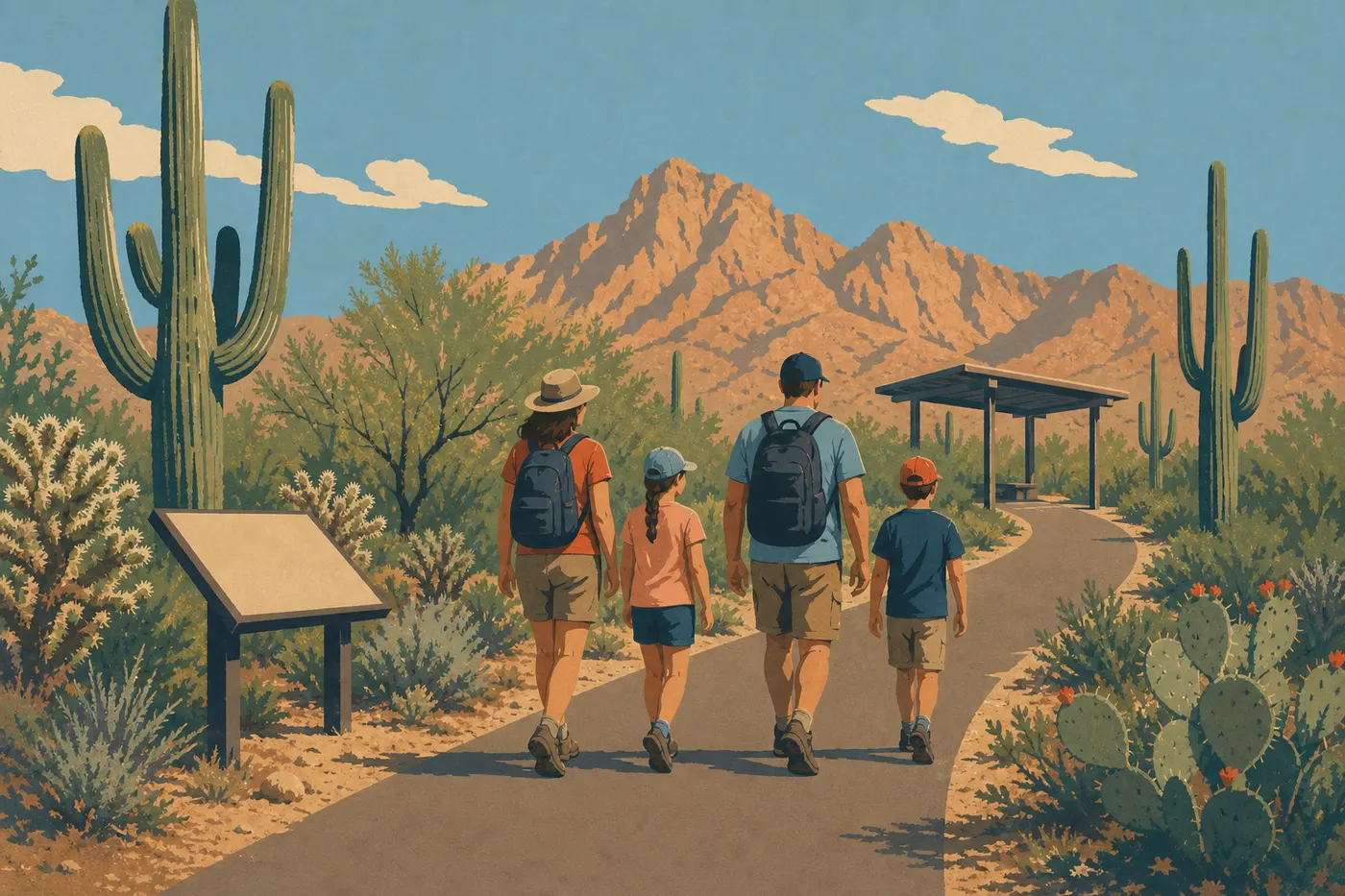
Saguaro National Park in Arizona is divided into two districts on either side of Tucson. People come here for one very specific reason: to see these giant cacti up close. They can grow to 50 feet tall and live for two centuries. For families, it makes for a memorable outing, with instantly striking desert scenery, Sonoran wildlife, and activities designed for kids of all ages.
Is Saguaro good for families? Yes, with one nonnegotiable condition: avoid summer if your kids are under 10. From October through April, daytime temperatures stay between 50°F and 77°F, and most trails work for kids as young as 3 or 4. Both districts offer short loops, a free Junior Ranger program, and scenic drives you can enjoy entirely from the car.
Why Visit Saguaro with Kids
The park offers something few American natural areas deliver so immediately: scenery that speaks to a 5-year-old without any explanation. Saguaros rise at regular intervals like sentinels with their arms raised, and within two minutes kids usually ask, “Why do they have arms?” You'll have answers.
Another practical advantage is Tucson's proximity. Both districts border the metro area, which gives you plenty of flexibility. If a child runs out of steam in the middle of the afternoon, you can head back to the hotel, take a break by the pool, and return later to enjoy the low-angle light on the cacti.
The park is also noticeably less crowded than Zion or the Grand Canyon. Parking remains manageable, and trails are lightly traveled outside November weekends. With young kids, avoiding a line on a cliffside trail changes the stress level of the entire day.
Finally, the two separate sites make it easy to organize your stay naturally, with a pace that fits each day.
Is Saguaro Good for Kids? What Age Works Best
The park has no major physical obstacles for families. The two scenic drives, Bajada Loop Drive in the west and Cactus Forest Loop Drive in the east, are entirely by car. Family trails such as Desert Discovery Nature Trail in the West District are flat, signed, and suitable for all-terrain strollers.
Starting at 3 or 4, a child can usually walk 0.6 to 1.2 miles on flat ground without difficulty. The park's short trails fit that age range well. The Junior Ranger program is designed for ages 5 to 12, but younger kids are happy to take part with an engaged parent alongside them.
By ages 8 to 10, the possibilities open up. Kids can tackle trails with more elevation gain, learn to read a map at the visitor center, and look for wildlife at dusk from an open viewpoint.
Summer, from June through September, requires caution. Daytime temperatures regularly climb from 95°F to 111°F. At those temperatures, children can become dehydrated quickly. With toddlers and preschoolers, avoid outings in full sun altogether.
When to Visit as a Family (The Easiest Season with Kids)
The ideal window runs from mid-October through late March. Daytime temperatures range from 50°F to 72°F, nights are cool without being cold, and trails aren't overwhelmed with visitors.
December and January bring bright, pleasant days and few crowds. February and March mark the start of the Sonoran Desert's spring bloom. Palo verdes and ocotillos begin to bud, and the first Costa's hummingbirds return.
April quickly turns hot. Afternoons can top 86°F by midday. It's still doable, but you'll need to hit the trail early, around 7 to 8 a.m., and be back by 11 a.m. with young kids.
To fine-tune your travel dates, the Saguaro seasonal guide breaks down conditions month by month, including crowds, precipitation, and events. The park's weather and climate records provide more detail.
How Many Days to Plan for a Family Visit
Two full days let you see both districts without rushing. The natural plan is simple: one district per day.
Day 1 (West District, Tucson Mountain): Drive Bajada Loop Drive in the morning, visit Signal Hill and its petroglyphs late in the morning, then head back before noon if you have very young kids.
Day 2 (East District, Rincon Mountain): Drive Cactus Forest Loop Drive, take a short walk, then visit the visitor center and do the Junior Ranger program in the afternoon.
If you only have one day, choose the West District. Combining Bajada Loop Drive with Desert Discovery Nature Trail gives you a well-rounded look at the park in 3 to 4 hours, without rushing.
To add Saguaro to a larger road trip toward the Grand Canyon, Chiricahua, or Kartchner Caverns, the Saguaro itineraries offer family-friendly plans.
What to Do at Saguaro with Kids: Our Picks
The Saguaro experience builds through observation, walking, and understanding. Here's what we recommend first when you're visiting with kids.
Bajada Loop Drive (West District). A 5.9-mile drive on a graded dirt road through a forest of saguaros. Take it slowly with the windows down. The show starts within minutes: hundreds of cacti in every shape and size, with desert light that changes by the hour. Allow 45 minutes. Standard passenger cars can make the drive without trouble.
Cactus Forest Loop Drive (East District). This paved, 8-mile one-way loop has several signed pullouts. It's ideal for families with toddlers and preschoolers: get out whenever you want, then climb back into the car. The views of the Rincon Mountains in the distance are especially beautiful.
Signal Hill (West District). A 0.4-mile round trip to centuries-old Hohokam rock carvings. You'll spend no more than 30 minutes here. The ground gets rocky during the final 100 yards, so kids should wear sturdy closed-toe shoes.
The visitor centers. Both sites have exhibits on wildlife, cacti, and Tohono O'odham culture. They're well suited to kids, with models and illustrated panels. This is also where you'll pick up Junior Ranger booklets.
The activities at Saguaro cover more options for visitors who want to explore further.
Easy Family Hikes (Short, Low Elevation Gain, Stroller-Friendly)
Saguaro has several trails that work especially well for young walkers and some all-terrain strollers.
Desert Discovery Nature Trail (West District). A 0.5-mile, completely flat trail with a graded surface suitable for all-terrain strollers. Interpretive signs explain the Sonoran Desert's plant life along the way. It's the ideal first outing with 2- or 3-year-olds.
Desert Ecology Trail (East District). Less than 1,000 feet long, this is a very short interpretive loop. It explains how the desert ecosystem works and pairs well with Cactus Forest Loop Drive.
Freeman Homestead Trail (East District). A 1-mile round trip on flat ground. It leads to the ruins of a 19th-century homestead through a beautiful saguaro forest. Coyotes and squirrels are common sightings. It works well for kids ages 5 or 6 and up.
Mica View Loop (East District). About 0.9 miles with little elevation gain and open views of the Rincon Mountains. It's a good choice for kids who already have a few hikes under their belts.
One practical note applies to all these trails: none has a water source along the way. Bring at least 1.5 liters per person, even in winter. The Saguaro trails, with elevation profiles and difficulty ratings are all listed in the park's hiking guide.
The Junior Ranger Program
The NPS Junior Ranger program is available in both Saguaro districts. Here's how it works: pick up an activity booklet at the visitor center, complete the exercises in the park and on the trail, then return it to a ranger for validation and your official badge. Activities include observations, drawings, and questions about nature and local culture.
The Saguaro booklet is designed for ages 5 to 12. Younger kids can easily participate with a parent's help. Topics include saguaro biology, Sonoran Desert animals, and Tohono O'odham culture.
The badge is presented during a short ceremony at the visitor center, complete with an oath. When we visited, a ranger took the time to explain to the kids why the saguaro is a protected species in Arizona. That moment alone was worth the stop. The official ceremony makes an impression even on the most skeptical teens.
The program is free and included with admission. If your kids collect NPS badges, Saguaro is an excellent place to start. The activities are realistic to complete in a day, even with very young children.
Safety with Kids at Saguaro
Saguaro isn't a park with exposed cliffs or geothermal hazards. The dangers are real but different, and good preparation goes a long way.
Heat. This is the main risk. In summer, 95°F in the shade is normal, and temperatures can reach 111°F. Children dehydrate quickly. Never hike between 10 a.m. and 4 p.m. from May through September. Outside the ideal season, bring much more water than you think you'll need: 2 liters per adult and 1 liter per child for a two-hour outing.
Cacti. Saguaro spines are long and sharp. Don't touch the plants, and stay at least 12 inches away. Kids should wear closed-toe shoes and pants on less-developed trails. If a spine gets stuck, don't try to pull it out by hand in the field. Use fine-tipped tweezers.
Wildlife. The Sonoran Desert is home to rattlesnakes, especially Western diamondbacks, and Gila monsters, which are venomous lizards. Both species are most active from March through October, particularly at dusk and at night. Never reach under a rock or into a bush without looking first. On the trails, watch where you place your feet.
Coyotes are common but aren't dangerous as long as you don't feed them. Javelinas, or collared peccaries, are harmless when you keep a reasonable distance.
The practical essentials for Saguaro cover seasonal safety guidelines and what to bring.
Where to Stay with Kids (In and Around the Park)
Saguaro National Park has no lodge or other lodging within its boundaries in either district. For families, the easiest option is to stay in Tucson, less than 30 minutes from each entrance.
Tucson has a wide range of hotels and motels with pools. That's worth considering if you're visiting in April or early October, when daytime temperatures are already hot. The major chains are well represented, along with solid value options.
A few resorts west of Tucson offer a more immersive desert experience, with views of saguaros from the rooms or terrace.
The park operates just one campground, Rincon Mountain Backcountry Campground. It's accessible only on foot and not well suited to families with young children. Campgrounds operated by Pima County around the park are a more accessible alternative.
The Saguaro lodging options compare accommodations by family type and budget, with addresses in and around Tucson.
Meals and Breaks with Kids
Neither district has a restaurant or snack bar inside the park. Build that fact into your day's plans from the start.
Our recommendation is to pack a picnic before you enter. Tables are available in both districts. Avoid eating in full sun, even in winter, because Arizona's sun is intense. Look for shade beneath a palo verde or mesquite.
You can refill water bottles at the visitor centers. Fountains run during open hours, 9 a.m. to 5 p.m. from October through May and 8 a.m. to 4 p.m. from June through September.
Tucson has plenty of choices, including restaurants specializing in Sonoran cuisine such as machaca, carne seca, and tamales. Our Where to Eat page lists good options around both districts, including places that work well with kids.
Family Budget
Admission costs $25 per private vehicle and is valid for seven days for everyone inside. That's the most economical option for a family.
If you're visiting other national parks during your Arizona trip, such as Grand Canyon, Petrified Forest, or Organ Pipe Cactus, the America the Beautiful pass ($80) covers admission to all NPS sites for 12 months. It pays for itself after two parks.
Children under 16 enter all U.S. national parks for free. The Junior Ranger program is included with admission at no extra charge.
For admission fees and annual passes, see the national parks fees and passes page.
Places to Combine with Saguaro for a Family Trip
Tucson makes a natural base for exploring several sites within easy reach.
Biosphere 2 (about 31 miles north). This former enclosed-ecosystem experiment is now an educational site run by the University of Arizona. Guided tours work for kids ages 8 and up and are thoughtfully designed for science-curious families.
Colossal Cave Mountain Park (about 22 miles east). A network of limestone caves with guided flashlight tours. It's suitable for kids ages 6 and up, stays cool even in summer, and is a good counterpoint to a morning in the sun.
Kartchner Caverns State Park (about 31 miles southeast). Caves with some of the best-preserved aragonite formations in the United States. Tour capacity is limited, so book well in advance.
For complete one- or two-week Arizona itineraries, the Regions and Road Trips sections offer combinations that include Saguaro as a stop.
Saguaro with Kids: Is It Worth It?
Yes, as long as you come outside summer. The combination of giant cacti, short trails, the Junior Ranger program, and Tucson's proximity makes Saguaro especially accessible for families with young kids. This isn't the park that will take your breath away with cliffs or geysers. Its appeal lies elsewhere: a unique ecosystem, activities well suited to little ones, and logistics that let the whole group set the pace.
It's also an excellent first U.S. national park for kids who haven't visited one before. The park is easy to understand, distances are short, and the Junior Ranger program gives the visit a story that makes it much more engaging than simply walking among cacti.
Our complete Saguaro guide brings together everything you need to prepare your trip, including access, activities, and lodging.
Frequently Asked Questions
Is Saguaro suitable for children and families?
Saguaro works well for families with kids ages 3 or 4 and up from October through April. Temperatures are mild then, and all the park's short trails are accessible, including one that works with an all-terrain stroller. In summer, extreme heat, reaching 111°F, makes outings dangerous for young children.
Is Saguaro worth visiting with kids?
Saguaro is a good choice for families curious about nature and the desert. The park offers an original experience, with a forest of giant cacti, desert wildlife, and Hohokam petroglyphs, while keeping physical demands low and logistics simple from Tucson. The Junior Ranger program keeps kids engaged throughout the visit.
What's the best time to visit Saguaro with kids?
The best family season runs from mid-October through late March. Daytime temperatures are mild, from 50°F to 72°F, trails are manageable throughout the day, and crowds remain reasonable. Our When to Visit guide explains the advantages and drawbacks of each month.
What is there to do at Saguaro with kids?
Families can drive both scenic loops, hike several short trails including one accessible with a stroller, complete the Junior Ranger program at the visitor center, and look for desert wildlife such as roadrunners, coyotes, javelinas, and Gila woodpeckers. Our Things to Do page lists all the activities.
How long does it take to visit Saguaro as a family?
Two days let you visit both districts without rushing, spending one day in each. One day is enough for a solid overview if you focus on a single district. Our Itinerary and Length page offers family-friendly schedules.
{ "@context": "https://schema.org", "@type": "FAQPage", "mainEntity": [ { "@type": "Question", "name": "Is Saguaro suitable for children and families?", "acceptedAnswer": { "@type": "Answer", "text": "Saguaro works well for families with kids ages 3 or 4 and up from October through April. Temperatures are mild then, and all the park's short trails are accessible, including one that works with an all-terrain stroller. In summer, extreme heat, reaching 111°F, makes outings dangerous for young children." } }, { "@type": "Question", "name": "Is Saguaro worth visiting with kids?", "acceptedAnswer": { "@type": "Answer", "text": "Saguaro is a good choice for families curious about nature and the desert. The park offers an original experience, with a forest of giant cacti, desert wildlife, and Hohokam petroglyphs, while keeping physical demands low and logistics simple from Tucson. The Junior Ranger program keeps kids engaged throughout the visit." } }, { "@type": "Question", "name": "What's the best time to visit Saguaro with kids?", "acceptedAnswer": { "@type": "Answer", "text": "The best family season runs from mid-October through late March. Daytime temperatures are mild, from 50°F to 72°F, trails are manageable throughout the day, and crowds remain reasonable." } }, { "@type": "Question", "name": "What is there to do at Saguaro with kids?", "acceptedAnswer": { "@type": "Answer", "text": "Families can drive both scenic loops, hike several short trails including one accessible with a stroller, complete the Junior Ranger program at the visitor center, and look for desert wildlife such as roadrunners, coyotes, javelinas, and Gila woodpeckers." } }, { "@type": "Question", "name": "How long does it take to visit Saguaro as a family?", "acceptedAnswer": { "@type": "Answer", "text": "Two days let you visit both districts without rushing, spending one day in each. One day is enough for a solid overview if you focus on a single district." } } ] }