

Saguaro National Park: The Complete Visitor Guide
Saguaro protects the densest concentration of giant cacti in the Sonoran Desert, on both sides of Tucson, Arizona. The park takes its name from this iconic cactus, pronounced “sah-WAH-ro,” whose arms reach several feet high and which can live for more than 150 years. One fact shapes your entire itinerary: the park has two districts separated by the city, the West (Tucson Mountain District) and the East (Rincon Mountain District), about a 30-minute drive apart.
The short version. You’ll visit Saguaro by car from Tucson, using two separate entrances on opposite sides of the city. Plan on a half day per district, or a full day if you want to take your time in both. The saguaro forest, a scenic loop drive in each district, and a few short trails are the heart of the visit. The best season runs from fall through spring, when the heat stays manageable.
This guide covers the essentials for planning your visit. Follow the links as you read to go deeper on each topic.
Saguaro at a glance: Where the park is and how to get there
Saguaro is in southern Arizona, just outside Tucson. The nearest major city, Phoenix, is about a two-hour drive north. Tucson International Airport serves the region directly, making Saguaro a logical stop on a road trip through the American Southwest.
The key thing to understand is that the park is split in two. The West District (address: 2700 N Kinney Rd) borders the Tucson Mountains. It’s closer to downtown and has the park’s most spectacular cactus forest. The East District sits against the higher, wilder Rincon Mountains, with a paved road and trails that quickly gain elevation.
Here’s a practical tip. The NPS advises against using consumer navigation apps to search for “Saguaro National Park.” They often confuse the two districts and send you to the wrong side of town. Instead, enter the exact address for the visitor center in your chosen district, or search for the district’s exact name.
Entrance fees, passes, and reservations
Saguaro charges $25 per private vehicle, valid for 7 days and both districts. The fee is $20 for a motorcycle and $15 per person if you enter on foot or by bicycle. The park’s annual pass costs $45, so it quickly pays off if you’re planning several days or multiple visits.
Here’s good news for longer itineraries. If you’re visiting several national parks in the West, the America the Beautiful pass also covers Saguaro, so you won’t pay an entrance fee each time. No timed entry reservation is required, unlike at some other crowded parks.
For special cases such as fee waivers, senior passes, and free entrance days, the National Park Fees & Passes page explains entrance fees and passes. And if you collect stamps, each district’s visitor center has its own. See our Passport & Stamps page.
Reservations, permits, and rules to follow
Entrance reservation: You don’t need a reservation to enter the park. Just go straight to the entrance station.
Camping: Mica View Campground in the East District can be reserved through Recreation.gov, especially during the busy season from October through April. Backcountry campsites in the same district require a permit issued in person at the visitor center, and the permit comes with a fee.
Essential rules:
- Arizona state law protects saguaro cacti. Touching, cutting, or damaging them can result in a fine.
- Pets are allowed on roads and in parking areas, but they’re prohibited on all trails and in the backcountry.
- Collecting any natural object, including cacti, rocks, and fossils, is illegal.
- Drones are prohibited throughout the park.
- Campfires are prohibited outside designated areas.
Getting around Saguaro
You’ll mainly explore Saguaro by car. There’s no shuttle system here, and each district has its own scenic loop drive, which you can take at your own pace.
In the West District, Bajada Loop Drive follows Golden Gate Road and Hohokam Road. This graded dirt road winds through the park’s densest saguaro forest. Careful driving is enough in dry weather, but use caution after a major storm. In the East District, Cactus Forest Loop Drive is a paved, one-way loop about 8.1 miles long. It’s an easy drive for all vehicles, with regular pullouts and trailheads.
The park itself is open 24 hours a day, so you can enter on foot or by bicycle at any time. The visitor centers are open daily from 9 a.m. to 5 p.m. October 1 through May 31, then from 8 a.m. to 4 p.m. June 1 through September 30. The earlier summer hours help visitors avoid the afternoon heat.
For traffic rules, speed limits on dirt roads, and weather-related road conditions, see our Getting Around page and our Practical Information, Rules & Safety page.
How much time do you need to visit Saguaro?
Plan on a half day per district for the highlights: the scenic drive, one or two overlooks, and a short trail. If you only have one half day, choose the West District, which has denser cactus forests and more photo opportunities.
To see both districts without rushing, allow a full day, or even two if you want to take on serious hikes in the Rincon Mountains in the East District. Many travelers make Saguaro a one- or two-day stop on a larger Arizona road trip, using Tucson as their base.
Our Itinerary & Time Needed page breaks down the day hour by hour, whether you arrive in the morning or late in the day.
Plan your visit
What to see and do in Saguaro
The experience unfolds district by district. Both share the same Sonoran Desert setting, but they have different personalities. Our Things to Do page covers each activity in detail.
Road trip journal · 3 areas
West District: Tucson Mountain District
This is postcard-perfect Saguaro. The cactus density is striking, with thousands of tall silhouettes spread across the hills and the Tucson Mountains in the background. Bajada Loop Drive circles the area and connects its main attractions.
Two stops stand out. Valley View Overlook sits at the end of a short, easy trail and opens onto a valley filled with saguaros as far as you can see. It’s especially beautiful late in the day, when the low light skims across the cacti. Signal Hill is a short walk to a collection of petroglyphs carved centuries ago by the Hohokam, the first farming communities in these valleys. The West District is also the best place for sunset, when the spines glow gold.
East District: Rincon Mountain District
The East District offers a different experience. The Rincon Mountains rise much higher, so the vegetation changes with elevation. As you climb, the cactus forest gives way to oaks and then pines. Cactus Forest Loop Drive offers an accessible introduction to this transition.
This is the district for hikers. Trails climb toward the ridges and, for experienced hikers, toward summits overlooking the entire Tucson basin. If you’re looking for solitude and hiking rather than dense cactus forests, this is where you should go.
Which district should you choose?
If you only have a half day and want the densest cactus forest and the best photos, choose the West District. If you’re a hiker looking for elevation gain, changing landscapes, and fewer people, head to the East District. With a full day, do both: the East in the morning, before the heat, for hiking, and the West in the late afternoon for sunset.
Explore the park
Saguaro’s best hikes
Hiking is the best way to experience the desert, as long as you start early during the hot season. A few standouts rise to the top.
In the West District, Valley View Overlook Trail offers maximum scenery for minimal effort, while Hugh Norris Trail climbs along a ridge into the Tucson Mountains for more experienced hikers. In the East District, Cactus Forest Trail runs fairly level through the saguaros, while the ridge trails in the Rincon Mountains head toward the summits, with real elevation gain and full sun exposure.
These are only the headliners. Complete trail guides covering distance, elevation gain, time, difficulty, and water sources are collected on our Hiking page.
The detailed guide Hiking in Saguaro: The Best Trails for Every Skill Level East or West District, easy or strenuous, here's our selection of Saguaro's… Read the guide →Wildlife and plants to look for
The star is still the saguaro, a giant cactus that grows nowhere outside the Sonoran Desert. In late spring, it’s crowned with white flowers, Arizona’s state flower. They open at night and close the next day. Around it grows a whole community of desert plants: prickly pears, chollas with formidable spines, ocotillos, and palo verdes with green trunks.
For wildlife, keep your eyes open in the early morning and evening, when the desert comes alive. You may spot the greater roadrunner, collared peccaries, jackrabbits, and sometimes a coyote. More elusive species, including desert tortoises, Gila monsters, and bobcats, take more luck to find. Finally, watch for rattlesnakes. They avoid people, but stay on the trails and watch where you put your hands and feet.
Our Wildlife page covers the species to look for, seasonal patterns, and the best times of day.
The detailed guide Saguaro Wildlife: Which Animals to See and Where to Find Them Which animals live in Saguaro? Gila woodpeckers, elf owls, javelinas, and Gila… Read the guide →When should you visit Saguaro?
The ideal window runs from fall through spring. In winter, daytime temperatures are mild, around 50 to 77°F, which is perfect for hiking in the middle of the day. Spring also brings cactus blooms and desert wildflowers.
Summer is much harsher, with daytime temperatures ranging from 95°F to more than 109°F. It’s not impossible to visit, but plan for dawn or the very end of the day, never the hottest hours. Keep in mind that in late spring and summer, the park offers interpretive programs only intermittently.
Our When to Go and Weather pages cover the seasons month by month, along with the summer monsoon and blooming periods.
The detailed guide When to Visit Saguaro. Best Seasons and Month-by-Month Guide The best time to visit Saguaro is October through April Read the guide →Where to stay near Saguaro
There’s no hotel or lodge inside the park. Camping is limited to backcountry sites in the East District, with authorization, after several hours of hiking. The bottom line is that most visitors stay in Tucson.
The city sits between the two districts and offers every type of lodging, from chain hotels and motels to boutique properties and RV campgrounds on the outskirts. Staying in Tucson also makes it easy to reach both park entrances.
Stay in the park
Around Saguaro: Things to do nearby
Saguaro pairs naturally with Tucson and the surrounding desert. Just outside the West District, the Arizona-Sonora Desert Museum combines a botanical garden, zoo, and desert museum. It’s an ideal half day for understanding the ecosystem you’ve just explored. Nearby, San Xavier del Bac rises with its white facade, a legacy of the Spanish colonial era.
North of the city, Sabino Canyon and the Mount Lemmon Highway offer a refreshing contrast, with pine forests at higher elevations. To extend your road trip, Saguaro fits into a larger loop through the Southwest.
The park makes the most sense as part of its regional context and the major Southwest road trips.
Our take: Is Saguaro worth a visit?
Yes, as long as you know what you’re looking for. Saguaro doesn’t have the towering canyons or geysers that draw crowds at the major parks of the West. What it offers is total immersion in the Sonoran Desert and its giant cacti, a one-of-a-kind landscape that’s easy to explore and never overcrowded.
During our visit, late afternoon was the moment that stayed with us: Bajada Loop Drive in the West District, light sliding across thousands of raised arms, and silence. As a stop on an Arizona road trip with Tucson as a base, Saguaro fits perfectly into one or two days and leaves a lasting impression. For a trip devoted entirely to the park, though, you should genuinely enjoy the desert and hiking.
Frequently asked questions
How much time do you need to visit Saguaro?
Plan on a half day per district and a full day to see both without rushing. Only have one half day? Choose the West District, with its denser cactus forest. Our Itinerary & Time Needed page breaks down the day hour by hour.
How much does it cost to enter Saguaro?
Saguaro charges $25 per private vehicle, valid for 7 days and both districts. The fee is $20 for a motorcycle and $15 per person if you enter on foot or by bicycle. The park’s annual pass costs $45. See our Fees & Passes page.
Can you visit Saguaro by car?
Yes. You’ll mainly visit Saguaro by car, with a scenic loop drive in each district: Bajada Loop Drive in the West District, on a dirt road, and Cactus Forest Loop Drive in the East District, on pavement. There’s no shuttle. See our Getting Around page for details.
When is the best time to visit Saguaro?
The best time to visit Saguaro is from fall through spring, when daytime temperatures range from 50 to 77°F. Summer often climbs above 104°F, so plan your visit for dawn or dusk. Our When to Go and Weather pages cover the seasons month by month.
Is Saguaro worth visiting?
Saguaro is worth visiting if you love the desert. It has the finest giant cactus forest in the United States, a one-of-a-kind landscape that’s never overcrowded. As a stop on an Arizona road trip from Tucson, it easily deserves one or two days.
Which part of Saguaro is better, East or West?
The best district depends on what you want. Choose the West District (Tucson Mountain District) for the densest cactus forest and sunsets, or the East District (Rincon Mountain District) for higher-elevation hiking and solitude. With a full day, do both: the East in the morning and the West in the evening.
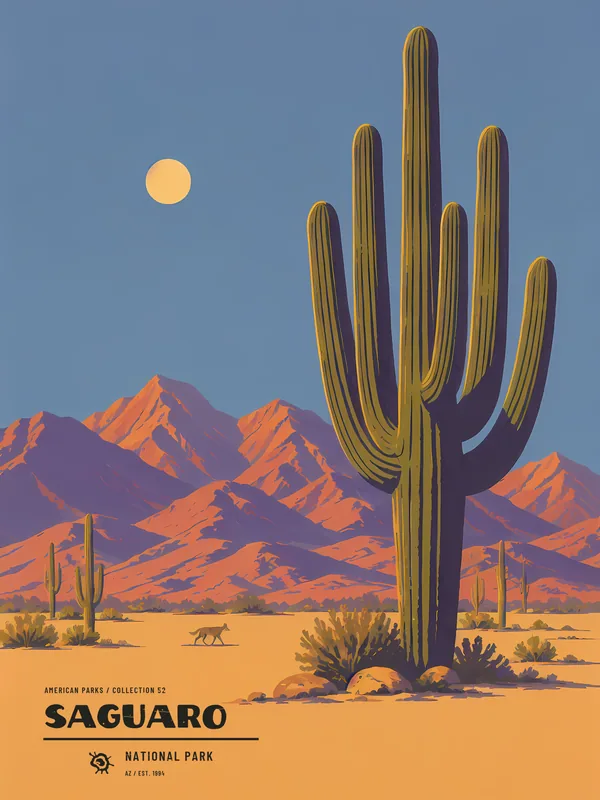
The American Parks shop
Bring Saguaro home
Our park-inspired creations, made to order and shipped to your door.
Latest park news
- Saguaro: Javelina Wash Trail Closed After Flash FloodingJust outside the Red Hills Visitor Center, the Javelina Wash Trail is closed for repairs after flash flooding.
- Saguaro: National Weather Service issues flash flood warningThe National Weather Service issued an official flash flood warning for the Saguaro area on September 29, 2026.
- Saguaro: West Side Loop Drive Closed After Severe StormsStorm debris has shut down the Loop Drive on Saguaro's west side. Here's what's still open and what you can still drive.