
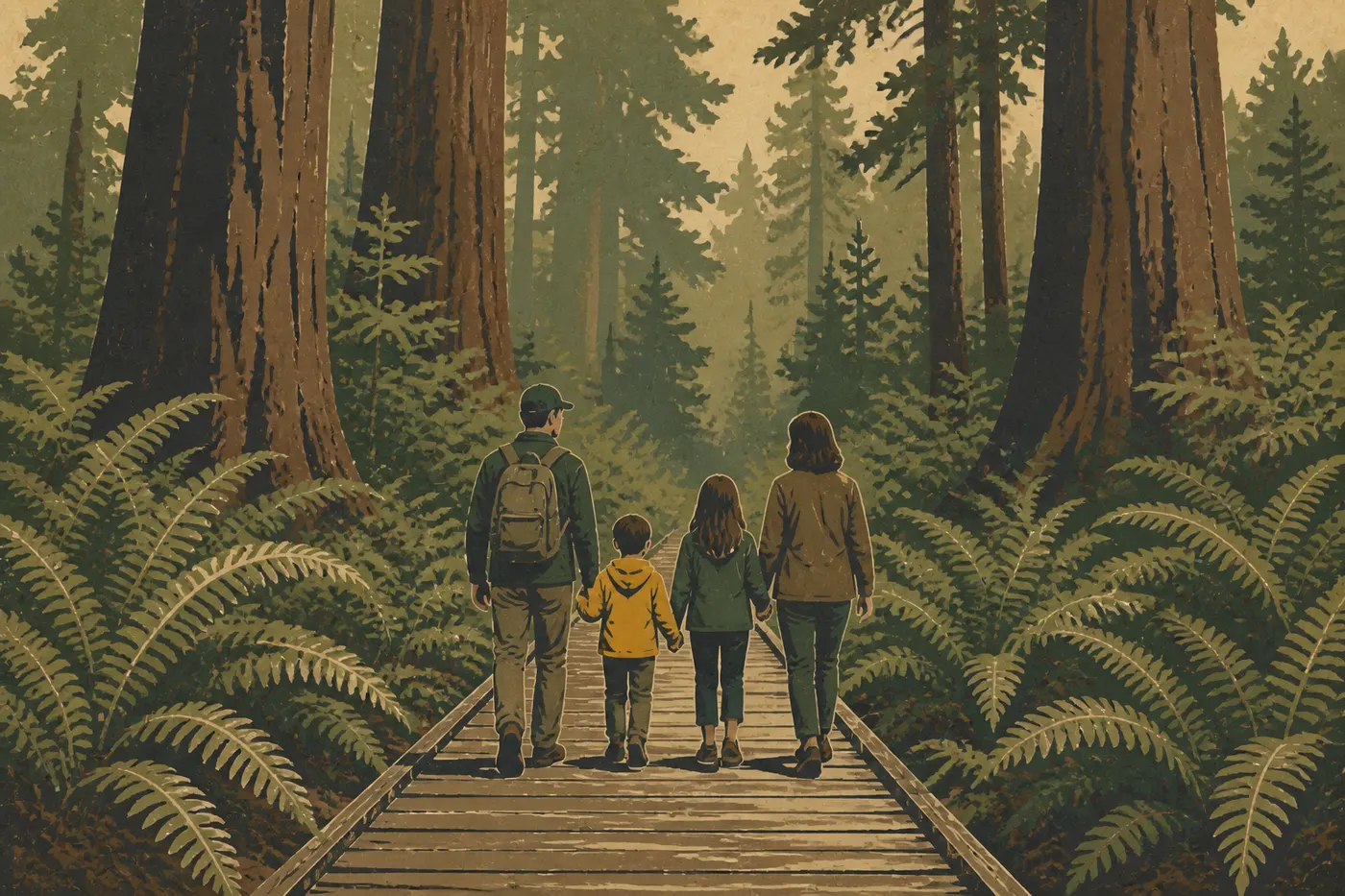
Redwood with Kids: What to Do and How to Plan Your Trip
Yes, Redwood is a family destination in its own right. The coastal redwoods are so tall that even toddlers look up with their mouths open. The sense of wonder is immediate and effortless. The park works for visitors of all ages, including stroller users on some trails. Still, we recommend waiting until kids are 3 or 4 for a visit they'll fully enjoy, and until they're 6 or 7 for forest hikes without carrying them the whole way.
Redwood National and State Parks, the official name for one national park and three California state parks, stretches along California's northern coast, about 323 miles north of San Francisco, or a 6- to 7-hour drive. The coastal redwoods (Sequoia sempervirens) commonly reach 328 to 377 feet, making them the tallest living things in the world. To a child, that scale is impossible to imagine, which is exactly what makes the park unforgettable.
Why Visit Redwood with Kids
Redwoods have an immediate educational advantage: they make an abstract idea tangible. “This tree is 1,000 years old” becomes real when you place your hand on its thick, corklike bark. That's the kind of experience that sticks with you.
From a practical standpoint, the park offers families several advantages.
Short trails with a big visual payoff. Fern Canyon and Lady Bird Johnson Grove both take less than an hour, with scenery that more than justifies the drive.
Wildlife visible from the road. Roosevelt elk regularly graze along Newton B. Drury Scenic Parkway. You don't need to hike 6.2 miles to see impressive wildlife.
The Pacific coast. The park follows the ocean for miles. Gold Bluffs Beach is accessible by vehicle and offers wild beaches backed by forested cliffs. Kids can run, collect pebbles, and watch seabirds without having to work for it.
Free admission. Redwood National and State Parks doesn't charge an entrance fee for vehicles. That's a serious advantage when you're traveling as a family.
Is Redwood Good for Kids? What Age Is Best
Redwood works for all ages as long as you adjust your expectations and itinerary.
Babies and toddlers (ages 0–2). Focus your visit on stops you can reach by car. Big Tree Wayside, for example, has a short, hardened path that lets you get close to a giant redwood without leaving a firm surface. A baby carrier or all-terrain stroller is all you need.
Ages 3–6. Fern Canyon (0.8 miles, flat but sometimes muddy) and Lady Bird Johnson Grove (0.9-mile loop) are within reach. Kids can walk them comfortably if you keep a slow pace and plan observation breaks.
Ages 7 and up. Your options open up. The Junior Ranger program becomes genuinely engaging. Hikes from 1.9 to 3.7 miles are manageable, and some teens will want to make it to Tall Trees Grove, which requires a free permit picked up at a visitor center.
One thing to remember: trails are often muddy and slippery outside the summer months. Bring waterproof shoes for everyone, regardless of age.
When to Visit as a Family (The Easiest Season with Kids)
Summer (July and August) offers the most stable conditions, with temperatures around 59–68°F and less rain. Coastal fog can still settle in during the morning, especially in June. Locally, it's called “June Gloom.” The trees handle it just fine, but kids may not if you haven't packed extra layers.
Spring (April and May) and fall (September and October) are good alternatives, with fewer crowds, lush vegetation, and more active wildlife. Rain is common from November through March, and some campgrounds or visitor centers close or reduce their hours outside the peak season.
Our Redwood weather guide breaks down precipitation month by month. To choose the best time for your type of trip, see our guide to when to visit Redwood.
How Many Days Should You Plan for a Family Trip?
Two full days is a reasonable minimum for covering the highlights. Three days give you room to breathe: you won't feel like you're just passing through, you can return to a favorite spot (Fern Canyon often deserves a second visit), and you'll have time to simply sit at the foot of a redwood.
With young children, two fully enjoyed experiences are better than an exhausting itinerary nobody remembers. Our Redwood itinerary guide offers structured suggestions based on how many days you have.
Keep in mind that the park stretches nearly 62 miles from north to south, with four visitor centers spread throughout the area. The drive between sections can surprise anyone who underestimated the distances on the map.
What to Do in Redwood with Kids: Our Picks
Fern Canyon. This is the crowd-pleaser. Ferns cover the canyon walls from bottom to top, creating a spectacular green corridor. Kids love hopping from stone to stone across the small stream. Some scenes from Jurassic Park 2 were filmed here, which is an unbeatable argument for 8- to 12-year-olds. The ground is flat but can be muddy outside the main season.
Newton B. Drury Scenic Parkway. Drive 10 miles through the forest, with several short stops along the way. It's ideal for days when everyone's energy is running low. Roosevelt elk are regularly seen here.
Big Tree Wayside. A 10-minute roadside stop where you can get close to a giant redwood and take in its immense scale. It's very accessible, even with a stroller. There's no reason to skip it.
Lady Bird Johnson Grove. A 1.4-mile loop through an old-growth redwood forest. There's barely any elevation gain, and the ground is relatively firm. It's a good introduction to hiking with the family.
Gold Bluffs Beach. A wild beach beneath forested cliffs. Swimming isn't recommended because of the cold water and dangerous currents, but it's perfect for running around, watching birds, and unwinding after time in the forest.
For the complete list of park activities, see our Redwood activities guide.
Easy Family Hikes (Short, Little Elevation Gain, Stroller-Friendly)
| Trail | Distance | Difficulty | Stroller access |
|---|---|---|---|
| Big Tree Wayside | ~0.1 miles round-trip | Very easy | Yes (hardened path) |
| Fern Canyon Loop | ~0.8 miles | Easy (uneven ground) | No (wet terrain) |
| Lady Bird Johnson Grove | ~1.4 miles | Easy | Partial |
| Trillium Falls | ~2.5 miles | Easy to moderate | No |
Here's a practical tip: pick up a paper trail map at the entrance or at a visitor center. Cell service is often nonexistent in dense forest, and offline apps may not show details about trail conditions after rain.
Our Redwood hiking guide covers every trail in the park, with difficulty ratings and complete elevation profiles.
The Junior Ranger Program
It's one of the most effective ways to keep kids engaged in an American national park. Here's how it works: pick up a free activity booklet at one of the four visitor centers, complete the field observations (species identification, questions about wildlife and plants, drawings), then return the booklet to a ranger to take the park-protection pledge and receive an official badge.
At Redwood, booklets are designed for several age groups, starting at around age 5. When we visited, I saw reluctant kids become the most attentive members of their families as soon as they had the booklet in hand. The promise of a badge works wonders. Each park issues a different badge, which often turns into a collection over the course of a road trip.
Safety with Kids
Roosevelt elk. These imposing animals, with adult males weighing more than 992 pounds, are common throughout the park. Never get closer than 100 feet. A stressed elk can charge quickly and without warning. In parking lots and along roads, keep kids within arm's reach at all times.
Pacific Ocean water. The beaches are beautiful, but swimming is dangerous because of the cold water (50–57°F in summer), strong currents, and unpredictable waves. Tell kids clearly that the water isn't safe. A simple rule to set as soon as you arrive: don't go in past your knees.
Slippery trails. Forest floors are often wet, covered with moss and exposed roots. Lug-soled shoes are essential, even in good weather. Falls are the leading cause of incidents on the trails.
Poison oak. This plant has shiny leaves grouped in threes and can cause severe skin reactions on contact. It grows along trails and in open areas. Teach kids this hiking rule: “Leaves of three, let them be.”
Changing weather. Northern California's coast can shift from overcast skies to light rain in a matter of minutes, even in July. Always pack a lightweight waterproof layer for everyone in the family.
For complete safety information and current alerts, see the main Redwood park page.
Where to Stay with Your Family (In and Around the Park)
Campgrounds offer the most direct way to immerse yourself in the park. Jedediah Smith Campground, in the north, is especially popular with families because of its shaded sites along the Smith River. Gold Bluffs Beach Campground, farther south, lets you sleep facing the ocean, between cliffs and forest. Both require reservations, which you should make well ahead of the peak season.
Families who prefer a solid roof can find accessible hotels and motels in Crescent City to the north and Eureka to the south. Depending on where you stay, expect a 45-minute to 1.5-hour drive to the park's main sites.
Our Redwood lodging guide compares campgrounds, hotels, and alternative accommodations, along with distances to the sites.
Meals and Breaks with Kids
Let's be direct: there's no restaurant inside the national park. Orick, the village along the southern edge, has a few very limited options, such as a snack shop and a grocery store. Crescent City offers more choices.
Our recommendation for families is to prepare your own meals. Picnic areas are plentiful, well located, and equipped with tables. Eating beneath a redwood canopy 328 feet above the ground is the kind of meal even the pickiest kids remember.
Keep in the car: a cooler for lunch, plenty of water (fountains are rare on the trails), and snacks suited to trail breaks, such as dried fruit, bars, and fresh fruit. Picnic areas are marked on the maps available at visitor centers.
Family Budget
Admission is free. Redwood is one of the few major American national parks that doesn't charge a vehicle entrance fee. Some campgrounds charge a fee, with rates varying by site type, and a few specific activities may cost extra.
If your road trip includes other parks that charge admission, such as Yosemite or Grand Canyon, the America the Beautiful pass (about $80 per year) covers the pass holder and passengers in the vehicle, including children. It pays for itself after the third fee-based park. Children under 15 enter all national parks free, with or without a pass.
For details and to see how this stay fits into your overall road-trip budget, consult our Fees and passes page and the complete Redwood guide.
Places to Combine with Redwood When Traveling with Kids
Prairie Creek Redwoods State Park is technically part of the Redwood National and State Parks system. It deserves a dedicated half-day. Roosevelt elk are particularly easy to spot there, and the access to Fern Canyon starts in this area.
The Northern California coast. As you drive north or south on US-101, the scenery is spectacular. The beaches of Humboldt County, small fishing towns such as Trinidad, and the cliffs of the Lost Coast make good road-trip stops with kids.
Southern Oregon. The park is about 19 miles from the Oregon border. If you have time, southern Oregon, with its coast and Cascade forests, fits naturally into a route from Redwood.
Our Road Trip pages and our regional guide offer the information you need to work Redwood into a longer Pacific Coast itinerary.
Redwood with Kids: Is It Worth It?
Yes, without reservation. But this is a park that calls for a shift in mindset. You don't come here to string together one trail after another. You come to slow down and pay attention. The forest sets the pace, and that's exactly what makes it a relaxing destination even with kids. Free admission, wildlife visible from the road, short trails with a major visual impact, and the Junior Ranger program create a combination that's hard to match for an accessible nature trip at any age.
The one honest drawback is that Redwood is far from any major airport and nearly impossible to reach without a personal or rental vehicle. This isn't a park you visit in passing. It's a destination in its own right, worth at least two nights, and it rewards families who make the time.
Frequently Asked Questions
What is redwood?
Redwood refers to the coast redwood (Sequoia sempervirens), a tree species native to the northern California coast and southern Oregon. It's the tallest tree species in the world, and specimens in the park regularly exceed 328 feet. Don't confuse it with the giant sequoia (Sequoiadendron giganteum), which is shorter and broader and grows in the Sierra Nevada.
Where is Redwood?
Redwood is in the northernmost part of the California coast, about 19 miles from the Oregon border. Crescent City, to the north, is the main gateway. Expect a 6- to 7-hour drive from San Francisco and about 10 hours from Los Angeles.
Is Redwood suitable for families with young children?
Redwood works well for families with young children if you keep a slow pace and choose activities accordingly. Short trails such as Big Tree Wayside and Lady Bird Johnson Grove work for kids as young as 3 or 4, while wildlife visible from the car works for all ages. The Junior Ranger program starts at around age 5.
How long does it take to visit Redwood with kids?
Two full days let you cover the essentials: Fern Canyon, Newton B. Drury Scenic Parkway, a coastal beach, and a visitor center. Three days are better for families so you don't have to rush. Our Itinerary and length page offers suggestions based on how many days you have.
Do you have to pay to enter Redwood?
No. Admission to Redwood National and State Parks is free, and there's no vehicle entrance fee. Some campgrounds and specific activities do charge fees. For entrance fees and annual passes, see the National Parks fees and passes page.