
Petrified Forest with Kids: What to Do and How to Plan Your Visit
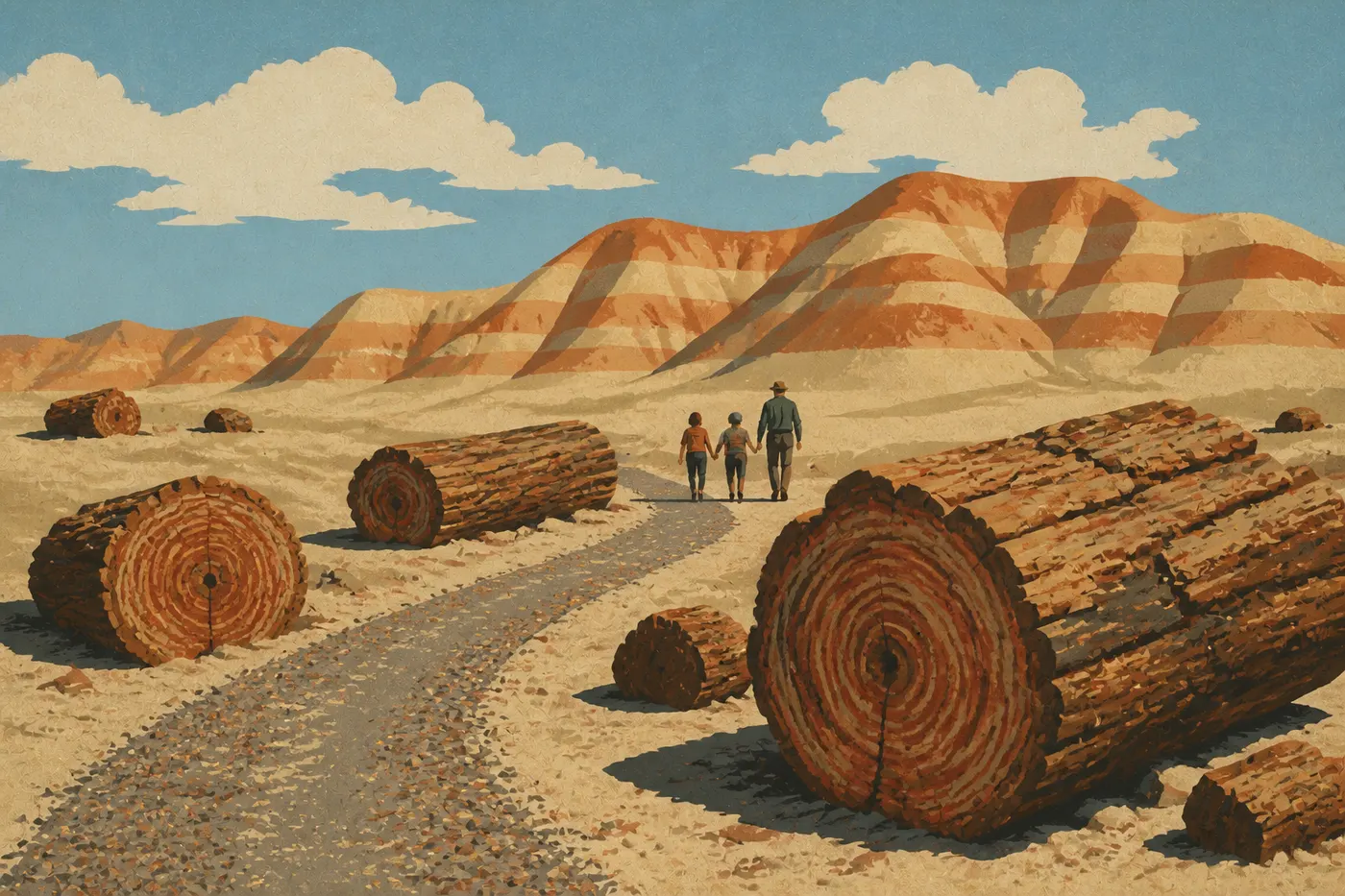
Petrified Forest is unlike any other park. There are no geysers, waterfalls, or bears along a river. Instead, you'll find 225-million-year-old tree trunks turned into multicolored stone, plus the Painted Desert stretching out in shades of purple, orange, and white. For kids, it feels like a science-fiction set they can actually touch.
Is Petrified Forest good for kids? Yes, starting at around 4 or 5. You see most of the park from a 28-mile scenic road lined with short stops, which makes it accessible for all ages, including very young children. The trails are short and mostly flat, and the Junior Ranger program gives kids as young as 5 a structure for the day. The one serious challenge is summer heat, which regularly climbs above 100°F.
Why visit Petrified Forest with kids
The park gives families three solid reasons to visit.
A spectacle kids can see right away. Children can look, observe, and understand without much explanation. The petrified logs sparkle in the sun, and their purple, pink, and white quartz crystals hold even the youngest children's attention. It's geology in 3D, with no textbook required.
A flexible drive-through format. Plan your visit around a 28-mile road with overlooks and short loops. Get out, look around for ten minutes, and get back in the car. You don't have to spend the day on a long hike. It's ideal when the kids don't have much stamina or a baby is sleeping in the car seat between stops.
Accessible cultural history. The petroglyphs at Puerco Pueblo, carved more than 650 years ago, spark surprisingly engaging conversations with kids around 7 or 8. A few interpretive panels explain Pueblo symbols with pictures, and curious children can look for the spirals that served as a solar calendar.
Is Petrified Forest good for kids? What age is best
The number-one question parents ask when considering the park deserves an age-by-age answer.
Under 4: You can still see the park by car. The Painted Desert landscapes may hold their attention for a moment, but young children won't yet understand what petrified wood is. Expect some time in the car seat between stops.
Ages 4 to 7: The short trails, including Giant Logs and Crystal Forest, work very well. The Junior Ranger program keeps them engaged throughout the day. Avoid the peak of summer if your kids struggle with heat.
Ages 8 and up: This is the ideal age. Kids grasp the scale of 225 million years, take an interest in the petroglyphs, and enjoy reading the interpretive panels. A full day is easy to justify.
Physical accessibility: Crystal Forest and Giant Logs have paved trails that work with an all-terrain stroller. The Painted Desert overlooks are accessible from their parking areas. Blue Mesa, with steps cut into the clay, requires more caution and isn't suitable for strollers.
When to visit with kids (the easiest season for families)
The season you choose can completely change the experience. Our Petrified Forest weather guide breaks down temperatures month by month. Here's the family-focused summary.
Spring (March through May): Our top recommendation. Temperatures range from 59 to 77°F, the Painted Desert looks beautiful in the late-afternoon light, and crowds are moderate.
Fall (September through November): The second choice, comparable to spring. September is still hot, with temperatures up to 86°F, but October and November are ideal.
Summer (June through August): Avoid it with young children. Temperatures often rise above 100°F. Monsoon storms roll in during the late afternoon, and the road may close temporarily.
Winter (December through February): Temperatures range from cool to cold, with a few snowy days that transform the landscape. Keep in mind that the park is closed on Thanksgiving and Christmas.
For a closer look at dates and crowds by month, see our Petrified Forest seasons guide.
How many days to plan for a family visit
One full day is enough to drive through the park from end to end with kids. The classic plan is to enter from the north at the Painted Desert Visitor Center, reached from I-40, drive to the southern entrance on Highway 180 with four or five stops along the way, and exit toward Holbrook.
If Petrified Forest is part of an Arizona road trip that includes the Grand Canyon, Monument Valley, or Sedona, allow half a day to get there and one day to visit. Our Petrified Forest itinerary guide suggests practical combinations based on the length of your trip.
Don't pack too much into the schedule. Two or three well-chosen overlooks and two short hikes are more than enough for a rewarding day that doesn't wear the kids out.
What to do in Petrified Forest with kids: our picks
Our Petrified Forest activities guide covers every activity. Here's our family filter, focused on the options that really work with kids.
The Painted Desert. The first few miles from the north entrance open onto sweeping views of the colorful badlands. The Tawa, Kachina, and Chinde overlooks are accessible from their parking areas, with no walking required, so they're ideal with a stroller.
Puerco Pueblo and its petroglyphs. This site includes the ruins of an ancestral Pueblo village and hundreds of petroglyphs. The 0.3-mile loop is paved and flat. Give your kids a challenge: can they spot the spiral that served as a solar calendar?
Crystal Forest. This is where you'll find some of the park's most spectacular petrified logs, covered in quartz and amethyst crystals. The loop is paved and flat, and takes 20 to 30 minutes. This is also where the park's “don't pick anything up” rule is most tempting to break, so remind your kids before you get out of the car.
Rainbow Forest Museum. Admission is included with your entrance fee. This museum at the south entrance displays dinosaur skeletons and plant fossils from the Triassic period. It's perfect for an air-conditioned break in the middle of the day.
Easy family hikes (short, little elevation gain, stroller-friendly)
Our Petrified Forest hiking guide details the technical conditions for every trail. These are the four essentials for a family visit.
Giant Logs Trail: 0.4 miles round-trip, paved, starting behind the Rainbow Forest Museum. The petrified log known as “Old Faithful” measures more than 10 feet in diameter at its base. It works with a sturdy stroller.
Crystal Forest Trail: 0.7 miles round-trip, paved, and flat. The park's highest concentration of petrified wood is here. It works with an all-terrain stroller.
Puerco Pueblo Loop: 0.3 miles, paved, and flat. It's short but very informative, with petroglyphs and village ruins along the way.
Long Logs Trail: 1.6 miles round-trip on an unpaved but even surface. It's suitable for kids 6 and up who are comfortable walking. The concentration of petrified wood is remarkable.
Blue Mesa Trail: 1 mile, with moderate elevation change and steps cut into the blue bentonite. It's very photogenic, but slippery when wet and unsuitable for strollers.
The Junior Ranger program
It's the NPS's secret weapon for keeping kids engaged, and Petrified Forest is particularly well suited to it.
Pick up a Junior Ranger booklet at the entrance. It's free and available at the Painted Desert Visitor Center and Rainbow Forest Museum. Your kids then have a structured program to follow: draw a fossil, identify a petroglyph, and answer questions about Triassic geology. At the end of the day, a ranger presents them with an official badge during a brief ceremony.
The booklet comes in two age levels, for ages 5 to 7 and 8 to 12. Allow 2 to 3 hours to complete the activities while visiting the park. It gives kids who get impatient between stops something to follow throughout the day.
Safety with kids
Petrified Forest isn't a risk-free park. Keep these four points in mind.
Heat. In summer, temperatures can climb above 100°F. Bring at least 2 liters of water per person for each half-day, a hat for every child, and SPF 50 sunscreen or higher. Potable water is scarce between the two visitor centers, so fill your water bottles before you start driving.
Monsoon storms (July through September). These storms often develop without warning in the late afternoon. At exposed overlooks, get back in the car as soon as you hear the first rumbles. Rocky promontories attract lightning.
Rattlesnakes and scorpions. They live throughout the park. Never let children turn over rocks or put their hands under a petrified log. Everyone should wear closed-toe shoes, even on short paved trails.
Don't take anything home. Removing petrified wood is a federal offense that can lead to a substantial fine and immediate confiscation. Explain this to the kids before you enter the park, and turn it into a teaching point. If each of the park's 600,000 annual visitors took one piece, the park would be empty within a few decades.
The complete park rules are covered in our Petrified Forest guide.
Where to stay with kids (in and around the park)
There is no lodging inside the park. You won't find a hotel or lodge there. The only official campground is a walk-in backcountry campground with no amenities or running water, so it's best reserved for experienced families with older children.
Holbrook (19 miles north on I-40) is the usual base, with several family-friendly chain hotels and all the basic amenities. Winslow (31 miles west) and Show Low (50 miles south) offer additional options if Holbrook is full.
Our Petrified Forest lodging guide lists accommodations by type and proximity, along with our notes on the options that work best for families.
Meals and breaks with kids
Food service in the park is limited to the basics.
Painted Desert Inn (north entrance) is a historic National Historic Landmark that now houses a museum and gift shop. No hot meals are available.
The snack area near Rainbow Forest Museum (south entrance) serves snacks, sandwiches, and hot and cold drinks. It's convenient for a midday break, but not a full meal.
Our recommendation is to pack a picnic before entering the park. Tables are available at Chinde Picnic Area in the Painted Desert and near Rainbow Forest Museum. Eating with a view of the badlands makes a stronger memory than a gas-station sandwich in Holbrook.
Family budget
Entrance fee: $25 per private vehicle, regardless of the number of passengers. For two adults and two children, that's $6.25 per person.
America the Beautiful pass: At $80 per year, it covers admission to more than 2,000 federal recreation sites, including all national parks. It pays for itself starting with your third national park. Children under 16 enter all national parks free, regardless of how you pay.
Petrified Forest annual pass: $45 if this is the only park you visit during your Arizona trip.
Our Fees and passes page explains entrance fees and pass options for different itineraries.
What to combine with Petrified Forest when traveling with kids
Petrified Forest sits along I-40, the old Route 66, in northeastern Arizona, which makes it easy to add to a road trip.
Meteor Crater (31 miles west on I-40) is a 0.7-mile-wide meteorite crater with an interactive museum. The visit takes about 2 hours and works very well for kids 6 and up.
Monument Valley (3 hours north) has the red buttes kids often recognize before they've even been there. A Navajo jeep tour works for kids as young as 4 or 5.
Grand Canyon South Rim (3 hours northwest) has overlooks accessible to all ages, even though hiking into the canyon requires more physical preparation.
Holbrook and Route 66 offer vintage atmosphere, retro motels, and mineral shops that legally sell crystals and fossils, unlike the park. It's a good stop for kids who like to collect things.
Our Region and Road trip guides offer itineraries built around Petrified Forest based on the length of your trip.
Petrified Forest with kids: is it worth it?
Yes, absolutely. It's one of the few national parks where the main experience happens from the car, without requiring a long hike, and where the sights, including petrified wood, colorful badlands, and petroglyphs, immediately make sense to kids. The Junior Ranger program gives the day structure, the $25 vehicle entrance fee is very reasonable, and adding the park to an Arizona road trip is easy on I-40.
The only caveat is to avoid the peak of summer with young children unless you're prepared for the heat. Outside July and August, Petrified Forest makes an excellent first national park for a family discovering Arizona. Our complete Petrified Forest guide gives you the full picture for planning your visit.
Frequently asked questions
How much does it cost to enter Petrified Forest?
Admission to Petrified Forest National Park costs $25 per private vehicle, regardless of the number of passengers. The America the Beautiful pass ($80 per year) covers admission and pays for itself starting with your third national park. Children under 16 enter all U.S. national parks free. For entrance fees and annual passes, see the national parks fees and passes page.
What do visitors say about Petrified Forest National Park?
Reviews of Petrified Forest consistently highlight the unique petrified wood and the beautiful colors of the Painted Desert. The most common disappointment comes from visitors who imagined a forest of standing trees. The logs lie on the ground and are broken into sections. Show your kids photos before you leave so they know what to expect and won't be disappointed when you arrive.
What makes the petrified forest so special?
Petrified Forest is unique because of its exceptional concentration of 225-million-year-old silicified wood. Sediment buried the trees, and quartz and other minerals slowly replaced the original material. Today, the crystals form multicolored logs that sparkle in the sun. The site is one of the world's largest concentrations of petrified wood in such a limited area.
What is the curse of the petrified forest?
The petrified forest curse says that anyone who takes a piece of wood will be followed by bad luck, including accidents, illness, and one misfortune after another. Every year, the NPS receives dozens of packages from “repentant” visitors who mail back fragments with apology letters. The curse is just a legend, but it remains an effective way to explain to children why they shouldn't pick anything up in the park. Federal law, on the other hand, is no legend.