Petrified Forest National Park: The Complete Visitor Guide
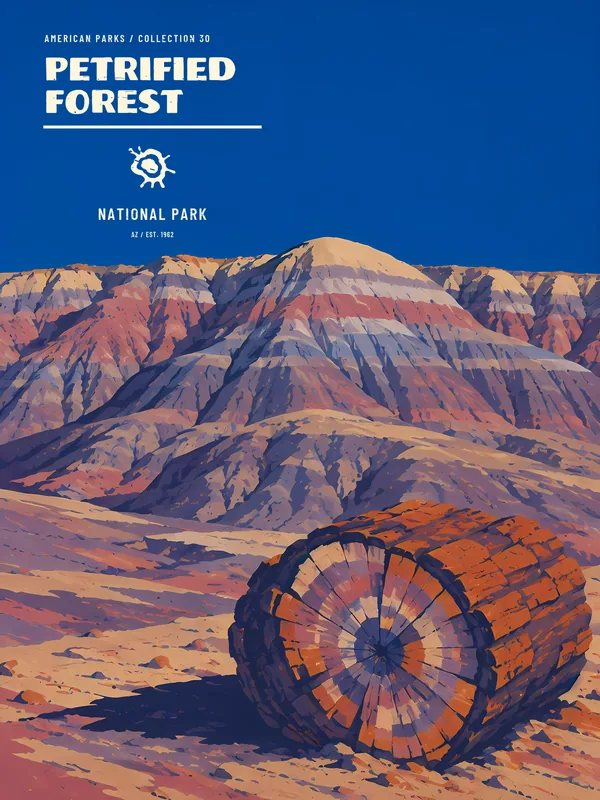
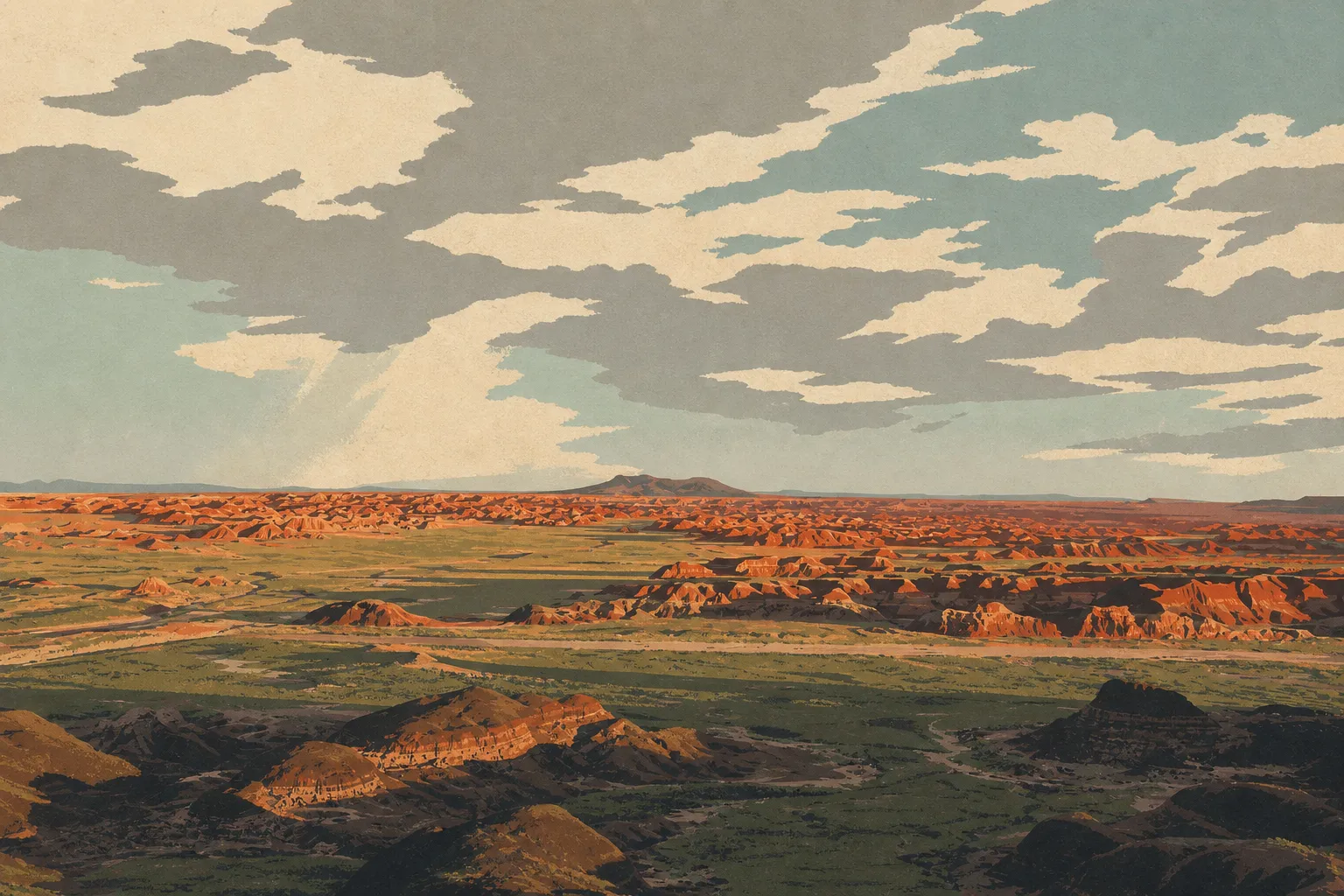
Petrified Forest is a national park in northern Arizona where you drive through a desert painted pink and mauve, surrounded by tree trunks turned to stone nearly 225 million years ago. A single scenic road runs about 28 miles from one end to the other, and that's what makes this park unusual: you explore it by car, driving north to south and stopping at the overlooks. Allow a half-day for the highlights, or a full day if you enjoy hiking and photography. We drove it in both directions, and here's how to make the most of it without rushing.
This guide is your starting point. It sums up each topic and points you to our detailed pages when you want to dig deeper.
Petrified Forest at a Glance: Where the Park Is and How to Get There
The park stretches north to south across northeastern Arizona, tucked between two highways: I-40 to the north and Highway 180 to the south. That geography shapes the entire visit because there are two entrances and one road connecting them.
If you're arriving from the west on I-40, take Exit 311. You'll enter through the north side, by the Painted Desert, then drive about 28 miles south before exiting onto Highway 180. From there, about 19 miles will take you back to Holbrook and I-40 if you're continuing west on your road trip. You can just as easily do the reverse and enter from the south. The direction doesn't matter; only the light changes with the time of day.
The park lies between Holbrook, the nearest town to the west, and the New Mexico border. It's a natural stop along the route between the Grand Canyon and Albuquerque, or along Route 66. The historic Mother Road also runs through the park, making it the only national park to preserve a protected section of it.
Admission Prices, Passes, and Reservations
Admission costs $25 per private vehicle and is valid for 7 days. Motorcycles cost $20. If you're traveling on foot or by bicycle, the fee is $15 per person. You don't need a reservation or a timed entry slot. Just show up at the entrance, pay, and head in.
If you're staying several days or coming back during the year, the park's $45 annual pass quickly becomes worthwhile. And if Petrified Forest is part of a larger road trip through the Western parks, the America the Beautiful pass, valid for one year at all national parks, remains the best option. Our Admission Fees & Passes page explains entrance fees and passes.
Here's a small tradition we recommend: get your national parks passport stamped at the visitor center. Our page Passport & Stamps explains where to pick one up and get it stamped.
Reservations, Permits, and Rules to Follow
Reservations
You don't need a reservation to enter the park. Pay at the entrance. Petrified Forest has no timed entry system or timed windows, unlike Arches or Zion during the busy season. If you want to avoid the line at the booth, you can purchase admission online through Recreation.gov.
Backcountry Permits
There are no developed campgrounds in the park. Backcountry camping is allowed with a free permit issued the same day at the visitor center. You must camp at least 1 mile from the main road. Permits are limited and distributed in the morning.
Absolute Rules
Never collect petrified wood. This is rule number one, and the park enforces it seriously. Taking even a small fragment is a federal offense punishable by a fine. The park uses sniffer dogs trained to detect petrified wood in visitors' bags as they leave. Over the years, thousands of visitors have mailed pieces back after regretting their decision, creating a collection displayed as the “conscience rocks” at the Rainbow Forest Museum.
Here are the other rules to know:
- Drones are prohibited throughout the park.
- Pets are allowed on a leash, no longer than 6 feet, only on roads and in parking areas. They're prohibited on all trails and in the backcountry.
- Campfires are prohibited unless you have specific authorization at a backcountry site.
- Fossils and archaeological artifacts may not be touched or moved.
Getting Around Petrified Forest
There is no shuttle here, so you'll explore in your own vehicle. The roughly 28-mile scenic road connects the north entrance, by the Painted Desert, with the south entrance, by the Rainbow Forest, and reaches all the points of interest via parking areas and short loops.
The idea is simple: drive, stop at each overlook and trailhead, walk for a few minutes, and get back on the road. The park road has a speed limit, and driving straight through takes just under an hour. Because the park is a through route, fill your gas tank and bring your water before entering. There is no gas station or resupply inside, and the climate is dry.
Park road hours vary with the season, weather, and any safety concerns. The park closes on Thanksgiving Day and Christmas Day. Check the day's hours on our page Practical Information, Rules & Safety.
How Long Does It Take to Visit Petrified Forest?
How long should you spend in Petrified Forest? Allow at least 2 to 3 hours for a drive with the main stops, and a half-day to a full day if you want time to hike, take photos, and linger at the overlooks.
Here's the itinerary that has worked best for us: a half-day is enough to see the Painted Desert in the north, Blue Mesa in the center, and the largest concentrations of petrified wood in the south. Add the short hikes and a lunch break, and the day passes easily. Few visitors spend the night in the area, so the park works well as a one-day stop between two major sites. To fit this timing into your road trip, see our Itinerary & Time Needed page, which offers half-day and full-day plans.
Plan your visit
What to See and Do in Petrified Forest
The heart of the visit is the succession of areas along the road, from north to south. Here's how we link them together.
Road trip journal · 4 areas
The Painted Desert and the North Side of the Park
At the north entrance, a series of overlooks looks out over the Painted Desert. Layered hills shift from red to pink to purple as the light changes. Sunrise and sunset are the best times to visit, when the colors become most intense. This is also where you'll find the Painted Desert Inn, a former Route 66 hotel that is now a small museum perched above the view.
Puerco Pueblo and Newspaper Rock
As you head toward the center, two stops tell the story of the area's human history. Puerco Pueblo is an ancestral puebloan village whose ruins you can walk alongside. A little farther on, Newspaper Rock features hundreds of petroglyphs carved into sandstone blocks, viewed from a platform equipped with spotting scopes.
Blue Mesa
In the center of the park, Blue Mesa is our favorite area: badlands covered in blue-gray and mauve hills carved by erosion. A loop road and a short trail descend among these otherworldly formations. It's the most photogenic area, especially under overcast skies, when the blue stands out.
The South: Jasper Forest, Crystal Forest, and Rainbow Forest
The southern half is where the petrified wood is most concentrated. Jasper Forest and Crystal Forest are lined with petrified trunks whose gemlike sections show how silica replaced the wood with colorful crystals. At the far south end, the Rainbow Forest Museum and Giant Logs Trail feature the park's largest trunks, just steps from the parking lot. Agate Bridge, a petrified trunk several yards long that forms a natural bridge over a ravine, completes the picture.
One thing to know before you even arrive: collecting any petrified wood in the park is strictly prohibited. It's a federal offense, and the park watches closely for it. If you want to take home a souvenir, buy one at shops outside the park, where the wood comes from private land.
Explore the park
The Best Hikes in Petrified Forest
This isn't a place for long mountain hikes. Instead, you'll find short, accessible loops, often less than 0.6 miles, that are enough to get you into the landscape. Giant Logs Trail, the Crystal Forest loop, and the descent into Blue Mesa are among our favorites. They're easy and spectacular. For more experienced hikers, the park allows unrestricted hiking and overnight camping in the Painted Desert Wilderness with a permit.
We list every trail, including distance, elevation gain, difficulty, and duration, on our Hiking page. Use it as your reference when planning your route on foot.
The detailed guide The Best Hikes in Petrified Forest for Every Skill Level Which trails should you choose in Petrified Forest? A practical guide to… Read the guide →Wildlife and Plants to Look For
Petrified Forest is a semiarid grassland, a livelier environment than it may seem. You may see pronghorn, coyotes, jackrabbits, lizards, and plenty of birds adapted to dry conditions. Low, hardy vegetation clings to soil that swings from extreme heat to freezing temperatures. Animals are most active early in the morning and late in the day, when temperatures drop. Our page Wildlife covers the species and the best places to see them.
The detailed guide Petrified Forest Wildlife: Animals to See and Where to Find Them Pronghorns, coyotes, rattlesnakes, and roadrunners Read the guide →When to Visit Petrified Forest
The climate is semiarid, with sharp temperature swings. The thermometer can rise above 100°F in summer and drop well below freezing in winter. Precipitation is scarce, about 10 inches a year, falling as snow in winter and sometimes as severe thunderstorms in summer.
Spring and fall offer the most comfortable conditions: mild weather, clear light, and moderate crowds. Summer is manageable if you leave early and carry plenty of water. Winter brings striking snowy landscapes, but watch for weather-related road closures. Our page When to Visit breaks things down month by month, while our Weather page covers temperatures and precipitation in detail.
The detailed guide When to Visit Petrified Forest: Best Times, Weather, and Seasons The best times to visit Petrified Forest, month-by-month weather, seasonal… Read the guide →Where to Stay Near Petrified Forest
There are no accommodations or developed campgrounds inside the park. Most visitors stay nearby, mainly in Holbrook, a few minutes from the south entrance. The town has classic motels and Route 66 businesses, including the famous teepee-shaped Wigwam Motels. Winslow and the surrounding area offer more options if you're exploring farther afield.
For campers, overnight camping is possible in the Painted Desert Wilderness with a free permit picked up at the visitor center. We compare the options in our Lodging Guide: hotels and lodges on our Hotels & Lodges page, campgrounds on our Camping page, and RV parking on our RV Camping page.
For meals, plan on bringing a picnic lunch into the park. You'll find tables and water mainly at the visitor centers. We list nearby restaurants on our Where to Eat page.
Stay in the park
Around Petrified Forest: Things to Do Nearby
The park is rarely a stand-alone destination. To the west, Holbrook and Winslow continue the Route 66 atmosphere. Farther on, the road leads toward Flagstaff, the Grand Canyon, and the broad landscapes of the Colorado Plateau. To the east, it leads toward New Mexico and Albuquerque. Meteor Crater and northern Arizona's other sites pair well on the same route. Petrified Forest also fits naturally into longer trips through the region and the Southwest's major routes.
Our Take: Is Petrified Forest Worth a Stop?
Is Petrified Forest worth the stop? Yes, as long as you know what you're coming for: a contemplative park you drive through, with a character all its own, rather than a park of major hikes. You come for a landscape found nowhere else, a mix of Painted Desert and stone forest, along with the Route 66 atmosphere around it. A well-planned half-day easily earns its place on a Southwest road trip. When we visited, Blue Mesa under gray skies and the colors of the Painted Desert at sunset made the biggest impression on us. If you're looking for waterfalls and summits, skip it. If you enjoy geology, light, and wide-open quiet, stop here.
To plan everything, follow the links throughout the text. Each question has its own detailed guide.
Frequently Asked Questions
How long does it take to visit Petrified Forest?
Allow 2 to 3 hours for a drive with the main stops, and a half-day to a full day for hiking and photography. The roughly 28-mile scenic road connects the two entrances, and you can take it at your own pace. Our Itinerary & Time Needed page offers detailed plans.
How much is admission to Petrified Forest?
Admission to Petrified Forest is $25 per private vehicle, valid for 7 days, or $15 per person if you're entering on foot or by bicycle. The park's annual pass costs $45. For entrance fees and annual passes, see the National Parks Admission Fees & Passes page.
Can you visit Petrified Forest by car?
Yes. You can visit Petrified Forest by car. A single scenic road crosses the park from north to south and reaches all the overlooks via short loops. There is no shuttle. See our Getting Around page.
When is the best time to visit Petrified Forest?
The best time to visit Petrified Forest is spring and fall, when the weather is milder and the light is clear. Summer is hot, with temperatures above 100°F, and winter is cold, with possible road closures. Our When to Visit page covers each season in detail.
Which area of Petrified Forest is best?
The best area depends on what you like: the Painted Desert in the north for its colors, Blue Mesa in the center for its badlands, and the south, with Crystal Forest and Giant Logs, for the highest concentration of petrified wood. Our Things to Do page reviews each area.
Can you collect petrified wood at Petrified Forest?
No. Collecting petrified wood in the park is strictly prohibited and is a federal offense. For a souvenir, buy petrified wood at shops outside the park, where it comes from private land. The complete rules are on our Practical Information, Rules & Safety page.
The American Parks shop
Bring Petrified Forest home
Our park-inspired creations, made to order and shipped to your door.