
Olympic National Park: The Complete Visitor Guide
Three parks in one is the simplest way to describe Olympic when people ask what to expect. On the Olympic Peninsula, at the northwestern tip of Washington State, the park brings together glacier-carved mountains, one of the wettest temperate rain forests in the contiguous United States, and nearly 60 miles of wild Pacific coastline. The whole area has been a UNESCO World Heritage Site since 1981. Plan on 3 to 4 days to experience all three environments without rushing, or a long weekend if you're focusing on two areas. The park is open 24 hours a day year-round, but some high-elevation roads close in winter. More on that below.
This overview gives you the essential bearings. Follow the links as you read to dive deeper into each area.
Olympic at a glance: Where the park is and how to get there
Olympic occupies the heart of the Olympic Peninsula, an isolated stretch of land west of Seattle, bordered by the Strait of Juan de Fuca to the north and the Pacific Ocean to the west. One detail changes everything when you're planning: no road crosses the park. The central mountain range remains wild, and you drive around it on Highway 101, which makes a roughly 330-mile loop around the peninsula. Each area is reached by a dead-end road that heads inland from Highway 101.
From Seattle, you've got two options. The ferry from downtown Seattle to Bainbridge Island is the shortest route toward the park's eastern side. By car, take I-5 south to Olympia, then switch to Highway 101 north toward Port Angeles, the main gateway town and home to the primary visitor center. Depending on your choice and ferry traffic, the drive from Seattle to Port Angeles takes about 2.5 to 3 hours.
The key point to build into your planning is that distances between areas are measured in driving hours, not minutes. Getting to the Hoh Rain Forest from Hurricane Ridge takes a good half day. Plan your itinerary by geographic area, never by zigzagging back and forth.
To get your arrival logistics in place:
- Our Getting There & Transportation page covers ferries, airports, and travel times from Seattle and Portland.
- Our Getting Around page covers Highway 101, area roads, and road conditions.
- Our Map of the park and its access roads helps you visualize the distances.
Entrance fees, passes, and reservations
Admission to Olympic costs $30 per vehicle and is valid for 7 consecutive days. The fee is $25 for a motorcycle and $15 per person if you enter on foot or by bicycle. The pass covers every area of the park for its validity period.
If your road trip includes several national parks, the annual pass quickly starts to make sense. The Olympic annual pass costs $55, but the federal America the Beautiful pass is the better value at $80. It covers more than 2,000 federal sites, including every national park, for 12 months. A round trip to Olympic, Mount Rainier, and North Cascades already pays for it.
One reservation detail to watch: in recent seasons, Hurricane Ridge Road has required a timed entry reservation for vehicles during the busiest summer periods. The rules change from year to year, so our dedicated pages explain the current requirements.
Our National Park Fees & Passes page explains entrance fees and passes and lists the five fee-free days each year.
Reservations, permits, and rules to follow
Campgrounds: Most sites need to be reserved in advance through recreation.gov, especially from mid-June through early September. Kalaloch and Hoh Campground fill up weeks ahead during peak season. Don't count on finding a site without a reservation in the middle of summer.
Wilderness permits (backcountry): Any overnight stay outside developed campgrounds requires a permit. Some popular areas, including Ozette Loop and Grand Valley, have daily quotas. Reservations generally open in March for the summer season through recreation.gov. Keep this in mind if you're planning a self-sufficient multi-day route.
Campfires: They're allowed only at sites with a designated fire ring. They're generally prohibited on beaches and in the backcountry. Restrictions change with drought conditions, so check the situation when you arrive at the visitor center.
Rules to follow:
- Stay at least 50 feet from any wild animal and 100 feet from bears and elk.
- Dogs are allowed on paved roads and in campgrounds, but they're prohibited on almost all trails and beaches. Check trail by trail.
- In the backcountry, filter or purify all surface water because of the risk of Giardia.
- Follow Leave No Trace principles. Pack out all your trash, including fruit peels and cigarette butts.
Getting around Olympic (area roads and the Highway 101 loop)
You visit Olympic by car. It's the only realistic option for a full stay: there's no internal shuttle and no public transportation connecting the different areas. Highway 101 is your backbone, and each major site is reached by a spur road branching off it.
The main access roads are:
- Hurricane Ridge Road climbs from Port Angeles to mountain viewpoints at about 5,250 feet. It's closed or subject to winter conditions, and chains are often required.
- Hoh Road heads into the rain forest from the west coast.
- Sol Duc Road and Lake Crescent connect to the northern branch of Highway 101.
- Coastal access roads lead to Rialto Beach, La Push, Ruby Beach, and Kalaloch along the Pacific shore.
A standard vehicle is enough for the vast majority of visits. A few backcountry roads require a 4WD vehicle, but nothing special is needed for the classic itinerary. Fill up before you go. Gas stations become scarce once you leave the gateway towns, and cell service gets spotty along the coast and in the forests.
Our Getting Around page details road conditions by area and seasonal closures.
How much time do you need to visit Olympic?
Plan on at least 3 days to experience the park's three ecosystems, mountains, rain forest, and coast, without turning the trip into an endurance event. That's the length of stay we recommend most often.
Here's how to divide your time:
- 2 days: Two areas only, such as Hurricane Ridge and Lake Crescent, or the Hoh and the coast. You'll only get a quick look.
- 3 to 4 days: The comfortable format. One day for the mountains, one for the forest, and one for the coast, with extra time for hikes and unpredictable weather.
- 5 days or more: Add Sol Duc, Quinault, a night on the coast for a Pacific sunset, and some real day hikes.
Weather plays a major role. A day of heavy rain on the coast is easier to absorb if your schedule has some flexibility. Our Itinerary & Trip Length page offers ready-made 2-, 3-, and 5-day routes, with actual driving times between stops.
Plan your visit
What to see and do in Olympic
The heart of the park is its collection of distinct areas. Each has its own character, and you won't experience them all the same way. They're presented here from the most accessible to the wildest. For trail, viewpoint, and activity details in every area, our Things to Do page brings everything together.
Road trip journal · 6 areas
Hurricane Ridge, a balcony over the mountains
Forty-five minutes by car from Port Angeles, Hurricane Ridge offers the park's most spectacular views of glacier-carved peaks, including Mount Olympus, which rises to nearly 7,900 feet. Wildflower meadows bloom in summer, easy ridge trails lead into the landscape, and deer and marmots often appear beside the road. In winter, the area becomes a small ski and snowshoe destination when the road is open. This is the park's essential high-country stop.
Lake Crescent, the turquoise lake
This deep-blue glacial lake sits between the mountains along Highway 101. Its striking clarity comes from water with very little nitrogen. You can kayak, take a chilly swim, or make the short walk to Marymere Falls, a waterfall accessible to everyone. A historic lodge sits on the shore.
Sol Duc, hot springs and a waterfall
The Sol Duc Valley combines deep forest, developed hot springs, and one of the park's most beautiful waterfalls, Sol Duc Falls, reached by a short, shady walk. It's an ideal stop for resting your legs between hikes.
Three pages to help plan your days:
- Our Things to Do page covers every area and activity in detail.
- Our Hikes page sorts trails by difficulty and area.
- Our Family Travel page covers kid-friendly stops and walks.
Hoh Rain Forest, a forest from another world
This is Olympic's postcard view: a temperate rain forest where mosses and lichens drape every branch, ferns blanket the ground, and giant trunks drip year-round. The Hall of Mosses, an easy loop of less than 0.6 miles, captures the magic of the place. The tradeoff for all that lushness is heavy rain through much of the year. Come prepared.
Lake Quinault, the southern forest
Farther south, the Quinault Valley offers a second rain forest, often quieter than the Hoh, surrounding a lake and a historic lodge. Some of the park's largest trees grow here, and a scenic loop road circles the area.
The Pacific coast, the end of the world
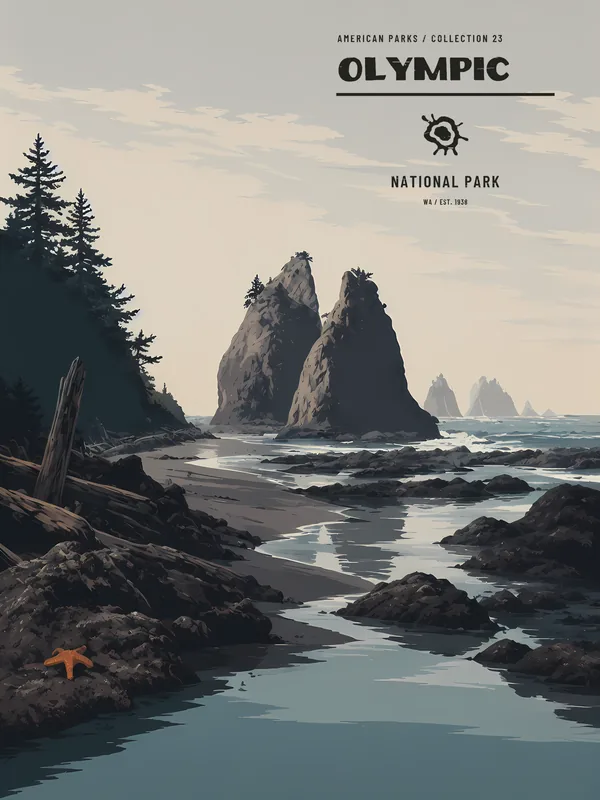
Olympic's oceanfront is a wild stretch of pebble beaches, rocky sea stacks, and driftwood. Rialto Beach, Ruby Beach, and Second Beach near La Push offer the most photogenic scenes, especially at sunset. Watch the tides. Always check the tide tables before heading onto a beach because some passages disappear at high tide.
Explore the park
Olympic's best hikes
Olympic has hikes for every level, from a 20-minute forest loop to a multi-day trek through the backcountry. The easiest must-dos include the Hall of Mosses in the Hoh, Marymere Falls at Lake Crescent, Sol Duc Falls, and the ridge trails at Hurricane Ridge. For a bigger challenge, hikes to Hurricane Hill and High Divide reward the effort with high-mountain views.
For the complete selection, our Hikes page sorts every trail by area, distance, elevation gain, and difficulty, with our field notes.
The detailed guide Olympic National Park Hiking: The Best Trails for Every Level The best Olympic National Park hikes by area, including Hall of Mosses,… Read the guide →Wildlife and plants to look for
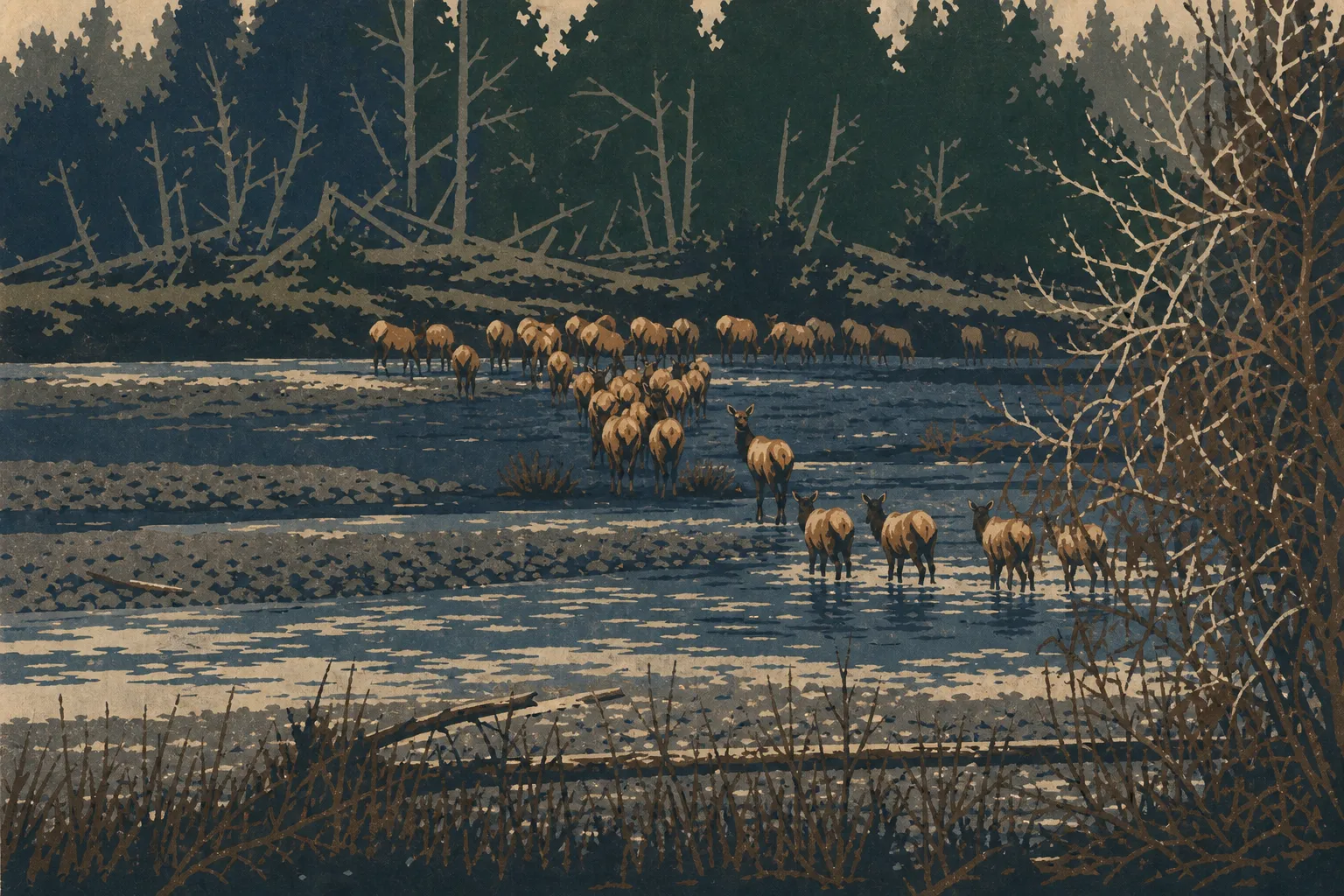
Olympic supports abundant wildlife thanks to its geographic isolation. Among the large mammals, you may see Roosevelt elk, the park's signature species and one of the largest protected wild populations, along with black-tailed deer and, more discreetly, black bears. Olympic marmots, endemic to the peninsula, can be spotted in high-elevation meadows. Along the coast, look for sea lions, sea otters, and, in spring, gray whales passing offshore.
Botanically, the park is in a class of its own: rain forests with enormous trees, subalpine meadows covered in flowers from June through August, and plants found nowhere else because of the peninsula's isolation. Our Wildlife page explains where and when to look for each species and reviews the required viewing distances.
The detailed guide Olympic Wildlife: What to See and Where to Find It Roosevelt elk, black bears, Olympic marmots, and marine mammals Read the guide →When should you visit Olympic?
The best window runs from July through September, the three driest months of the year and the only period when all the high-elevation roads, especially Hurricane Ridge Road, are reliably open. Summers are mild, with highs generally between 64 and 75 °F. The rest of the year brings considerably more rain, while mountain snowfall is heavy in winter.
One Olympic-specific detail: it's common to have several kinds of weather in the park on the same day. Bright sun on the coast, persistent fog in the Hoh, and snow on the ridges. Always bring layers and rain protection, even in August.
For month-by-month details, crowds, and seasonal closures, see our When to Visit guide and our Weather page, which cover temperatures, precipitation, and area openings.
The detailed guide When to Visit Olympic National Park: Best Seasons and Month-by-Month Guide The best time to visit Olympic is July through September, with September as the… Read the guide →Where to stay in Olympic (hotels and campgrounds)
The park doesn't have one central village. Lodging is spread around the loop, which makes staying close to the next day's area especially worthwhile. There are three main options:
- Historic lodges in the park (Lake Crescent, Sol Duc, Kalaloch, and Lake Quinault) are full of character and in high demand. Reserve months ahead for summer.
- Hotels and motels in the gateway towns, especially Port Angeles and Forks, are more flexible and often more affordable.
- Campgrounds are plentiful in the park and managed by the NPS, ranging from rain forest sites to oceanfront campsites.
To choose and reserve your base:
- Our Lodging Guide gives an overview and area-by-area strategy.
- Our Hotels & Lodges page lists properties in and around the park.
- Our Camping page and RV Camping page cover sites, services, and reservations.
Food options are limited inside the park: a few lodge restaurants and nothing else for long stretches of road. Plan on picnics and stocking up in the gateway towns. Our Where to Eat page lists restaurants and resupply stops by area.
Stay in the park
Around Olympic: things to do nearby
The peninsula and its surroundings make it easy to extend your stay. Port Townsend, a charming Victorian town, is northeast of the park. To the south, Long Beach stretches for miles along the Pacific. The area also fits naturally into a wider Washington State road trip that includes Seattle, Mount Rainier, and North Cascades within driving distance.
These extensions fit naturally into a road trip combining several parks and a broader exploration of the region, including Washington State, its cities, and stops outside the park.
Our take: Is Olympic worth the trip?
Yes, absolutely, and for one simple reason: few American parks pack so many different worlds into one area. Going from a glacier-carved ridge to a moss-covered forest and then to a Pacific beach in the same day is an experience that Olympic offers at a rare intensity. What stayed with us from our visit was the contrast: the soft silence of the Hoh in the morning and the crash of waves over Rialto's pebbles in the evening.
The honest tradeoff is the distance and the weather. You can't really do Olympic in one day, and you have to be willing to work around the rain. But with 3 or 4 days and an itinerary planned by area, the park more than rewards the effort. For a first trip to the Pacific Northwest, it fully deserves a place on your itinerary.
Frequently asked questions
How do you visit Olympic National Park?
You visit Olympic National Park by car, following Highway 101 around the peninsula and taking an access road to each area. No road crosses the park, and there is no internal shuttle. Plan your stay by geographic area, mountain, rain forest, and coast, ideally over 3 to 4 days.
How much does it cost to enter Olympic National Park?
Admission to Olympic National Park costs $30 per vehicle and is valid for 7 days. It's $25 for a motorcycle and $15 per person on foot or by bicycle. The park's annual pass costs $55, while the America the Beautiful pass ($80) becomes worthwhile if you visit several parks in a year.
How much time do you need to visit Olympic?
Plan on at least 3 days to visit Olympic and experience its three ecosystems without rushing. Two days is enough for two areas, while 5 days gives you time to add day hikes and a night on the coast. Distances between areas are measured in driving hours, so leave yourself some flexibility.
Can you visit Olympic by car?
Yes. Visiting Olympic by car is the only realistic option for a full stay. A standard vehicle is enough for all the main areas, since the Highway 101 loop and its access roads are paved. Fill up on gas before leaving the gateway towns because stations become scarce outside them.
What is the Olympic Peninsula?
The Olympic Peninsula is the large landmass at the northwestern tip of Washington State, bordered by the Pacific Ocean and the Strait of Juan de Fuca. Olympic National Park lies at its center, surrounded by Highway 101. It's one of the wildest and wettest regions on the American West Coast.
Is Olympic worth visiting?
Yes, Olympic is well worth the trip, especially for its rare combination of landscapes in one park. You can move from glacier-carved mountains to temperate rain forest and wild Pacific coast. You have to accept the distances and changing weather, but a well-planned 3- to 4-day stay makes the effort worthwhile.
The American Parks shop
Bring Olympic home
Our park-inspired creations, made to order and shipped to your door.
Latest park news
- Olympic Road Closures Will Disrupt Access to Popular Areas This FallA series of road closures affects access to Olympic's busiest areas in September and October 2026, so check your itinerary before you go.
- Olympic: Lightning Fire North of Maiden PeakA small wildfire is burning near a ridgeline north of Maiden Peak in Olympic National Park, with no closures or evacuations for now.
- Olympic: Two Small Lightning Fires Are Out, but Crews Stay WatchfulTwo lightning-caused fires were put out on August 26, 2026 in Olympic National Park, where crews are still working two other fires.