
Denali Itinerary: What to See in 1, 2, or 3 Days
Denali is one of the few American parks where your car comes to a dead stop after 15 miles. Of the 92-mile Denali Park Road, only this first stretch is open to private vehicles. Beyond that, the road belongs exclusively to official NPS buses, and that changes everything about planning your stay.
In short: two days is the minimum if you want to reach the heart of the park and catch a glimpse of Denali from Eielson Visitor Center. Three days let you add Wonder Lake and a full day of free hiking across the tundra. You visit from east to west, one area at a time, following the road.
How Much Time Do You Need to Visit Denali?
Denali deserves time, and not just because it covers 9,460 square miles. The first challenge is logistics: buses to the deep sections of the park cannot make the round trip in a few hours. A trip to Eielson Visitor Center, at mile 66, takes 4 to 5 hours each way, including wildlife stops. Wonder Lake, at mile 85, requires a full 11- to 12-hour day.
Here's how to plan your stay:
- 1 day: entrance area only, with a drive to Savage River. You'll get a good introduction to the tundra, but the deeper park remains out of reach.
- 2 days: Savage River on day one, then a bus ride to Eielson on day two. It's the best-balanced option for a first trip.
- 3 days: the full program, with Wonder Lake on day three, or off-trail hiking if you'd rather explore on foot.
The main season runs from June through early September. Outside that window, the buses stop running and access is very limited. Our Denali seasons guide breaks down the calendar month by month, along with typical temperatures and conditions.
Access, Entrance Areas, and Getting Around the Park
How to Get to Denali
You can reach Denali via Highway 3, about 5 hours north of Anchorage or 2 hours south of Fairbanks. For detailed transportation options, including the Alaska Railroad, shuttles, and driving, see how to get to the park.
The Bus Rule: Understand It Before You Arrive
Private vehicles cannot access the Denali Park Road beyond mile 15. The NPS made this choice to protect wildlife and reduce noise. In practice, you'll need to reserve your bus seat before you arrive in the park, especially in July and August, when departures sell out weeks ahead.
Two types of buses operate here. Transit buses have no onboard commentary and let you get off and back on wherever you want along the road. If a bear appears, you can stay as long as you need, then board the next available bus. Guided buses, such as the Tundra Wilderness Tour, include a naturalist interpreter, fixed stops, and a set schedule. They're useful for a first look, but less flexible for photographers and curious travelers.
Cell service disappears after the first few miles. Download offline maps before you enter, or buy a paper map at the Visitor Center. Our Denali shuttle guide explains how to book buses and manage connections along the road.
Denali's Areas
The Denali Park Road crosses three clearly distinct areas: subarctic forest near the entrance, open tundra in the central area, and the wildest landscapes to the west.
Entrance Area (Miles 0-15): The Only Section Open to Cars
This is where everything starts. Denali Visitor Center offers a solid introduction to the park's ecology, with exhibits on wildlife and geology plus a 20-minute film. The nearby Wilderness Access Center handles bus reservations and free backpacking permits. Take time to stop there because your entire stay depends on getting organized here.
The Savage River walking loop, about 3.1 miles with little elevation gain, follows the river through the tundra. Caribou, ptarmigan, and Arctic foxes appear regularly. It's an easy hike for all abilities, and visitors often overlook it in favor of the longer bus rides.
Central Area (Miles 15-66): Tundra, Color, and Wildlife
The landscape opens up as you ride the bus. The road climbs gradually toward Polychrome Pass, around mile 45, with sweeping views of ridges in ochre, red, and pale green. Toklat River, around mile 53, is a classic stop. Grizzlies regularly search for food along its white gravel bars around midday.
Wildlife stops are frequent and unpredictable. When we visited in July, the bus stopped five times in two hours between Polychrome and Toklat: two bears, a distant wolf, a caribou herd crossing the road, and Dall sheep perched on a ridge. Patience always pays off on this road.
Western Area (Miles 66-92): Eielson, Wonder Lake, and Wide-Open Country
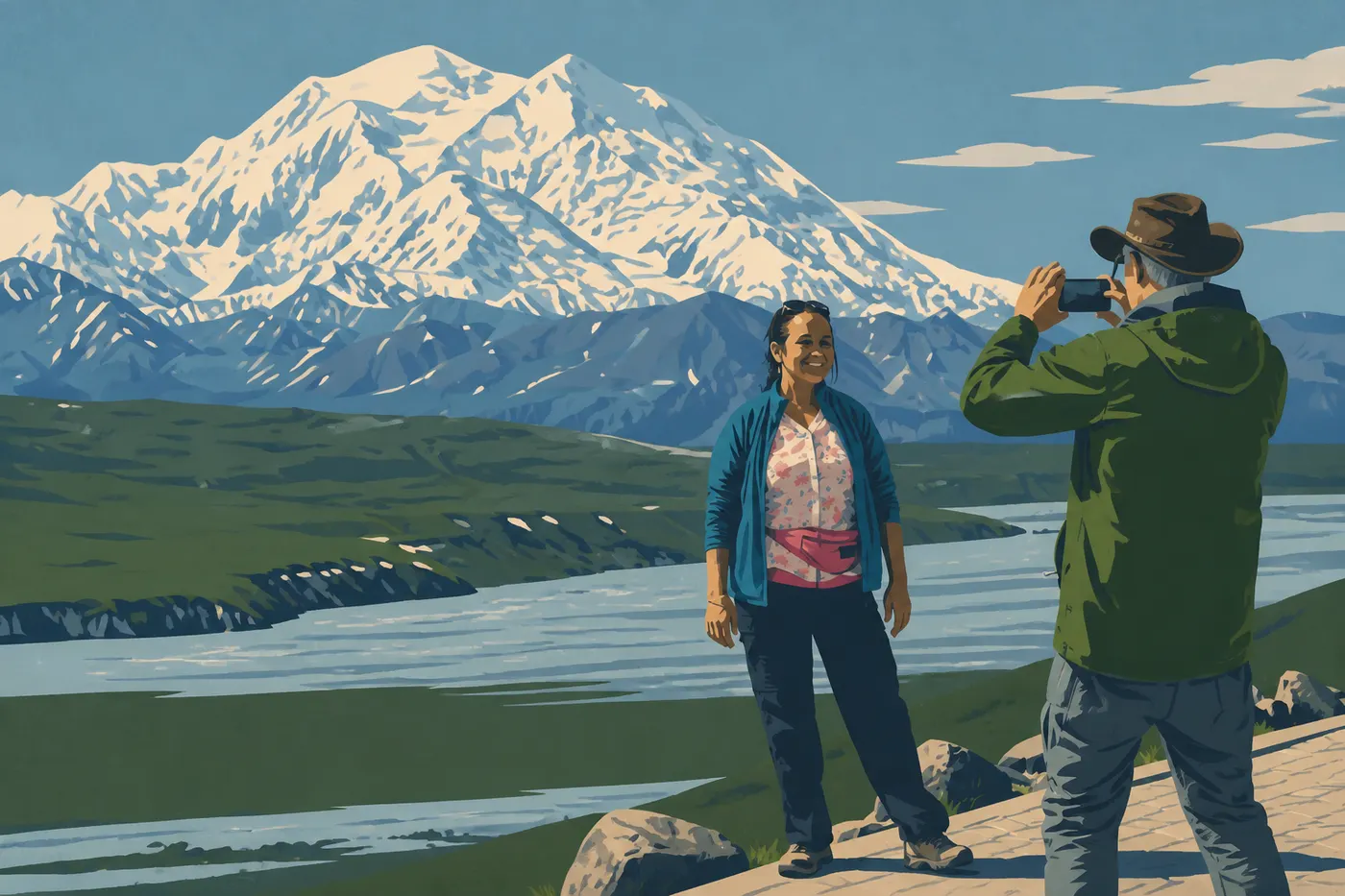
Eielson Visitor Center, at mile 66, is the go-to viewpoint for Denali. On clear days, which account for about a third of summer days, the summit rises more than 62 miles away, immense and snow-covered. The indoor exhibit explains how the Alaska Range formed. A short 1.2-mile round-trip trail leads to another overlook.
Wonder Lake, at mile 85, is farther away, but on a calm, clear day it offers Denali's legendary reflection on the water. Wind erases the mirror effect, but the setting is still beautiful. This trip is best reserved for stays of at least three days.
Day-by-Day Itinerary
Day 1: Arrival and the Entrance Area
Arrive early in the morning, ideally before 8 a.m. If you haven't booked your bus online, make that your first priority at the Wilderness Access Center when it opens. Then start at the Visitor Center, allowing about an hour, and drive to Savage River for the walking loop. Plan on 1.5 to 2 hours, depending on your pace.
In the late afternoon, head back toward the entrance. Evening light is good for wildlife viewing, and the road between the entrance and Savage River regularly comes alive with bears, foxes, and caribou. If you're staying in Healy, the closest town, 12 miles north of the entrance, stock up before entering the park. There are no grocery stores or restaurants inside. Our Where to Stay guide and Denali camping guide list all the options for different budgets.
Day 2: The Long Bus Ride to Eielson
Get up early. Buses to Eielson usually leave as early as 6 or 7 a.m., depending on the season. Bring enough food and water for the entire day, along with a windbreaker. Temperatures can drop from 64°F to 41°F in a few hours at elevation, even in July. The ride to Eielson takes 4 to 5 hours, depending on wildlife stops.
Once there, allow 1 to 2 hours for the overlook trail, the exhibit on the Alaska Range's geology, and a picnic with a view of the summit if the weather cooperates. The return trip takes up the afternoon. You'll get back in the late afternoon or early evening, often with more wildlife sightings along the way.
Our advice is to choose a transit bus instead of a guided tour for more flexibility. If a bear lingers beside the road and you want time to photograph it, you won't be tied to a tour schedule.
Day 3: Wonder Lake or Free Hiking
If you've reserved a bus to Wonder Lake, take the first departure, often at 6 a.m. The day lasts 11 to 12 hours in total. The route crosses the same areas as the day before, then continues deeper into the wilderness. Wonder Lake is surrounded by wetlands, so bring effective mosquito repellent. Mosquitoes are fierce in summer.
Another option is to spend the day hiking across the tundra in the Savage River area or farther in, with a free backpacking permit. Off-trail hiking is allowed throughout Denali with this permit, which you can pick up at the Wilderness Access Center the day before or that morning. It's a rare privilege in America's national parks. Our Denali hiking guide lists areas suited to every ability level.
Variations Based on Your Time
Passing through (1 day): stay in the car-accessible area, hike the Savage River loop, and head back in the late afternoon. It's a realistic plan as long as you don't expect to see the deeper park.
Classic plan (2-3 days): follow the day-by-day itinerary above. This is what we recommend to most first-time Denali visitors.
Alaska road trip (5 days or more): Denali fits naturally into a circuit from Anchorage. A typical itinerary heads north to Denali via Talkeetna, where you can take a scenic flight 2 hours south of the entrance, spends 2 to 3 days in the park, continues to Fairbanks, and optionally takes the Denali Highway. This unpaved gravel road runs 134 miles between Cantwell and Paxson and remains wild and lightly traveled. Our Alaska road trip guide covers these routes between parks in detail.
Itinerary Map
The NPS publishes an official map in its "Unigrid" format. It shows the entire Denali Park Road, bus stops, campgrounds, and the main points of interest. You can pick one up for free at the Visitor Center or download it from the NPS website.
The paper map is essential once you're in the park because there is no cell service beyond the first few miles. Our Map page explains how to read the park's layout and which areas correspond to which bus routes.
Where to Stay Along the Itinerary
The park has several campgrounds along the Denali Park Road, including Savage River, Teklanika River, Igloo Creek, and Wonder Lake. They're accessible by bus beyond mile 15. They fill up early in the season, so reserve several months ahead. Healy has most of the hotels and lodges outside the park, with a wide range of prices.
For detailed options and typical rates, our Where to Stay guide and our Hotels & Lodges, Camping, and RV pages cover all the possibilities.
Extend Your Trip: What to See Around Denali
Talkeetna, about 2 hours south of the entrance on Highway 3, is a must for anyone who wants to see Denali from even closer. Scenic flights from its airfield pass over the summit at low altitude, offering a complement to the bus trip. The town itself has the feel of an Alaskan frontier settlement, with cafés and mountaineering guides.
Farther north, Fairbanks opens the way to the Arctic Circle. Farther south, Anchorage is the starting point for Kenai Fjords or the Kenai Peninsula. Our Alaska regions guide covers these routes between parks.
The Ideal Itinerary for Your Time
| Length | What you'll see | What you'll miss |
|---|---|---|
| 1 day | Entrance area, Savage River | The entire deeper park |
| 2 days | Eielson Visitor Center, wildlife from the bus | Wonder Lake |
| 3 days | Eielson + Wonder Lake + free hiking | Nothing essential |
| 5 days or more | Backpacking, remote areas | That depends on your ambitions |
If you remember only one thing, reserve your bus seats before you arrive in the park. Everything else can be adjusted once you're there. And if clouds hide Denali, which happens often, don't leave disappointed. The wildlife, tundra, and Arctic light are worth the trip even without the summit.
Frequently Asked Questions
How difficult is climbing Denali?
Climbing Denali is one of the most demanding mountaineering challenges in North America. It requires a 2- to 3-week expedition, extensive high-altitude mountaineering training, and a specific permit that costs $350 per climber. Almost no park visitors climb it. Scenic flights from Talkeetna offer a spectacular alternative, with no ropes or crampons required.
What are the must-see places in Denali?
Denali's highlights include the Savage River walking loop, which you can reach by car, Polychrome Pass and Toklat River by bus, Eielson Visitor Center for views of the Alaska Range, and Wonder Lake if you have a full day. Our Things to Do page covers each site, including time requirements and difficulty levels.
Where is Denali National Park?
Denali National Park is in central Alaska, about 5 hours north of Anchorage and 2 hours south of Fairbanks, along Highway 3, also known as the George Parks Highway.
What is the vegetation like in Denali?
Denali's vegetation is dominated by alpine tundra at higher elevations, including lichens, mosses, dwarf birch, bearberries, and blueberries, and by boreal forest in the low valleys, with black spruce and balsam poplar. Fall colors appear on the tundra as early as mid-August, among the earliest in America's national parks. Our Wildlife page also covers the park's vegetation and ecosystems.
Can you drive across Denali?
No, not all the way. Private vehicles can access only the first 15 miles of the Denali Park Road, as far as Savage River. Beyond that, only official NPS buses are allowed. Reserve these seats ahead of time on the NPS website or at the Wilderness Access Center near the entrance.
How much does it cost to enter Denali?
Admission costs $15 per person. The park-specific annual pass costs $45, while the America the Beautiful interagency pass, at $80, covers all U.S. federal recreation sites. For entrance fees and annual passes, see the National Parks Fees & Passes page, which explains the main admission fees and pass options.
When is the best time to visit Denali?
The best time to visit Denali is from June through early September, when buses run and daylight lasts up to 20 hours. July generally offers the best overall conditions. August brings fewer visitors and the first fall colors on the tundra. Our When to Go page compares every part of the season.
Is Denali worth it?
Yes, as long as you have at least two days and book your bus in advance. Denali is one of the wildest parks in the United States relative to its visitor numbers. You see more bears than cars on the main road, and that's exactly what makes it unique among America's national parks.