
Crater Lake by RV: Campgrounds, Rules, and Tips
The short answer: yes, you can visit Crater Lake by RV. Mazama Campground, in the southern part of the park, is the only official campground that accommodates RVs. The number one constraint isn't your vehicle's size. It's the season. Rim Drive and North Entrance close on November 1, and the park turns into a winter wonderland until May or June. Plan your trip between late June and early October.
Crater Lake isn't the park with the most campgrounds, but it's perfectly manageable by RV. The access roads are wide, the caldera's elevation (about 6,200 feet) means cool nights even in summer, and the lake's blue water is well worth the logistical challenges.
Can you drive and camp at Crater Lake in an RV?
Yes, you can drive an RV freely around Crater Lake. West Entrance (Highway 62, open year-round) is accessible to vehicles of all sizes without special restrictions. North Entrance (Highway 138), accessible from Interstate 5 in summer, works for standard-size RVs.
Rim Drive, the 33-mile road around the caldera, poses no size problem on the road itself. The overlooks' parking areas, however, are often short and designed for cars. If you're driving a large RV, arrive early to find a spot or be prepared to park a little farther away.
The good news for first-time visitors is that Crater Lake has no equivalent of the Zion-Mount Carmel Highway tunnel, which requires a special permit for wide vehicles. Here, the $30 entrance fee per vehicle is all you need.
Restrictions and regulated roads for RVs
Here are the essential rules to know before you arrive:
- Winter closure: Rim Drive (the west and east sides), North Entrance, and several secondary roads close on November 1, sometimes earlier if early snow arrives. Roads gradually reopen starting in April, often not until late May or early June. West Entrance (Highway 62) stays open year-round.
- Maximum length at Mazama: the campground accommodates RVs up to about 50 feet on its larger sites. If your vehicle is longer, contact the campground before you leave.
- Parking at overlooks: spaces are limited at Rim Village and at several viewpoints along Rim Drive. An RV longer than 23 to 26 feet may have trouble maneuvering. Leave early, before 9 a.m., to avoid parking congestion in July and August.
- Generators: you may use them during the hours posted at the campground, generally from 8 a.m. to 8 p.m. Quiet hours are mandatory outside that window.
The park's official campgrounds
Mazama Campground
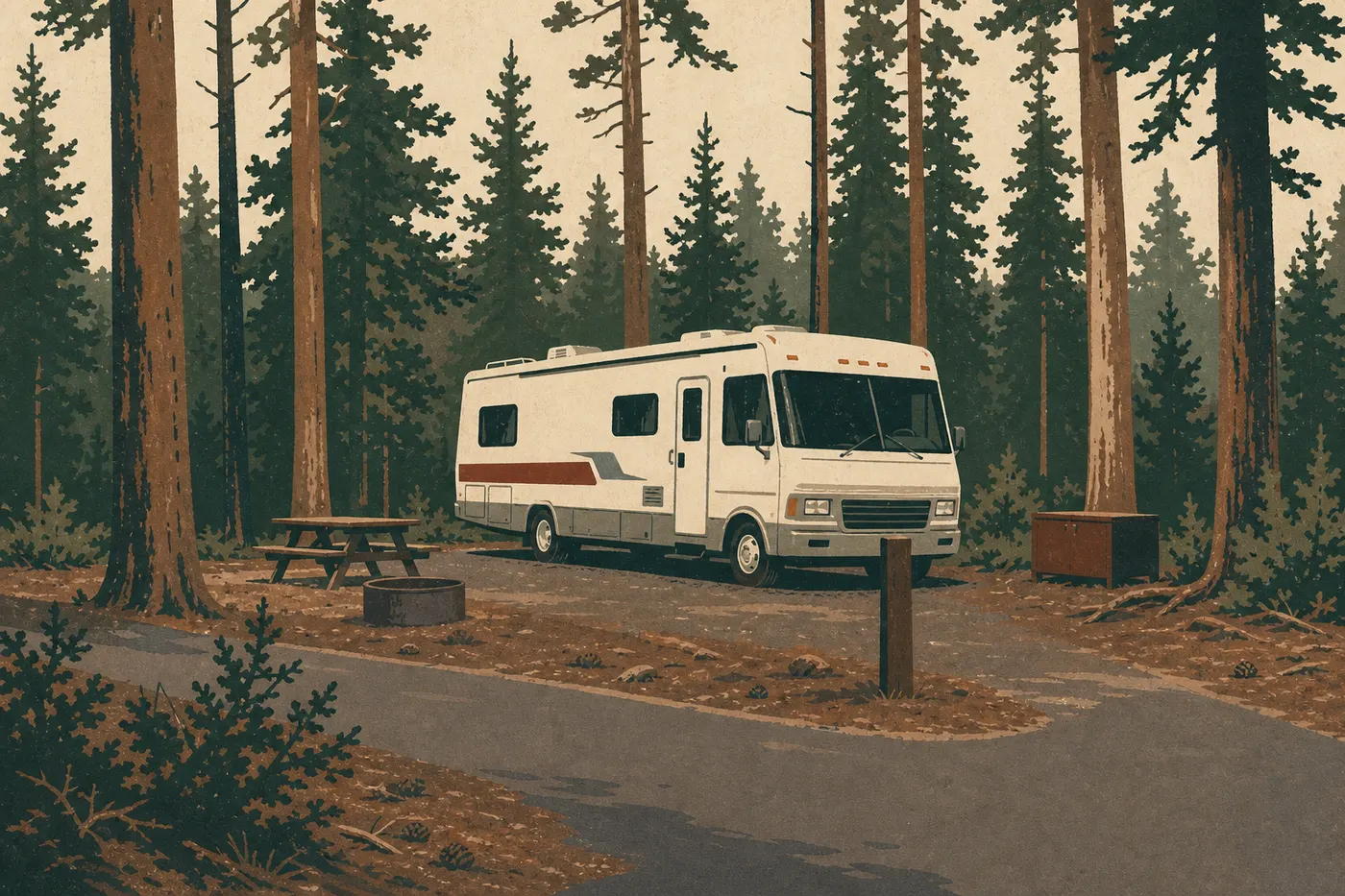
Mazama is the park's only campground that accommodates RVs. It's south of the caldera, about 3 miles from Rim Village, in a pine forest.
The campground has several hundred sites, some with electrical hookups. These sites have electricity only, with no water or sewer connection at the site. Sites without hookups work perfectly well for a self-contained two- or three-night stay.
Practical details:
- Open season: generally from late June through mid-October, depending on snow conditions.
- Reservations: through Recreation.gov, starting in early March for the summer season. July and August weekends sell out within hours of reservations opening, so don't wait.
- Rate: between $21 and $36 per night, depending on the site type, with or without a hookup. Check Recreation.gov for current rates, which are revised each season.
- On-site services: pay showers, restrooms, a grocery store, a gift shop, and a dump station.
When we visited in August, we chose a site without a hookup in the shade of the pines. The nighttime quiet is remarkable. At this elevation, temperatures often drop to 41 to 46°F even in midsummer, so bring sleeping bags suited to the conditions or extra blankets.
Lost Creek Campground
Lost Creek is a small campground on the eastern side of the park, reserved for tents. It isn't suitable for RVs or trailers. If you're traveling in a very small camper van, such as a short Sprinter, check directly with the campground. The sites are narrow and maneuvering is difficult. For a standard RV, Mazama is your only option inside the park.
Dispersed camping and areas around Crater Lake (boondocking)
Dispersed camping is strictly prohibited inside the national park outside designated areas. The national forests surrounding Crater Lake, however, offer good boondocking alternatives.
Fremont-Winema National Forest to the southeast and Umpqua National Forest to the north allow free overnight stays on forest roads, for up to 14 consecutive days in one location. These roads work for vans and mid-size RVs. If your vehicle is longer than 30 feet, stick to the main forest roads and avoid secondary routes.
These boondocking areas also make good bases for exploring the park's less-visited surroundings. For lodging options beyond camping, see lodges and places to stay near Crater Lake.
Dump stations, water, and services
Mazama Campground has a dump station available to campground guests. Potable water is available at the campground's faucets.
For boondocking stays or sites without services, the closest dump stations are in Klamath Falls, about 56 miles south, or Medford, about 75 miles southwest. Make sure you have enough water before entering the park. There are no fill-up stations outside Mazama.
Propane bottles aren't available in the park. Stock up in Klamath Falls or Medford before you arrive.
Which campground should you choose?
At Crater Lake, the choice is simple. There's only one campground in the park accessible to RVs. The real decision is between a site with a hookup and one without.
- Electrical hookup: ideal if you're traveling with family, need to recharge batteries or devices, or want to use the air conditioning. July afternoons can make the interior uncomfortably hot in the sun.
- No hookup: enough for two or three nights with a good solar panel and full tanks. The setting feels more like a forest, and these sites are often better shaded.
- Lake-view setup: the campground sits in a hollow in the forest. You won't see the lake from your site. For panoramic views, head up to Rim Village or drive Rim Drive first thing in the morning.
- Close to trails: Mazama is well located for reaching Cleetwood Cove Trail, the only access to the lakeshore, in about 20 minutes by car.
To choose the best time to visit, our guide to the best times to visit Crater Lake explains the advantages of each month based on weather and crowds.
Renting an RV to visit Crater Lake
Don't have a camper? Portland, about a 3.5- to 4-hour drive away, has the best selection of rental companies. Agencies there offer converted Class B vans, Class B Sprinters, and Class C motorhomes, which are roomier for families.
A few tips:
- Choose a van or Class B if this is your first RV road trip. They're much easier to handle on Rim Drive and in overlook parking areas than a large Class A.
- Book at least three months ahead for a July or August departure. Popular rental fleets, including RVShare, Outdoorsy, Escape Campervans, and Jucy, sell out by spring.
- Make sure the included mileage covers the round trip from Portland to Crater Lake, about 435 miles, plus driving within the park.
Medford, Oregon, also has local rental agencies for travelers flying in from the south.
RVs, pets, budget, and reservations: what to know
Pets: dogs are allowed at Mazama Campground but prohibited on the park's designated trails. They may stay leashed on paved roads. Bring something to keep them occupied at the campground while you hike.
Budget: plan on a $30 entrance fee per vehicle, valid for 7 days, plus $21 to $36 per night for camping, fuel, and supplies. If you're visiting several national parks in one year, the $80 America the Beautiful Pass pays for itself starting with the second park. For entrance fees and annual passes, the National Parks Fees and Passes page has the information you need.
Reservations: reservations for Mazama Campground generally open in March on Recreation.gov. July and August weekends sell out within hours. Watch for the opening date and be ready. During the week in mid-September, sites are often still available at short notice.
Elevation: at about 6,200 feet, some travelers feel slightly tired on their first day. Stay hydrated, and don't plan a long hike right after you arrive.
Our RV plan for Crater Lake
Enter from the west via Highway 62, settle into Mazama Campground, and book through Recreation.gov as soon as reservations open in March. The next morning, drive the full Rim Drive early. Set aside half a day for Cleetwood Cove and the descent to the lakeshore. Before you leave, use the dump station at Mazama. To go farther, spend the following night boondocking in Winema or Umpqua National Forest.
Frequently asked questions
Can you camp at Crater Lake in an RV?
Yes. You can camp at Crater Lake in an RV at Mazama Campground, the park's only campground that accommodates RVs. It offers sites with and without electrical hookups and is generally open from late June through mid-October.
Can you visit and drive around Crater Lake in an RV?
You can drive an RV around Crater Lake without size restrictions on the main roads. Rim Drive, the 33-mile road around the caldera, is manageable, but overlook parking areas are narrow. Leave early in the morning so you can maneuver without stress.
Can you park an RV anywhere at Crater Lake?
No. Overnight parking outside a designated campground is prohibited in the park. Along Rim Drive, the viewpoints have short parking areas that aren't well suited to large RVs. Plan to park at Mazama and visit the viewpoints in a smaller vehicle or on foot.
Where are RVs prohibited at Crater Lake?
RVs can't stay overnight outside Mazama Campground. Lost Creek Campground is reserved for tents. Dispersed camping is prohibited in the national park.
How much does an RV campsite cost at Crater Lake?
A site at Mazama Campground costs between $21 and $36 per night, depending on the type, with or without an electrical hookup. The park entrance fee is extra: $30 per vehicle, valid for 7 days.
What's the best time to visit Crater Lake by RV?
The best time to visit Crater Lake by RV is from July through mid-September. Before July, some roads and the campground may still be closed because of snow. After mid-October, most access routes to the caldera close. For month-by-month details, see our When to Go page.
How do you reserve an RV campsite at Crater Lake?
Reserve a site at Mazama Campground through Recreation.gov. Reservations generally open in early March. For a July or August weekend, be online when reservations open because sites sell out within hours.