
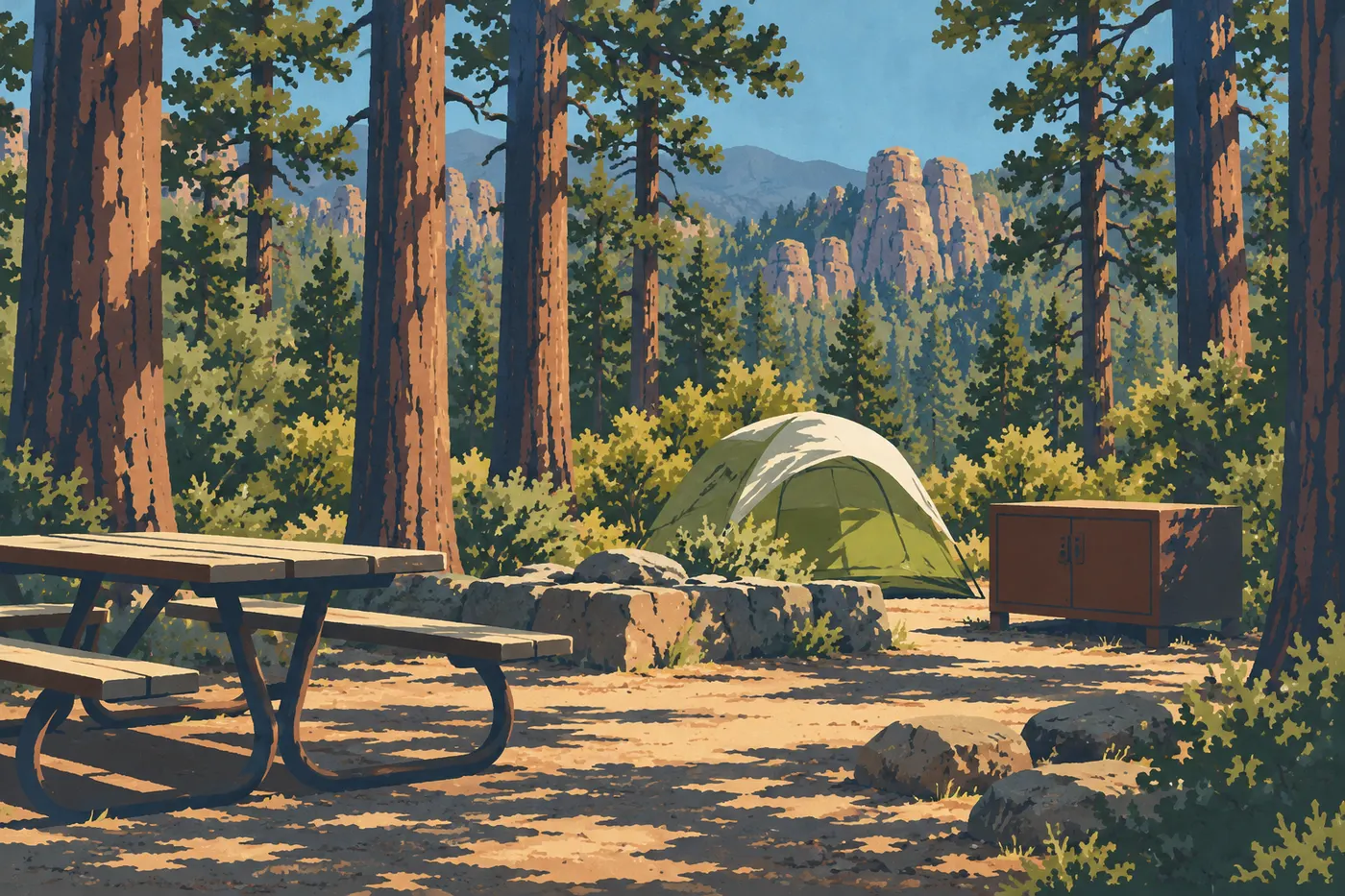
Camping at Chiricahua: Bonita Canyon Reservations, Fees and Rules
Chiricahua has just one campground, Bonita Canyon Campground, and you can't count on a spur-of-the-moment stay. All 23 sites are booked online, and none are first come, first served. A standard site costs $25 a night and the group site is $50. To see how camping fits into the rest of your visit, check out the complete guide to Chiricahua.
Chiricahua campgrounds by the numbers
1 official campgrounds inside the park, 23 campsites in total, 23 of them reservable.
| Campground | Sites | Booking | Fee / night | Open | Amenities |
|---|---|---|---|---|---|
| Bonita Canyon Campground | 23 (1 group) | Reservation | from $25 | Year round | toilets, potable water, bear lockers |
Source: National Park Service (NPS API), retrieved October 30, 2026. Fees and dates change: check the campground page before you go.
One Campground, and No Overnight Stays Anywhere Else in the Park
Sleeping in the park means sleeping at Bonita Canyon. Camping outside the campground, overnight parking, and sleeping in a vehicle in a parking lot are all prohibited. The road and trails stay open at night for sunrise, sunset and stargazing, though, and you don't have to sleep in the park to enjoy them.
Chiricahua doesn't issue backcountry camping permits, so Heart of Rocks and the Big Loop are day hikes. Our guide to hiking at Chiricahua covers distances, elevation gain and trailheads.
The national forest surrounding the park is managed by a different agency and has its own rules. Portal, on the far side of the range, isn't part of the park.
Sites and Amenities at Bonita Canyon Campground
The campground sits in lower Bonita Canyon. It has 23 sites in all, including one group site numbered 26. That number doesn't mean 26 spots, so ignore any older references to "25 sites" or first-come availability.
Standard, Group and Accessible Sites
- Standard site. Up to 8 people, 2 tents and 2 vehicles if space allows. A trailer counts as a vehicle. Read the listing for each site on Recreation.gov, since the maximum capacity says nothing about the actual size of the parking pad.
- Group site 26. Tents only, for 9 to 24 people and up to 5 regular vehicles. No one sleeps in a car, truck, trailer or RV there.
- Site 8. Accessible for visitors with limited mobility. Its electric hookup is reserved for medical or accessibility needs, so it isn't an ordinary electric RV site.
What the Campground Offers, and What It Doesn't
You'll find drinking water spigots, flush toilets with sinks, a table, an elevated grill and a tent pad. Food storage lockers are provided, sometimes shared among several sites, so don't count on having one all to yourself.
There are no showers, no recreational electrical hookups, no water or sewer connections, no dump station and no tank filling by hose. Cell service is spotty and the visitor center's Wi-Fi is slow, so save your confirmation and maps offline.
Booking, Arriving and Departing
Everything goes through Recreation.gov (campground ID 250901). Even a booking made on arrival requires a site that's still open online, which isn't easy with spotty cell service.
The NPS recommends booking a few weeks ahead, and up to three months ahead for holidays and the January to April period. That's planning advice, not the date reservations open. The Recreation.gov calendar shows the exact booking window and the maximum length of stay.
Check-in starts at noon, and checkout is before 11 a.m. If you'll arrive later than your first night, change your reservation online. It can be canceled after 24 hours with no arrival, and rangers can't hold the site for you.
Rates are the NPS rates, $25 a night for a standard site and $50 for the group site. The final amount appears at checkout. Park entry itself is free.
RVs and Vans, 24 Feet Up High and 29 Feet at the Campground
Don't mix up the two limits. At the campground, each unit (vehicle or trailer) can be no more than 29 feet long, accessories included, and the whole rig has to fit on the site's parking pad. A 29-foot vehicle isn't guaranteed to fit everywhere.
The road that climbs to the high country, past the campground, is limited to 24 feet, and trailers are prohibited. The 29-foot campground limit doesn't entitle you to drive up to Massai Point.
Our guide to RV camping at Chiricahua covers maneuvering and the backup plan. Generators are allowed only from 8 to 10 a.m. and 4 to 6 p.m., so plan your power needs accordingly.
Rules and Precautions at the Campground
Food. Store food, coolers, utensils, trash and pet food in the lockers provided. The NPS allows storage in a closed vehicle but warns of rodent damage, so use the metal lockers. Never leave food out, and don't feed animals or birds, feeders included. Our guide to Chiricahua wildlife explains which animals you're dealing with.
Fire. No ground fires and no wood gathering. You can use the elevated grill with fuel you bring yourself, but only if current restrictions allow it, so check them before you arrive.
Setup. Don't hang anything from the trees, whether hammocks, tarps, solar showers or dog leashes. Quiet hours run from 8 p.m. to 8 a.m.
Dogs. Keep dogs on a leash of 6 feet or less, and never leave them alone or tied up. Dogs are allowed at the campground and on the lower trails (Bonita Creek, Silver Spur, Faraway Ranch). They're prohibited on the high-country trails, even if carried. That includes Echo Canyon, Massai Point, Sugarloaf Mountain, Natural Bridge and Heart of Rocks. Line up another arrangement if you're set on a high-country hike.
Monsoon and cold. From June to September, up to half the sites may close when there's a flash flood risk. That doesn't happen every time, and it isn't a scheduled closure, so check the campground's status before you leave. Nights can be cold, and snow or ice is possible in winter. Our Chiricahua weather guide will help you decide which layers to pack.
Water. Fill your water bottles at the campground. There's no water at the Echo Canyon parking lot.
If the Campground Is Full
There's no other campground within the park boundaries. Your options are the hotels in Willcox, about 45 minutes away by car, or the neighboring national forest, which has its own regulations, so check with its managing agency before you pitch a tent. Our guide to where to stay around Chiricahua compares these options.
Frequently Asked Questions
Can you camp at Chiricahua?
Yes, but only at Bonita Canyon Campground, and only by reservation. Backcountry camping and camping outside the campground are prohibited in the park.
How many sites does Bonita Canyon Campground have?
It has 23 sites in all. The group site is numbered 26, but that number doesn't tell you how many spots there are.
Can you camp at Chiricahua without a reservation?
No. No site is first come, first served. Even a booking made on arrival requires a site that's open online on Recreation.gov.
How much does a night at the Chiricahua campground cost?
A standard site costs $25 a night and the group site costs $50. The final amount appears at checkout.
Can you sleep in your car at Chiricahua?
Only at a reserved standard site at Bonita Canyon, and only if your vehicle fits there. At the group site, no one sleeps in a vehicle, and sleeping in a car outside the campground is prohibited.
Can a 29-foot RV go to Massai Point?
No. The 29-foot figure is the campground limit, and it applies to each unit. The road to the high country is limited to 24 feet, with no trailers.
Where is the accessible site?
It's site 8, whose electric hookup is reserved for medical or accessibility needs.