

Things to Do in Chicago: Three Days Between Skyscrapers and Lake Michigan
Plan three days in Chicago with our picks for architecture, museums, and free walks, plus practical tips for adding a day at Indiana Dunes National Park.
By Jocelyn Pion · · 17 min read
From the river, the buildings draw your gaze upward; along Lake Michigan, the horizon suddenly seems endless. When deciding what to do in Chicago, we recommend making time for both perspectives. This Illinois city in the Midwest deserves three days without a car, combining free walks with paid attractions that match your interests. An extra day gives you time for Indiana Dunes, a national park where dunes and beaches take over from skyscrapers.
How Many Days Do You Need in Chicago, and How Should You Plan Your Visits?
Three days gives you time to explore downtown, spend time at a museum, and venture beyond the main attractions. We recommend booking just one main activity each day. That leaves room for meals, getting around, and changes in the weather.
| Day | Area | Priority | Adjustments for Kids |
|---|---|---|---|
| Day One | The Loop, Millennium Park, and the river | Architecture, the Bean, and an architecture cruise if available | Alternate walking with breaks in green spaces |
| Day Two | Your chosen museum and Lake Michigan | One main museum, followed by a walk | Shorten the visit to suit everyone's attention span |
| Day Three | A neighborhood, then back downtown | Pilsen or Wicker Park; optional observation deck | Swap the neighborhood for Lincoln Park if that works better |
With one day, stick to the Loop and the river. Walk from Millennium Park to the Riverwalk, then choose a cruise or an observation deck. Adding a major museum would mean giving up much of your walking time.
With two days, combine architecture and downtown on the first day, then a museum and the lake on the second. Skip the outlying neighborhood instead of crossing Chicago for a rushed stop. The Art Institute fits easily into a Loop-focused itinerary, provided you account for its closing day.
With four days, add Indiana Dunes if conditions are good for spending time outdoors. You could also use that day for a second museum or a more leisurely look around the neighborhoods.
Over a week, spread out the major museums. A morning spent looking at paintings could be followed by an afternoon with no reservations. Avoid scheduling several days entirely indoors if you also want to enjoy the lake.
These are our suggestions for a comfortable pace. Keep one half-day flexible so you can move a walk to a break in the clouds without rearranging the entire trip. Schedule visits with fixed hours or dates first, then fit walks around them.
Architecture and Skyline Views: A River Cruise or an Observation Deck?
To get a feel for Chicago, our first choice is a narrated architecture cruise. From the water, the differences between the buildings are easier to see. The commentary helps you understand the facades you'll later photograph from the bridges.
The Chicago Architecture Center tour aboard First Lady lasts 90 minutes. Other operators offer their own routes, so compare the duration, language, and boarding location. Check cancellation policies, too. Unpleasant weather does not necessarily mean a departure will be canceled.
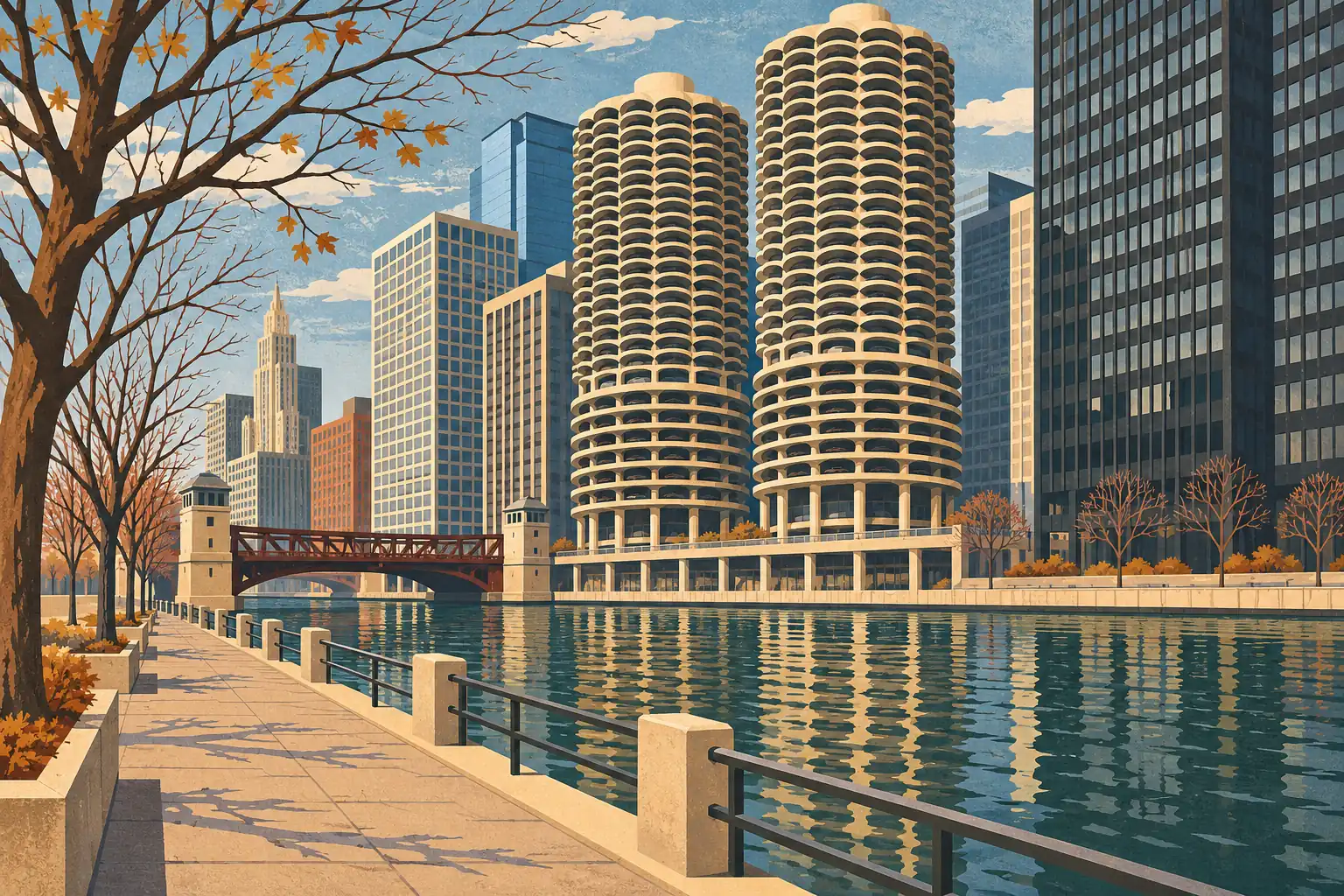
The Riverwalk is a free alternative for viewing the buildings from the waterfront. From there, head toward Michigan Avenue. The Wrigley Building, Tribune Tower, and Marina City's rounded forms are easy landmarks to recognize. You can include the Water Tower on a walk farther north.
| Experience | Appeal | What to Consider |
|---|---|---|
| Architecture cruise | Understand the buildings from the river | Weather, tour language, and departure schedule |
| Skydeck | Views from Willis Tower and The Ledge's glass balconies | Visibility and wait times for your time slot |
| 360 CHICAGO | Lake views from the Michigan Avenue area | Ticket conditions and the extra charge for TILT |
| Riverwalk | Admire the buildings for free at your own pace | No architectural commentary included |
Skydeck is on the 103rd floor of Willis Tower. Its glass balconies, The Ledge, let you look straight down through the floor. 360 CHICAGO is on the 94th floor of 875 North Michigan Avenue. TILT costs extra beyond general admission.
Choose just one observation deck on a short first visit. Pick Skydeck for The Ledge, or 360 CHICAGO for the lake views. In either case, visibility matters more than the prospect of a sunset.
Don't book a trip up just to fill an open slot. If the view doesn't particularly appeal to you, put that money toward a museum or a cruise. You'll already have plenty of opportunities to enjoy the skyscrapers from the street and the river.
Free Things to Do in Chicago: From the Bean to Lake Michigan
Start at Millennium Park. Cloud Gate, nicknamed the Bean, reflects people and buildings in its curved surface. Take time to walk all the way around it: the reflections change with your position.
Crown Fountain has a different feel, with its enormous portraits. Its water features operate seasonally. If you're traveling with kids, check that they're running before planning a stop to cool off.
Lurie Garden offers a green retreat. The Jay Pritzker Pavilion is also worth a detour for its metal structure. Admission to Millennium Park is free, but construction and events may affect access. Check the City of Chicago's Millennium Park information before your visit.
Continue to Grant Park if you feel like walking farther. There's no need to cover the entire park. With young children, it's better to save some energy for reaching the lake and spending time there.
The Lake Michigan shoreline is an attraction in its own right. Watch the boats, cyclists, and downtown skyline from the waterfront. Bring an extra layer: wind off the water can make a stop here less comfortable than a walk among the buildings.
The Riverwalk offers another stroll, right alongside the buildings. You can explore it in sections and return at a different time of day. Don't try to fit every walk into a single day.
Navy Pier is a good fit if you enjoy lively waterfront attractions. General access is free, but rides and other attractions may charge admission. We'd go for the atmosphere and lake views without spending on lots of extras.
Finally, Lincoln Park and its free-admission zoo offer an option north of downtown. Special activities and some services may cost extra. We'd make this a separate outing instead of adding it to an already packed day.
Which Chicago Museum Should You Choose?
In Chicago, choosing a museum also means choosing an area and a pace for your day. Buying a ticket doesn't mean you have to see every gallery. Set a few priorities before you go in, especially with kids.
| Interest | Best Museum Choice | What to Consider |
|---|---|---|
| Painting and art | Art Institute of Chicago | Tuesday closure and which collections to see |
| Dinosaurs and natural history | Field Museum | Check which exhibitions your ticket includes |
| Science and hands-on activities | Griffin Museum of Science and Industry | Allow for travel to Hyde Park and ticket add-ons |
| Aquatic life | Shedd Aquarium | Review ticket packages and time slots |
| Astronomy | Adler Planetarium | Distinguish exhibit admission from shows |
The Art Institute is our pick for painting enthusiasts. We suggest choosing a few collections instead of trying to see everything. The museum is closed on Tuesdays according to the schedule checked for November 2026. Check for additional closures before choosing your day, too.
The Field Museum is a good choice for anyone curious about natural history. SUE, the Tyrannosaurus rex skeleton, is in the Griffin Halls of Evolving Planet. Don't look for it in the main hall. The museum is part of Museum Campus, along with the Shedd Aquarium and Adler Planetarium.
The Griffin Museum of Science and Industry, in Hyde Park, requires a separate trip. Its U-505 submarine will appeal to history and technology enthusiasts. The exhibition surrounding the submarine and the tour inside it are separate experiences: going inside costs extra.
We don't recommend combining this museum with a long visit to Museum Campus on the same day. You'd spend part of your available time in transit and have less freedom to explore the exhibits.
Before paying, check reservation requirements, temporary exhibitions, and extra charges. Free admission offered to certain residents does not automatically apply to international travelers. Don't build your budget around a free day without reading the eligibility rules.
For children, start with the subject that interests them. Aquariums, dinosaurs, and science experiments appeal to different tastes. We'd favor a shorter visit they're excited about over a major museum chosen solely for its reputation.
Neighborhoods, Pizza, and Music: Beyond the Major Attractions
After downtown and the museums, set aside half a day for a neighborhood you have a specific reason to visit. A string of names on a map doesn't automatically make for an enjoyable walk.
Pilsen is a good choice for its murals and the National Museum of Mexican Art, which offers free general admission. The museum is closed on Mondays. Combine it with a walk around a few streets and a meal. The murals are part of a neighborhood where people live, so avoid blocking entrances while taking photos.
Wicker Park and Logan Square offer shops, cafes, and residential streets to explore. Choose one as your starting point. You can extend your walk if you have the interest and energy.
The 606, with the elevated Bloomingdale Trail as its main walking route, fits well with an outing in these areas. Identify where you'll enter and exit before setting out. You don't need to walk the entire route to enjoy it.
West Loop and Fulton Market are better suited to an evening built around dinner. Compare menus before settling in: a much-discussed restaurant won't necessarily fit your budget.
For food, try a deep-dish pizza, with its thick crust and generous filling, or a Chicago-style hot dog. Treat the pizza as a full meal. Ask how long it takes to prepare if you have tickets to a show afterward.
For the evening, follow your interests: blues, jazz, or improv. The Second City is best suited to visitors who are comfortable with spoken English and its cultural references. For any venue, check the minimum age, any drink minimums, and seating arrangements.
A Bulls game or a game at Wrigley Field could take the place of that evening out if the schedule works. Check for games during your travel dates before committing to the idea. Add any mandatory fees and the cost of getting back to the advertised ticket price.
Tickets and Passes: Where Should You Spend Your Money in Chicago?
Walks are the foundation of this itinerary: no admission ticket is needed to stroll along the Riverwalk, see the Bean, or enjoy accessible stretches of the lakefront. That lets you focus your initial spending on a museum and an architecture experience.
For observation decks and museums, check the price for your date and group. Rates may vary by time slot, age, and selected options. A starting price isn't enough to calculate the cost of a family outing.
To compare a sightseeing pass, start by listing the visits you would pay for individually. Adding an attraction just because it's included doesn't amount to a saving.
| Planned Activities | Buying Individual Tickets | Comparing a Pass |
|---|---|---|
| One museum and an architecture cruise | Add up the two tickets you want | Check that the exact cruise and museum are included |
| One museum, one observation deck, and an aquarium | Add up the three tickets with equivalent options | Compare a package that actually covers all three visits |
Compare equivalent experiences. A sightseeing cruise included in a package won't necessarily replace the architecture cruise you had chosen. Apply the same care to exhibitions and additional experiences.
The useful calculation is to take the total cost of individual tickets and subtract the pass price and any necessary extras. If the result is negative, the pass costs more for your itinerary.
Note the date you checked prices and each participant's age category. Compare final amounts including taxes and mandatory fees. Then check validity periods and reservation requirements: having a pass doesn't guarantee your preferred time slot.
For just two paid visits, we'd start with individual tickets before looking at packages. With more attractions, it's worth doing the math. Then include that amount as you plan your USA travel budget.
Set aside money for meals and transportation, too. Spending your entire available budget on admission leaves little room to enjoy a neighborhood or adjust plans on a rainy day.
Where Should You Stay, and How Can You Explore Chicago Without a Car?
The Loop is convenient for a first visit focused on Millennium Park, the Art Institute, and downtown architecture. Check the exact address, though: two hotels listed in the same area can differ greatly in convenience.
River North is another central base for reaching the river and restaurants. West Loop works well if dining and evenings out are a big part of your trip. None of these neighborhood names guarantees an inexpensive room.
Compare the full cost, including taxes, mandatory fees, breakfast, and cancellation terms. Also look at the route from the station to the hotel with luggage. A cheaper room may lose its appeal if it means making repeated transfers.
For sightseeing, combine walking and the CTA system. Elevated trains are part of the cityscape, but some routes run underground. A bus may work better than taking a roundabout train trip with a transfer.
From O'Hare, the Blue Line takes you downtown. Add the time needed to leave the airport and reach your hotel to the train ride itself. Check service before leaving, especially during construction.
Since January 5, 2026, the elevated State/Lake station has been closed for reconstruction. The CTA recommends nearby Clark/Lake or Washington/Wabash stations. This closure affects the elevated station, so be careful not to confuse different stops with similar names.
Ventra lets you manage transit fares. Compare individual fares and passes based on your actual trips, checking the rules for travel from the airport. An itinerary you can largely cover on foot doesn't automatically call for the longest-duration pass.
Plan your return trip before heading out for the evening. Check service and identify the route back to your lodging.
We recommend picking up a vehicle when you're ready to leave Chicago. When renting a car in the United States, focus here on the pickup location and the parking costs you'll avoid during your city stay.
When Should You Visit Chicago, and What Can You Do in Bad Weather?
We favor late spring and early fall for this mix of walking, lakefront time, and museums. Allow flexibility for rain and temperature changes. These preferences don't guarantee mild weather during your stay.
In summer, you can devote more time to walks. Carry water and plan breaks in the shade. An accessible beach doesn't mean swimming is allowed: follow the swimming season, lifeguard coverage, and posted instructions. As of November 2, 2026, the 2026 swimming season at city beaches has ended.
In winter, keep lakefront outings short. Wind can make a walk unpleasant even with suitable clothing. Alternate indoor visits with time outside instead of sticking to a summer itinerary.
In December, a museum can fill the middle of the day. Save walks for times when conditions feel comfortable to you. If you want to add a Christmas market, check the schedule for that year's event.
When it rains, move your museum visit and save the Riverwalk for a clear spell. In fog, postpone the observation deck if your ticket terms allow it. Avoid locking in all your nonchangeable reservations at the very start of planning.
Don't build your trip around a cruise, festival, or fireworks display without a confirmed schedule. A published 2026 program doesn't guarantee the same dates in 2027.
Indiana Dunes: Add a Day Outdoors from Chicago
Indiana Dunes deserves a separate day, with a simple goal: a beach and a walk, or a trail suited to your group. The national park has several distinct areas. They aren't all easy to reach from the same arrival point.
Distinguish between Indiana Dunes National Park and Indiana Dunes State Park. They charge separate entrance fees: a ticket for one doesn't automatically cover the other. Before planning a day at Indiana Dunes, choose the specific place you want to visit.
A car makes it easier to move between areas. For public transit, check South Shore Line service, then the remaining route to the trail or beach. A station named after an area doesn't mean you'll arrive right at the water.
The NPS lists several options for walking from train stations. Its transportation page does contain some older information, though, so confirm schedules and travel conditions with the operator before leaving.
Our page on getting to Indiana Dunes can help you plan those connections. For a first trip without a car, we'd choose one area instead of spreading the day across several locations.
Next, check the NPS visitor conditions and its entrance fee information. Check access, trails, and lake conditions for your chosen date.
With kids, plan a walk you can shorten and leave extra time for the return trip. Don't make swimming the deciding factor in whether the day is a success.
If Chicago is the start of a trip west, continue planning with the Route 66 itinerary.
Our Take: Three Days Without a Car, with Spending That Suits You
First trip as a couple. We recommend three days, with the architecture cruise as your first paid experience if it's operating during your visit. The Chicago Architecture Center's 90-minute tour provides context for exploring the buildings. An observation deck comes next, depending on your interest and visibility. We don't recommend automatically booking both.
With family. We'd choose just one major museum for a three-day itinerary. Keep the others as alternatives based on the children's interests and the weather. Breaks at the lake or in parks deserve space in the schedule. Account for the Art Institute's Tuesday closure if you choose that museum.
On a tight budget. We'd prioritize Millennium Park, the Riverwalk, and the lakefront before any paid attraction. Then add the visit that truly appeals to you. For one museum and one architecture experience, compare individual tickets first. We don't recommend packing your days just to justify buying a pass.
Adding time in nature. Add a fourth day for Indiana Dunes. We'd avoid squeezing Chicago into two days just to fit in the park. The trip requires choosing an area and planning how to get back.
For all these travelers, we'd leave the car out of the city stay. A conveniently located base, walking, and the CTA fit the itinerary we've suggested.
Frequently Asked Questions
What can you do in Chicago in one day?
With one day in Chicago, focus on the Loop, Millennium Park, and the Riverwalk. Add just one paid experience: an architecture cruise or an observation deck. We'd save the major museums for a longer stay.
What can you do for free in Chicago?
Free things to do in Chicago include Millennium Park, the Riverwalk, and walks along accessible stretches of the lakefront. Lincoln Park Zoo and the National Museum of Mexican Art also offer free general admission. Some special activities still cost extra.
Should you choose Skydeck or 360 CHICAGO?
The choice between Skydeck and 360 CHICAGO depends on the view you want. Skydeck draws visitors with The Ledge's glass balconies; 360 CHICAGO is a good choice for lake views. Check which options are included and prioritize good visibility.
Can you visit Chicago without a car?
A car-free visit works well for this three-day Chicago itinerary. Combine walking and CTA transit from conveniently located lodging. The Blue Line connects O'Hare to downtown, subject to construction and service conditions.
Which national park can you visit from Chicago?
Indiana Dunes is the national park we suggest adding to this Chicago trip. Set aside a separate day and choose your area before leaving. If you're using public transit, plan the connection between the station and your destination, as well as the return trip.