

Channel Islands National Park: The Complete Visitor Guide
Channel Islands is the national park closest to Los Angeles, yet it's one of the least visited in California. There's one simple reason: you can only reach it by boat. This group of five islands lies offshore from Ventura and Santa Barbara. There are no roads, bridges, or mainland shuttles. You board a boat, cross the Santa Barbara Channel, and step into a dry, windswept landscape that looks much like the California coast did before concrete took over.
The short answer. Plan on at least one day for a nearby island, such as Anacapa or Santa Cruz, with a crossing of about 1 hour. Allow two to four days if you want to visit several islands or camp overnight. The park is open 24 hours a day, and there's no standard entrance fee. Your real expense is the boat ride, which you should book in advance. Visitors come for coastal hiking, sea-kayaking through marine caves, and wildlife watching, including sea lions, dolphins, and seasonal whales.
Channel Islands at a glance: where the park is and how to get there
The park protects five of the eight islands in the California archipelago: Anacapa, Santa Cruz, Santa Rosa, San Miguel, and Santa Barbara. Don't confuse them with Catalina, the area's most touristy island, which isn't part of the national park.
Everything starts on the mainland at the Robert J. Lagomarsino Visitor Center in Ventura, which you can reach by car or public transportation. This is the logical starting point. You'll find the day's weather information, sea conditions, and trail maps there.
Then it's time to head for the islands. None is connected to the mainland. You can reach the park only on concessioner boats, by small plane to Santa Rosa, or in your own boat. Distances vary widely by island. Anacapa, the closest, is about 12 miles from the coast. San Miguel, the farthest, is more than 68 miles away, with a three-hour crossing and often rough seas. Planning ahead isn't just a convenience; it's essential. Departures are limited and fill up quickly in summer.
Entrance fees, boat trips, and reservations
Good news for your wallet. Channel Islands doesn't charge an entrance fee like Yosemite or Zion. That makes sense: there's no entrance booth when you arrive by sea.
The real cost is transportation. You book your boat trip through the park concessioner, and prices rise with the island's distance from the mainland. Anacapa and Santa Cruz are still the most affordable. Santa Rosa and San Miguel are farther away, cost more, and have fewer departures. If you plan to camp, you'll also need a camping permit, which must be reserved separately and in advance.
Book early, especially from May through September and on weekends. Boat spaces go quickly, and missing a departure can throw off a full day of your itinerary. For information on entrance fees and America the Beautiful passes, which are useful if you're visiting several parks, see the National Park Entrance Fees & Passes page.
Reservations, permits, and rules to follow
Camping
You can camp only at NPS campgrounds. Reservations are required through Recreation.gov. During the busy season, from April through October, sites fill up several weeks ahead. We recommend booking two to three months before your departure date.
All campgrounds are primitive. Most islands have no potable running water, electricity, or showers. Bring at least 4 liters of water per person per day, and bring all your food and supplies from the mainland.
Hiking and protected areas
You don't need a permit to hike marked trails. Some areas are strictly closed to the public, however, to protect nesting wildlife. These include the brown pelican colony on Anacapa and the sea lion and elephant seal colonies on San Miguel. Follow the boundary signs. Fines are enforced.
Key rules to know
- Pets: prohibited on every island, without exception.
- Fires: prohibited on every island.
- Trash: don't leave any trash behind, in keeping with Leave No Trace principles.
- Removing natural objects: don't pick, collect, or take anything, including shells and rocks.
- Drones: prohibited without special NPS authorization.
- Fishing: subject to California state regulations. A valid license is required.
Getting around Channel Islands: the crossing, the islands, and getting around on foot
Once you're on an island, forget about driving. There are no cars. You get around on foot, by kayak, or with fins. Each island is a small world of its own, with no stores, ATMs, or guaranteed drinking water, except at the water source at Scorpion Ranch on Santa Cruz. Bring everything you need, and take everything back with you.
In practice, the logistics depend on which island you choose. On Anacapa, you'll face a staircase of about 150 steps as soon as you land, leading to the plateau. On Santa Cruz, landing at Scorpion Anchorage gives you access to a larger trail network. On the remote islands, self-sufficiency is total, and the wind never seems to let up.
The key is to coordinate your plans with the boat's return schedule. Missing the last departure isn't an option on an island with no lodging.
How long do you need to visit Channel Islands?
The ideal length of a Channel Islands trip depends on what you want to do. For a first visit, one day on Anacapa or Santa Cruz is enough to get a feel for the park: cross in the morning, hike and have a picnic on the island, then return in the late afternoon.
For a deeper experience, plan on two to four days. One night of camping changes everything. You can enjoy the sunsets and the quiet after the boats leave, and you can explore an island more thoroughly. Nature lovers who want to cover several islands, including remote Santa Rosa and San Miguel, can reasonably plan on a week, weather constraints included.
To fit all of this into your California trip, our Channel Islands itinerary guide offers ready-to-use plans based on the time you have.
Plan your visit
What to see and do in Channel Islands
The heart of the visit is choosing your island. Each one has its own character, access challenges, and atmosphere. Here's how to decide.
Road trip journal · 5 areas
Anacapa, the gateway island
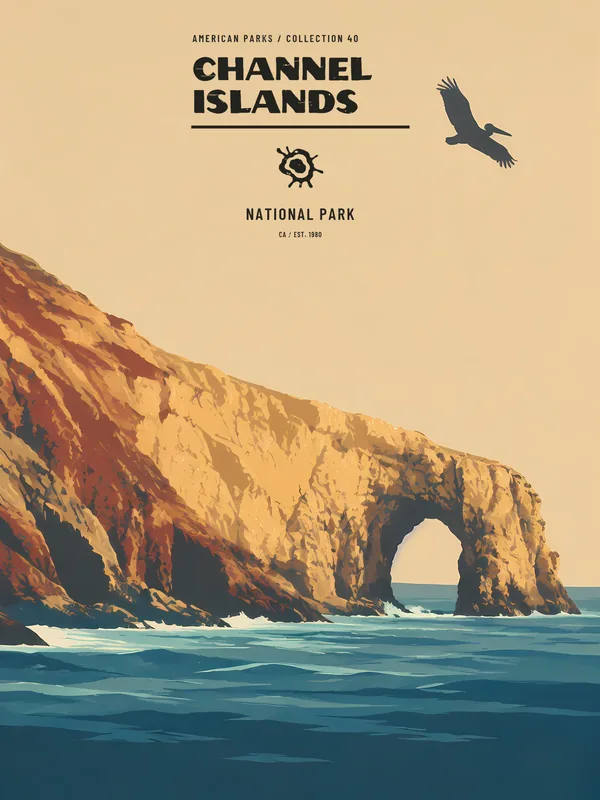
It's the closest and easiest island to reach, making it ideal for a first visit or a day trip. Anacapa is actually a chain of three islets. You climb a staircase cut into the cliff, then follow a loop trail to the lighthouse and views of Arch Rock, the park's most photographed landmark. In spring, giant coreopsis cover the plateau in yellow. It's also a major seabird colony.
Santa Cruz, the most complete experience
The park's largest island is the best choice if you want variety. The Scorpion Anchorage area offers several trails, beaches for kayaking, and direct access to Painted Cave, one of the world's largest sea caves. Explore it by kayak with a guide. If you visit only one island, this is often the one to choose.
Santa Rosa, for hikers
The second-largest island is wilder, with long windswept beaches, canyons, and a rare grove of Torrey pines. Getting there requires a longer crossing or a small-plane flight, and the wind sometimes makes camping difficult. This island is for self-sufficient hikers and anyone who enjoys solitude.
San Miguel, the farthest frontier
It's the farthest, most exposed, and most demanding island. Its beaches host one of the largest pinniped gatherings on the West Coast, with thousands of sea lions and elephant seals at Point Bennett. Access is irregular, depends on the weather, and is sometimes restricted. It's best for experienced visitors who can stay flexible with their dates.
Santa Barbara, a miniature wilderness
The park's smallest island lies isolated to the south. Low vegetation covers its landscape, while seabirds and sea lions fill its cliffs. There are few departures and few visitors, creating a truly remote atmosphere.
Explore the park
The best hikes in Channel Islands
Hiking is the most natural way to explore the park, since there's no other way to get around. Trails range from Anacapa's short scenic loop to the long, exposed routes on Santa Rosa and San Miguel. On Santa Cruz, Cavern Point Trail and the climb to Potato Harbor offer sweeping views over turquoise water without any technical difficulty.
Here's one piece of field advice. Wind and a complete lack of shade can turn an easy hike into an ordeal if you're poorly equipped. Water, a hat, sunscreen, and a windbreaker are nonnegotiable. Our Hiking page has the full itinerary details, including distances and difficulty levels.
The detailed guide Best Hikes in Channel Islands National Park (Difficulty & Access) The best Channel Islands hikes by island and difficulty, with trail details,… Read the guide →Wildlife and plants to see
This is one of the main reasons to come. The archipelago's isolation has produced unique species, earning Channel Islands the nickname “California's Galápagos.” The local star is the island fox, no bigger than a cat. It's curious and lives on several islands after coming close to extinction.
At sea, the show never stops. Sea lions and harbor seals gather on the beaches, seabirds nest in the cliffs, and dolphins often swim alongside the boats. Gray whales pass through from December to April, followed by blue and humpback whales in summer. The crossing itself becomes a marine safari. Our Wildlife page explains where to look and when.
The detailed guide Channel Islands Wildlife: What You'll See and Where to Find It Island foxes, sea lions, elephant seals, and blue whales Read the guide →When to visit Channel Islands
The climate is mild and Mediterranean year-round, with highs around 64°F and lows near 52°F. On paper, there's no bad season, but a few differences matter.
Spring, from April through June, is our favorite time. The islands are green, wildflowers bloom, and seabirds are nesting. Summer brings the best underwater visibility for diving and snorkeling, but also more visitors and afternoon wind. Fall stays quiet and mild. Winter is wetter and coincides with the beginning of gray whale season. Keep in mind that sea and weather conditions can change from one day to the next and from one island to another, which can cancel a crossing.
To choose a specific month, see our more detailed When to Go and Weather pages, which cover water temperatures and sea conditions.
The detailed guide When to Visit Channel Islands: Best Times, Weather, and Seasons The best time to visit Channel Islands is September and October, with calm seas… Read the guide →Where to stay in Channel Islands
On the islands, there's only one option: camping. Each park island has a primitive campground with tables, pit toilets, and sometimes a water source at Scorpion Ranch on Santa Cruz. There is no electricity or food resupply. A permit is required and must be reserved in advance. It's a memorable experience for anyone willing to be completely self-sufficient in the wind.
For a bed and a shower, stay on the mainland in Ventura, Oxnard, or Santa Barbara before or after your boat trip. Our complete comparison of lodging options is in the Where to Stay guide, with separate pages for Hotels & Lodges, Camping, and RVs for van travelers.
Stay in the park
Around Channel Islands: things to do nearby
A Channel Islands trip pairs well with California's Central Coast. Ventura and Santa Barbara are worth a stop for their waterfronts, restaurants, and historic mission. Farther north, the scenic highway continues toward Santa Barbara and Solvang. Farther south, Los Angeles is a little over an hour away.
Many travelers include the park in a longer Pacific Coast road trip between Big Sur and San Diego. To build that itinerary, our Road Trips pages and Regions will give you useful planning points.
Our take: is Channel Islands worth the trip?
Yes, as long as you know what you're looking for. Channel Islands isn't a park of roadside viewpoints with a coffee shop at the top. It's a park that demands effort and rewards you with a change of scenery. You earn the landscape with a boat ride, your legs, and a paddle. In return, you get a nearly deserted, wild version of California, just an hour by boat from one of the country's most urbanized regions.
Our advice is to aim for Santa Cruz or Anacapa on a calm spring day if this is your first visit. You'll quickly know whether the archipelago is calling you back to camp. Before you leave, take one last look at our Practical Information, Rules & Safety page so you're prepared for the sea, wind, water and food needs, and the park's self-sufficient conditions.
Frequently asked questions
Is April a good time to visit Channel Islands?
April is an excellent time to visit Channel Islands. It's the heart of spring: the islands are green and covered in flowers, seabirds are nesting, and you may still see gray whales. The sea can still be unpredictable, so keep your crossing dates flexible. Our When to Go page breaks things down month by month.
Which island lies off the California coast?
Several islands lie off the California coast. They're the islands of the Channel Islands archipelago, offshore from Ventura and Santa Barbara. The national park protects five of them, Anacapa, Santa Cruz, Santa Rosa, San Miguel, and Santa Barbara. Catalina, farther south and more touristy, isn't part of the park.
What is Channel Islands known for?
Channel Islands is known for its isolated, protected landscapes, nicknamed “California's Galápagos” because of unique species such as the island fox. Visitors come for coastal hiking, sea-kayaking through marine caves, and sea lion, dolphin, and whale watching in a park that's accessible only by boat and therefore sees relatively few visitors.
Do you have to pay an entrance fee at Channel Islands?
There is no entrance fee at Channel Islands. The park doesn't charge for access the way mainland parks do. The main expense is the boat trip, which you should reserve in advance, plus a permit if you're camping. For entrance fees and annual passes, see the National Park Entrance Fees & Passes page.
How long do you need to visit Channel Islands?
Plan on one day to discover a nearby island such as Anacapa or Santa Cruz, and two to four days to camp or visit several islands. A week gives you time to include the remote islands of Santa Rosa and San Miguel. Our detailed plans are on the Itinerary & Timing page.
The American Parks shop
Bring Channel Islands home
Our park-inspired creations, made to order and shipped to your door.
Latest park news
- Channel Islands: Restoring Santa Rosa Island's Torrey PinesAfter the May 2026 fire, the National Park Service is protecting and replanting Santa Rosa Island's Torrey pines as the first new needles push out on burned trees.
- Channel Islands: Santa Rosa Reopens for Day Trips After the WildfireSanta Rosa Island is open again for day visits, but the burned areas and their campground stay closed through September 15.