
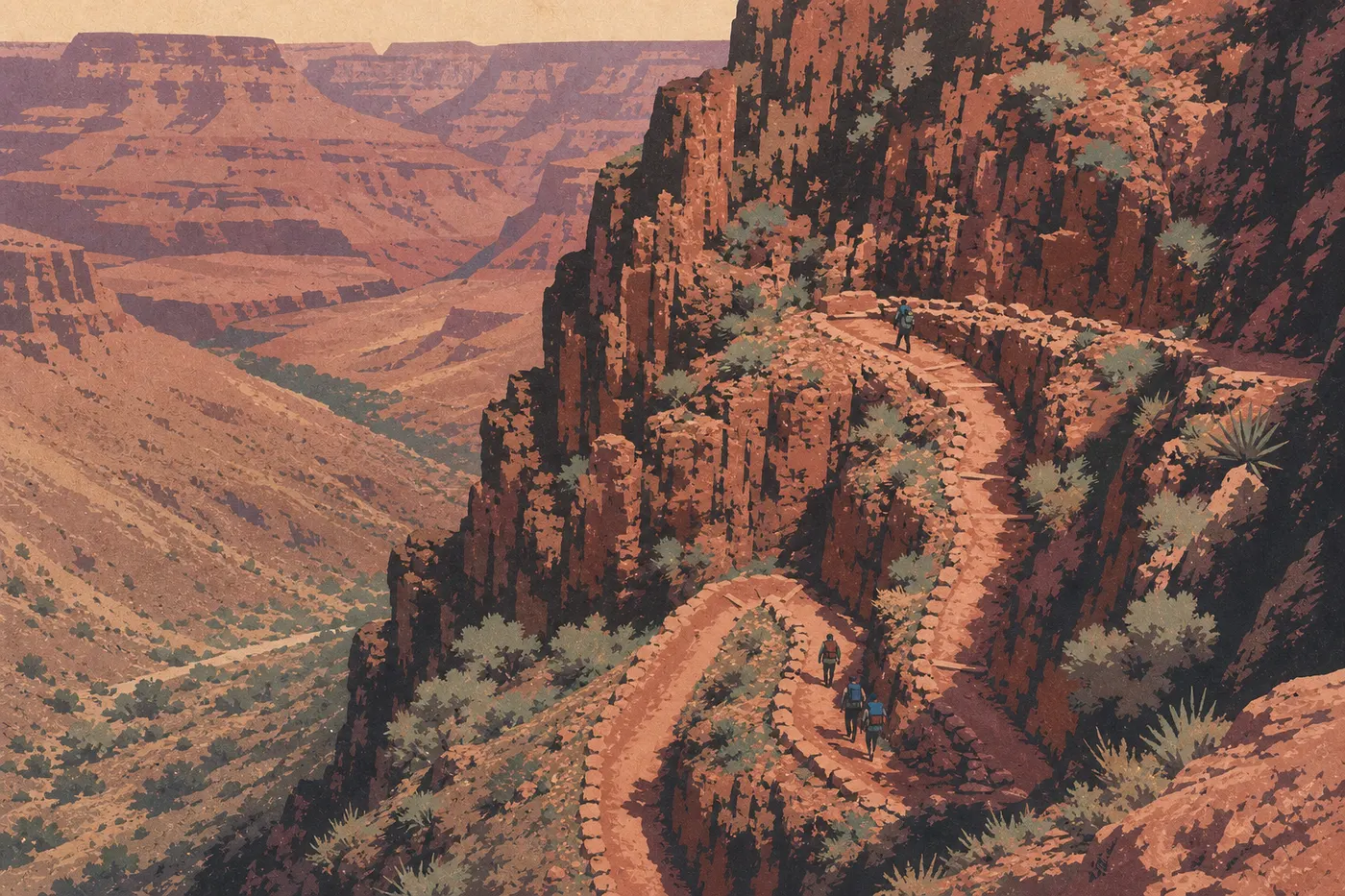
Grand Canyon Hiking: The Best Trails for Every Skill Level
At Grand Canyon, the trails don't skirt the scenery. They plunge into it. The pattern is always the same from the South or North Rim: you go down, the heat rises, the colors change, and you have to climb back out on those same legs. That's both the park's appeal and its trap.
If you only do one hike, make it the Bright Angel Trail from the South Rim. For a half-day, the 1.5-Mile Resthouse round-trip is enough (3.0 miles round-trip, 1,090 feet of elevation gain). You'll cross the canyon's first red sandstone layers and get back before the heat sets in. For a full day, Havasupai Gardens (about 9.3 miles round-trip, 3,060 feet of elevation gain) offers year-round water, shade beneath Fremont cottonwoods, and a view of the canyon from the bottom.
Two easy alternatives are the South Kaibab Trail (wider views, no shade or water, ideal for a short outing) and the Rim Trail (13 miles along the rim, flat, and accessible to everyone).
How to Prepare for a Grand Canyon Hike
You don't need a permit for a day hike, whether you're on a rim trail or heading down into the canyon. Any overnight stay below the rim, however, requires a wilderness permit ($10 application fee plus $8 per person per night). Reserve it through the Backcountry Information Center up to four months in advance.
The classic mistake is going too far, too fast. Summer temperatures at the bottom of the canyon climb above 104°F, which is 36 to 54°F hotter than on the South Rim. The NPS repeats it on all its signs: never go farther down than you plan to climb back up. If you're sweating on the way down, you'll be exhausted on the way back up.
Bring at least 1 liter of water for every hour of hiking in summer conditions. Fountains are available seasonally at the 1.5-Mile Resthouse and 3-Mile Resthouse on the Bright Angel Trail, and year-round at Havasupai Gardens. The South Kaibab Trail has no water sources, so carry everything from the start.
Safety and wildlife: Albert's squirrels on the South Rim and Kaibab squirrels on the North Rim beg for food near the trails. Don't feed them. Their bites can transmit diseases. California condors, reintroduced in 1996, regularly soar above the South Rim ridges.
Dogs are allowed only on the Rim Trail and in developed areas above the rim, and they must stay leashed. They're prohibited on every trail that descends below the canyon rim.
Spring (April–May) and fall (mid-September through October) are the ideal windows for descending into the canyon. Summer hiking is possible only at dawn. Our guide When to Visit Grand Canyon explains conditions month by month for each area.
The Best Grand Canyon Hikes, Area by Area
The South Rim has nearly all of the trails that are accessible year-round. The North Rim, higher at 8,400 feet and more remote, is open only from mid-May to mid-October.
South Rim: Trails Down Into the Canyon
Bright Angel Trail Route: round-trip · Distance: 3.0 miles (1.5-Mile Resthouse) / 6.0 miles (3-Mile Resthouse) / about 9.3 miles (Havasupai Gardens) · Elevation gain: 1,090 feet / 2,110 feet / 3,060 feet · Time: 2 to 6 hours depending on your destination · Difficulty: moderate to strenuous · Start: Grand Canyon Village, west of Bright Angel Lodge
This is the park's busiest trail, and it has earned that status. It descends in steady switchbacks through the canyon's geological layers, with two resthouses equipped with toilets and seasonal fountains. When we visited in May, families with children reached the first resthouse without trouble, while better-equipped hikers continued toward Havasupai Gardens.
Havasupai Gardens, formerly Indian Garden, is a good goal for hikers in good physical condition, as long as you start before 7 a.m. in summer and keep an eye on the return trip. The canyon bottom and the Colorado River are accessible from this trail (about 18.6 miles round-trip, 4,460 feet of elevation gain), but only with a wilderness permit or for guests staying at Bright Angel Campground.
South Kaibab Trail Route: round-trip · Distance: 1.8 miles (Ooh Aah Point) / 3.0 miles (Cedar Ridge) / 6.4 miles (Skeleton Point) · Elevation gain: 600 feet / 1,100 feet / 2,040 feet · Time: 1 to 4 hours depending on your destination · Difficulty: easy to strenuous · Start: South Kaibab Trailhead (shuttle only, no private vehicle parking)
South Kaibab doesn't give an inch: no shade, no water, and narrow ridges with 360-degree views. What it offers that Bright Angel can't match is total exposure to the landscape from the first few minutes. Ooh Aah Point (1.8 miles round-trip) is our pick for a short morning outing. The colors at sunrise are striking. Cedar Ridge (3.0 miles round-trip) is the right compromise for one to two hours of hiking and a real feeling of being inside the canyon.
Skeleton Point (6.4 miles round-trip) offers the first view of the Colorado River from this side. Save it for experienced hikers, cool weather, and at least 3 liters of water.
South Rim: Along the Rim
Rim Trail Route: one-way (shuttle back) · Distance: up to 13 miles from South Kaibab Trailhead to Hermit's Rest · Elevation gain: nearly none · Difficulty: very easy · Start: any shuttle stop on the South Rim
The Rim Trail follows the canyon edge along the entire length of the South Rim's visitor area. The surface is paved or compacted for nearly the whole route, with sections accessible to wheelchairs. Must-see viewpoints along the way include Mather Point, Yavapai Point, and Pima Point near Hermit's Rest. It's also the only trail in the park where dogs are allowed.
North Rim: Elevation, Forest, and Solitude
The North Rim opens every year around May 15. At 8,400 feet, surrounded by firs and spruce, it receives about one-tenth as many visitors as the South Rim.
Bright Angel Point Trail Route: round-trip · Distance: 0.5 miles · Elevation gain: minimal · Time: 20 to 30 minutes · Start: Grand Canyon Lodge (North Rim)
A paved trail leads from the lodge to a promontory suspended above the canyon, with a sweeping view of both arms of the Transept and the South Rim in the distance. It's ideal when you arrive or at the end of the day.
North Kaibab Trail Route: round-trip · Distance: 1.4 miles (Coconino Overlook) / 4.0 miles (Supai Tunnel) / about 9.3 miles (Roaring Springs) · Elevation gain: 420 feet / 1,390 feet / 3,160 feet · Time: 1 to 6 hours · Difficulty: easy to strenuous · Start: North Kaibab Trailhead (a morning shuttle from the lodge is recommended)
This is the only official trail that descends into the canyon from the North Rim. Roaring Springs (9.3 miles round-trip, 3,160 feet) is a full, strenuous day. At the end, a natural spring bursts noisily from the cliff. Supai Tunnel (4.0 miles round-trip) is a good morning destination for hikers in good physical condition. The entire North Kaibab connects with the Bright Angel Trail at the bottom of the canyon. This junction is part of the Rim to Rim, about 22 miles, usually completed in 2 to 3 days with a wilderness permit.
Easy and Family-Friendly Hikes
For families with young children or hikers without experience with elevation gain, three options work well:
The Rim Trail between Mather Point and Yavapai Point (about 1.2 miles) connects two major viewpoints, with no elevation gain and a shuttle ride back. It's also the only option if you're bringing a dog.
The Bright Angel Trail to the 1.5-Mile Resthouse (3.0 miles round-trip, 1,090 feet) works for kids as young as 8 who are in good physical condition. Start before 8 a.m. in summer and bring enough water. With children, follow this safety rule: turn around while they're still feeling strong, not once they're exhausted.
The Bright Angel Point Trail (North Rim, 0.5 miles round-trip) is different. There's no technical difficulty, it starts at the lodge, and it offers an immediate, spectacular view of the canyon.
Strenuous Day Hikes
For hikers used to long outings with substantial elevation gain, two demanding day hikes stand out:
Bright Angel Trail to Havasupai Gardens (9.3 miles round-trip, 3,060 feet) is the classic full-day hike on the South Rim. Start before 6 a.m. in summer and before 7 a.m. in spring. Carry at least 3 liters of water and refill at the seasonal fountains. The valley bottom, with its spring and cottonwoods, is an unexpected visual reward in this landscape of stone.
South Kaibab to Skeleton Point (6.4 miles round-trip, 2,040 feet, no water): bring at least 4 liters and start very early. The views of Bright Angel Canyon and the Colorado River from Skeleton Point make the effort worthwhile. Avoid this trail between 10 a.m. and 4 p.m. in summer.
For multi-day trips with an overnight stay below the rim, you need a wilderness permit. Reserve it through the Backcountry Information Center up to four months in advance. The Rim to Rim (South Kaibab plus North Kaibab, about 22 miles) is the park's signature undertaking, usually completed in 3 days with a night at Bright Angel Campground.
Access, Trailheads, and Parking
South Rim parking fills up by 8 a.m. during the busy season, from March through October. The practical solution is to park at Visitor Center Plaza, where there's a large free lot, and use the park's free shuttles.
Three routes serve the main trailheads:
- Orange Route (Kaibab/Rim Route): serves South Kaibab Trailhead. Private vehicles aren't allowed on this section.
- Red Route (Hermit Road): serves Hermit's Rest and the western viewpoints from March through November. Private cars are prohibited during this period.
- Blue Route (Village Route): serves Grand Canyon Village and the Bright Angel Trailhead.
At the North Rim, parking is available at Grand Canyon Lodge. A paid shuttle connects the lodge with North Kaibab Trailhead early in the morning. It's recommended so you don't have to walk 1.2 miles along the road before you even start hiking.
For shuttles and traffic in the park, see the Getting Around Grand Canyon guide.
When to Hike in Grand Canyon
The short version is spring (April–May) and fall (September–October) for any descent into the canyon. Summer hiking is possible only at dawn because temperatures at the bottom climb above 104°F. Winter hiking is possible on the South Rim, though trails can be snowy or icy and microspikes are recommended. The North Rim is closed from mid-October to mid-May.
Our Grand Canyon seasonal guide covers conditions month by month, including temperatures by area and the busiest periods.
Which Hike Should You Choose?
| Hiker profile | Our recommendation |
|---|---|
| First visit, limited time | Rim Trail (0.6–1.2 miles) + Mather Point at sunrise |
| Half-day, want to descend | South Kaibab to Cedar Ridge (3.0 miles round-trip) |
| Full day, good fitness | Bright Angel to Havasupai Gardens (9.3 miles round-trip) |
| Family with children | Bright Angel to the 1.5-Mile Resthouse (3.0 miles round-trip, early morning) |
| Views and photography | South Kaibab (wide-open views, clear light) |
| Wildlife viewing (condors) | Rim Trail near the South Rim viewpoints |
| Multi-day project | Rim to Rim (South Kaibab plus North Kaibab, about 22 miles, 2–3 days) |
| North Rim, forest setting | North Kaibab to Roaring Springs (9.3 miles round-trip) |
For the whole park, lodging, access from major cities, and budget, our Grand Canyon guide has everything covered.
Frequently Asked Questions
What's the best hike in Grand Canyon?
The best Grand Canyon hike depends on your fitness level. For a full day if you're in good physical condition, Bright Angel Trail to Havasupai Gardens (about 9.3 miles round-trip, 3,060 feet of elevation gain) offers the most complete experience: geological layers, water, shade, and a view of the canyon from below. For pure panoramas, South Kaibab to Ooh Aah Point or Cedar Ridge has no equal.
What's the most famous hike in Grand Canyon?
The most famous hike in Grand Canyon is Bright Angel Trail. It starts in Grand Canyon Village on the South Rim and descends to the Colorado River past two equipped resthouses. Millions of visitors hike it every year, and it remains the classic first descent into the canyon.
How much elevation does Grand Canyon have?
The elevation difference between the North Rim, at 8,400 feet, and the Colorado River, at about 2,490 feet, is roughly 5,900 feet. Trails descending from the South Rim to the river involve between 4,460 feet of elevation gain on Bright Angel and 4,760 feet on South Kaibab on the return. That climb, often in the heat, is what makes these hikes strenuous.
How long does it take to hike in Grand Canyon?
For a day hike on Bright Angel Trail to Havasupai Gardens, plan on 6 to 8 hours. For the Rim to Rim from the South Rim to the North Rim, about 22 miles, plan 2 to 3 days with an overnight stay at the bottom of the canyon and a wilderness permit. Don't attempt to descend to the Colorado River and climb back out in one day without serious preparation.
Is hiking in Grand Canyon difficult?
Grand Canyon hikes are demanding mainly because of the reverse elevation profile: you go down first, which feels easy, then climb back up exhausted. Summer heat at the bottom makes the fatigue worse. The rim trails, including Rim Trail, are easy and accessible to everyone. Descents into the canyon range from moderate to strenuous depending on the destination and season.
Are there easy hikes in Grand Canyon?
Yes. Rim Trail on the South Rim is completely flat, partially wheelchair accessible, and manageable for anyone without special fitness. Bright Angel Trail to the 1.5-Mile Resthouse (3.0 miles round-trip, 1,090 feet) works for kids 8 and older when you start early. Bright Angel Point Trail on the North Rim, 0.5 miles round-trip, is ideal for a first look without a strenuous effort.
Can you hike with a dog in Grand Canyon?
Dogs are allowed on Rim Trail and in developed areas of the South Rim, and they must stay leashed at all times. They're prohibited on every trail that descends below the canyon rim, including Bright Angel, South Kaibab, North Kaibab, Hermit Trail, and all trails at the canyon bottom.
Do you need a permit to hike in Grand Canyon?
You don't need a permit for day hikes, whether you're on a rim trail or descending into the canyon. An overnight stay below the rim requires a wilderness permit. Permits are limited and must be reserved in advance, up to four months before your desired date, through the park's Backcountry Information Center. The cost is a $10 application fee plus $8 per person per night.
Are there loop hikes in Grand Canyon?
Classic loop hikes don't exist on the canyon's main trails. Bright Angel and South Kaibab are out-and-back routes. You can, however, descend via South Kaibab and climb back out via Bright Angel, or the reverse, using the canyon-bottom trail, which technically creates a loop. This route requires at least one night at Bright Angel Campground and therefore a wilderness permit.