
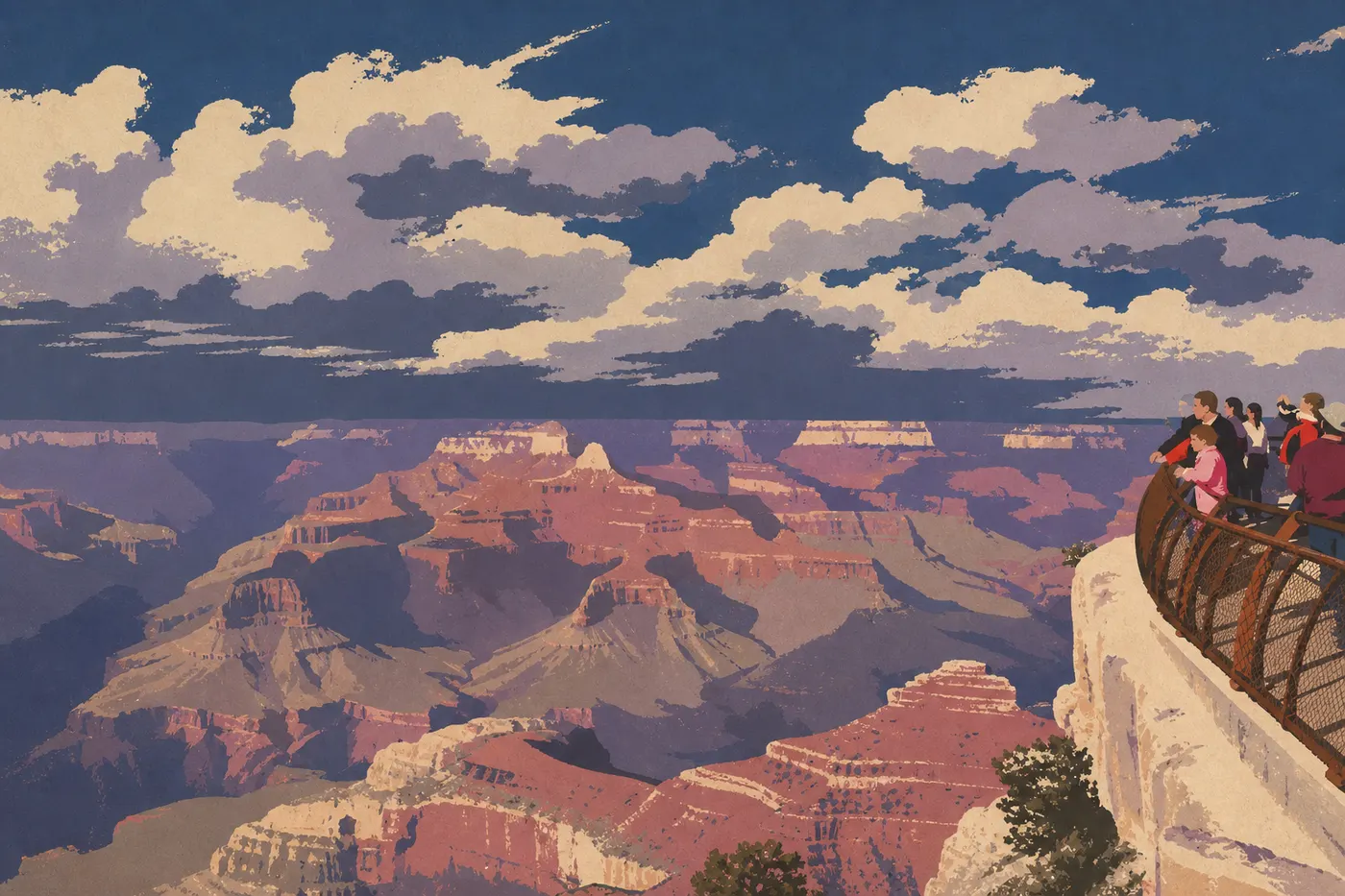
Grand Canyon with Kids: What to Do and How to Plan Your Visit
The Grand Canyon works well for families with kids as young as 5 or 6 on a South Rim visit, which is accessible and well equipped. With younger children, stick to the viewpoints and Rim Trail. With teens, the park opens up in full.
For an overview of the park before diving into the family details, our Grand Canyon guide is the best place to start.
Why Visit the Grand Canyon with Kids
The Grand Canyon leaves a mark. Not in the way an amusement park does, and that's exactly what makes it such a formative destination. Showing a child a canyon 280 miles long, 19 miles wide, and 5,250 feet deep, carved by a river over millions of years, gives them a lesson in geology and humility that no school textbook can replace.
Here's what works in practice with kids:
- Instant panoramas. From the Mather Point parking lot, the view is a two-minute walk away. You don't have to hike for three hours to be blown away.
- A manageable stretch of rim. The South Rim Visitor Area packs viewpoints, free shuttles, the Visitor Center, and restaurants into a few miles.
- The Junior Ranger program, a real source of motivation for kids ages 5 to 12.
- Geology you can read with your eyes. Red, orange, tan, and gray layers follow one another like an open book. You can explain Earth's history visually, without a lecture.
This isn't a park that's been designed entirely for kids. The edges are steep, the heat can be extreme, and distances are deceptive. But with the right preparation, it's a trip your family will remember.
Is the Grand Canyon Kid-Friendly? What Age Is Best?
Yes, the Grand Canyon works well for families, as long as you visit the South Rim and don't hike down into the canyon with young children.
By age group:
- Under 3. A visit is still possible, limited to the viewpoints and the Rim Trail with a stroller, since much of the surface is stroller-friendly. Kids won't remember any of it. This is mostly for the parents.
- Ages 3 to 5. Kids start to respond to the spectacle. Stay on the rim. Guardrails protect the main overlooks, but steep edges are everywhere else. Stick to short, flat trails.
- Ages 5 to 12. This is the ideal age for the Junior Ranger program. The geology starts to make sense, and the memories stick. A few accessible trails, described below, let kids really take part.
- Ages 12 and up. You can start down the first few miles of the Bright Angel Trail or South Kaibab Trail, carrying plenty of water and setting a turnaround point before fatigue sets in.
The North Rim, 227 miles from the South Rim by road, offers a wilder atmosphere at an elevation of 8,400 feet. It's closed from mid-October to mid-May and has far fewer facilities, so it's better suited to families with older kids who are comfortable hiking.
When to Visit as a Family: The Easiest Season with Kids
For families, spring (April and May) and fall (September and October) are the most comfortable windows. Temperatures on the rim range from 59 to 77°F, crowds are lighter, and the trails don't turn into a furnace.
Summer (June through August): the South Rim averages around 81°F, which is manageable along the rim. At the bottom of the canyon, temperatures regularly top 104°F. With kids, don't hike down in the middle of the day. Crowds are at their peak, with waits of up to two hours at the South Entrance between 9:30 a.m. and 4 p.m.
Winter (December through February): the South Rim stays open year-round. Cold and possible snow add a distinctive atmosphere, and crowds drop sharply. That's a real advantage for flexible families who can avoid the usual school breaks.
Season-by-season details, including weather on each rim and what to wear, are in the Grand Canyon weather guide and the guide to the best time to visit.
How Many Days to Plan for a Family Visit
Plan on at least two full days on the South Rim. One day is enough to see the main viewpoints, but with kids, you need to allow for frequent breaks, time at the Visitor Center, and the Junior Ranger program. Trying to do everything in one day is a recipe for an exhausting outing and a frustrated family.
With two full days, plan it this way:
- Day 1: arrival, sunset at Mather Point, orientation at the Visitor Center, evening in the Village.
- Day 2: Desert View Drive from Mather Point to Desert View Watchtower, 25 miles east; the Junior Ranger program; and the Rim Trail in the late afternoon.
Three to four days let you add a short hike down the Bright Angel Trail, with the first water stop 1.5 miles in, an evening ranger program, or a trip to Havasu Falls for families with athletic teens. Reservations are required well in advance.
For multi-park combinations and realistic timelines with kids, the Grand Canyon itinerary guide provides precise estimates.
What to Do at the Grand Canyon with Kids: Our Picks
Here are the experiences we recommend first with kids. The guide to all Grand Canyon activities covers every activity in the park. Here, we're filtering them for families.
Mather Point and Yavapai Point. These are the two most accessible viewpoints from the Village. The Yavapai Geology Museum, in the Yavapai Point building, explains how the canyon formed with visual displays. In twenty minutes, kids understand what they're looking at. It's free, and no reservation is required.
Desert View Drive. This road follows the South Rim for 25 miles to Desert View Watchtower, a 69-foot tower built in 1932 on the canyon's edge. The Hopi-inspired interior murals intrigue kids. Stop at the overlooks as your mood dictates. Allow two to four hours, depending on your pace.
Rim Trail. This trail follows the rim for 13 miles, but you can do as much or as little as you want: one mile, three miles, or a section by shuttle along Hermit Road, which is free and serves the western viewpoints. Part of it is stroller-friendly. Watch out for unprotected sections outside developed areas.
The IMAX in Tusayan. 1.9 miles from the South Entrance, this theater shows a 34-minute film about the Grand Canyon's history and geology. It's useful for a first immersion on arrival day or a break during the hottest part of the afternoon.
Ranger programs. The NPS offers free family sessions on wildlife, geology, and the history of Indigenous peoples. The day's schedule is posted at the Visitor Center and available in the NPS app.
Easy Family Hikes: Short, Little Elevation Gain, Stroller-Friendly
Grand Canyon trails can be deceptive. What goes down must come back up. Climbing back up in the sun with tired kids is a whole different expedition. Choose carefully.
Rim Trail (South Rim). The go-to option for families. It's flat, partly paved, signed, and served by shuttles. Adjust the distance to the group's energy level. Viewpoints come one after another with little effort.
Ooh Aah Point (South Kaibab Trail). At 1.1 miles one way from the trailhead, this overlook offers a sweeping view of the canyon from inside it. The descent is fairly steep, with 790 feet of elevation gain on the way back. The climb takes energy. It's suitable for kids ages 8 and up outside the hottest hours. There's no water on this trail, so bring everything you need.
Bright Angel Trail, first water stop. About 1.5 miles from the trailhead, with partial shade, restrooms, and a water fountain in season. The descent is gradual. For strong hikers ages 8 to 10 and up, it's a great introduction to the canyon's interior. One absolute rule: climb back out in the morning during summer, never between 10 a.m. and 4 p.m.
Don't attempt these with young children: any hike as far as Bright Angel Campground, 9.0 miles one way, or Phantom Ranch. These hikes are for experienced adults, with an overnight stay below the rim and a full complement of gear.
Detailed trail information, including distance, elevation gain, water, and difficulty, is in the Grand Canyon hiking guide.
The Junior Ranger Program
It's the number-one way to get kids involved in the visit. The NPS offers this program in all its parks, and the Grand Canyon makes it especially visible.
How it works: pick up a free activity booklet at the Visitor Center. Kids complete missions during the visit, including observations, drawings, and questions about geology or wildlife. Once the booklet is complete, a ranger checks the answers, leads the Junior Ranger oath, and presents an official badge.
Age range: the program is designed for kids ages 4 to 14. Age-appropriate booklets are available, and a Little Rocker badge is available for toddlers.
What it changes in practice: kids stop passively looking at the park. They search, observe, and ask questions. We've seen 6-year-olds stay engaged on the Rim Trail for four hours with a booklet in hand, when they would have tired out in forty-five minutes without a goal.
If you run out of time at the park, part of the booklet can be completed at home. The NPS accepts online submissions for several parks.
Safety with Kids
The Grand Canyon averages about a dozen accidental deaths each year. Most involve falls, heat, and misjudging distances. With kids, the following rules aren't suggestions.
The edges. Most fatal accidents involve falls. The canyon rim isn't protected along most of its length. The absolute rule is simple: kids should approach the edge only while holding an adult's hand or with an adult immediately behind them. Even at developed Mather Point, the protective wall is low.
Heat and dehydration. At the bottom of the canyon in summer, the temperature regularly tops 104°F. The hike down feels easy because you're fresh and going downhill. The climb back up is grueling, with full sun and built-up heat. In hot weather, the NPS recommends 1 liter of water per hour of hiking per person, plus salty snacks to replace lost salt. Never hike down into the canyon without water.
Deceptive distances. What looks like it's "just down there" is often a three- or four-hour round trip. Set a turnaround point before you leave, and stick to it even if the kids want to keep going.
Wildlife. South Rim squirrels have been begging for food for decades. They bite and can transmit rabies. Don't feed them, and don't let kids approach them. California condors sometimes soar over the rim. Admire them from a distance.
Elevation. The South Rim reaches 6,900 feet. Some kids, and adults, feel a slight headache during the first few hours. Take it easy and stay hydrated at the start of your trip.
The Grand Canyon guide covers these points in more detail, along with the NPS's official recommendations.
Where to Stay with Kids: In and Around the Park
Inside the park, South Rim lodges offer family rooms or configurations with separate beds. Bright Angel Lodge and Maswik Lodge are the most affordable options. Staying inside lets you catch sunrise and sunset just a two-minute walk away. Book six to twelve months ahead, especially for summer.
Mather Campground, in the Village, works well for families with a tent or RV. Sites with electricity are available. Reservations open six months ahead on recreation.gov.
Around the park, Tusayan, 1.9 miles from the South Entrance, has several American chain hotels. It's cheaper than the lodges inside the park, and the free Tusayan Route shuttle, which runs seasonally, goes directly to the Visitor Center.
Detailed options, including prices, capacity, and family-friendly features, are on our Where to Stay page and our Hotels & Lodges page.
Meals and Breaks with Kids
The park is better equipped for families than you might expect.
Bright Angel Restaurant, in Grand Canyon Village, serves burgers, sandwiches, and classic diner fare in a family-friendly dining room. It's open for breakfast, lunch, and dinner. Prices are reasonable for a restaurant in the heart of a national park.
Canyon Village Market & Deli, just steps from the restaurant, is a quick place to stock up on fruit, snacks, sandwiches, and cold drinks. It's ideal for putting together a picnic on the rim.
Desert View Trading Post, at the eastern end of Desert View Drive, has a small cafeteria and a shop. It's a convenient lunch stop if you're doing Desert View Drive during the day.
Tusayan, outside the park, has fast-food restaurants and regular grocery stores. They're useful for picky eaters or families camping.
Practical tip: with kids, a picnic on the rim at sunset beats a crowded restaurant. The Rim Trail has several picnic tables, some of them shaded.
Family Budget
Park admission costs $35 per vehicle and is valid for seven days, with multiple entries included. Good news for families: kids under 15 enter all U.S. national parks free.
The America the Beautiful pass costs $80 per year and covers admission to more than 2,000 federal recreation sites, including all NPS sites. If you're visiting three or more parks during your U.S. trip, it pays for itself by the second park.
The Junior Ranger program is free. The badges are free, too.
Estimated daily budget for a family of four: $150 to $350 for lodging, depending on whether you choose an inside lodge or an outside hotel; $60 to $120 for meals, depending on your choices; and a $35 admission fee paid just once for the entire stay. Park shuttles are free.
Our Admission Fees & Passes page explains entrance fees and passes for national parks.
What to Combine with the Grand Canyon When Traveling with Kids
The Grand Canyon fits naturally into a Southwest road trip.
Zion National Park (Utah, 4.5 hours by car). The park's shuttles, the Virgin River, which is easy to wade in during summer, and greener, shadier trails are big hits with kids. It's less arid than the Grand Canyon and more playful.
Bryce Canyon (Utah, 6 hours via Zion). Kids are fascinated by the hoodoos, those red and orange rock spires. Bryce's Rim Trail is easy and offers striking views of a forest of stone.
Monument Valley (Arizona/Utah, 3 hours by car). Red sandstone buttes, the legendary US-163, and Navajo culture offer a complete change of scenery. It's less strenuous than the two previous parks, but visually unforgettable.
Page, Arizona (3 hours by car). Horseshoe Bend is a twenty-minute walk away and spectacular. Antelope Canyon, which requires a reservation, fascinates older kids but involves narrow passages that aren't well suited to toddlers.
Our multi-park itinerary suggestions and realistic timelines are in our road trip guides and our Itinerary & Trip Length page.
Grand Canyon with Kids: Is It Worth It?
Yes, without a doubt. The Grand Canyon wasn't designed for kids, and some need a little help grasping the scale of what they're seeing. But the combination of instant spectacle, with viewpoints just two minutes from the parking lots, the Junior Ranger program, and kid-friendly trails is enough to build a rewarding two- or three-day visit.
The two keys to success are not hiking down into the canyon with kids under 8 to 10 and setting out early in the morning during summer. The rest is flexible.
It's one of the few places where a 6-year-old and a 16-year-old can be equally impressed, each in their own way.
Frequently Asked Questions
Is the Grand Canyon suitable for families?
The Grand Canyon works very well for families, especially on the South Rim, which is open year-round and equipped with free shuttles, a Visitor Center, and stroller-friendly trails. Hiking down into the canyon is still discouraged for kids under 8 to 10.
How old should kids be to visit the Grand Canyon?
There is no official minimum age. In practice, kids ages 5 and up get the most out of the visit thanks to the Junior Ranger program and accessible viewpoints. Very young children can come, but the visit will be limited to the rim.
What's the best time to visit the Grand Canyon with kids?
Spring, from April through May, and fall, from September through October, are the best times for a family visit. Temperatures on the rim are pleasant, crowds are lighter than in summer, and trails are manageable without the risk of heat exhaustion. Our When to Visit page explains the advantages of each season.
How long does it take to visit the Grand Canyon with kids?
Plan on at least two full days on the South Rim. That gives you time to cover the main viewpoints, do the Junior Ranger program, and walk part of the Rim Trail without rushing.
How much does a Grand Canyon visit cost for a family?
Admission costs $35 per vehicle and is valid for seven days. Kids under 15 enter all U.S. national parks free. The $80-per-year America the Beautiful pass pays off if you're visiting several parks on the same trip. For entrance fees and annual passes, see the National Parks Fees & Passes page.
Which part of the Grand Canyon is best for families?
The South Rim is the most family-friendly area. It's open year-round, accessible by car from Flagstaff, 81 miles away, or Williams, 62 miles away, and has all the necessary facilities. The North Rim is wilder and closed in winter, so it's better suited to families with older kids who are comfortable hiking.