
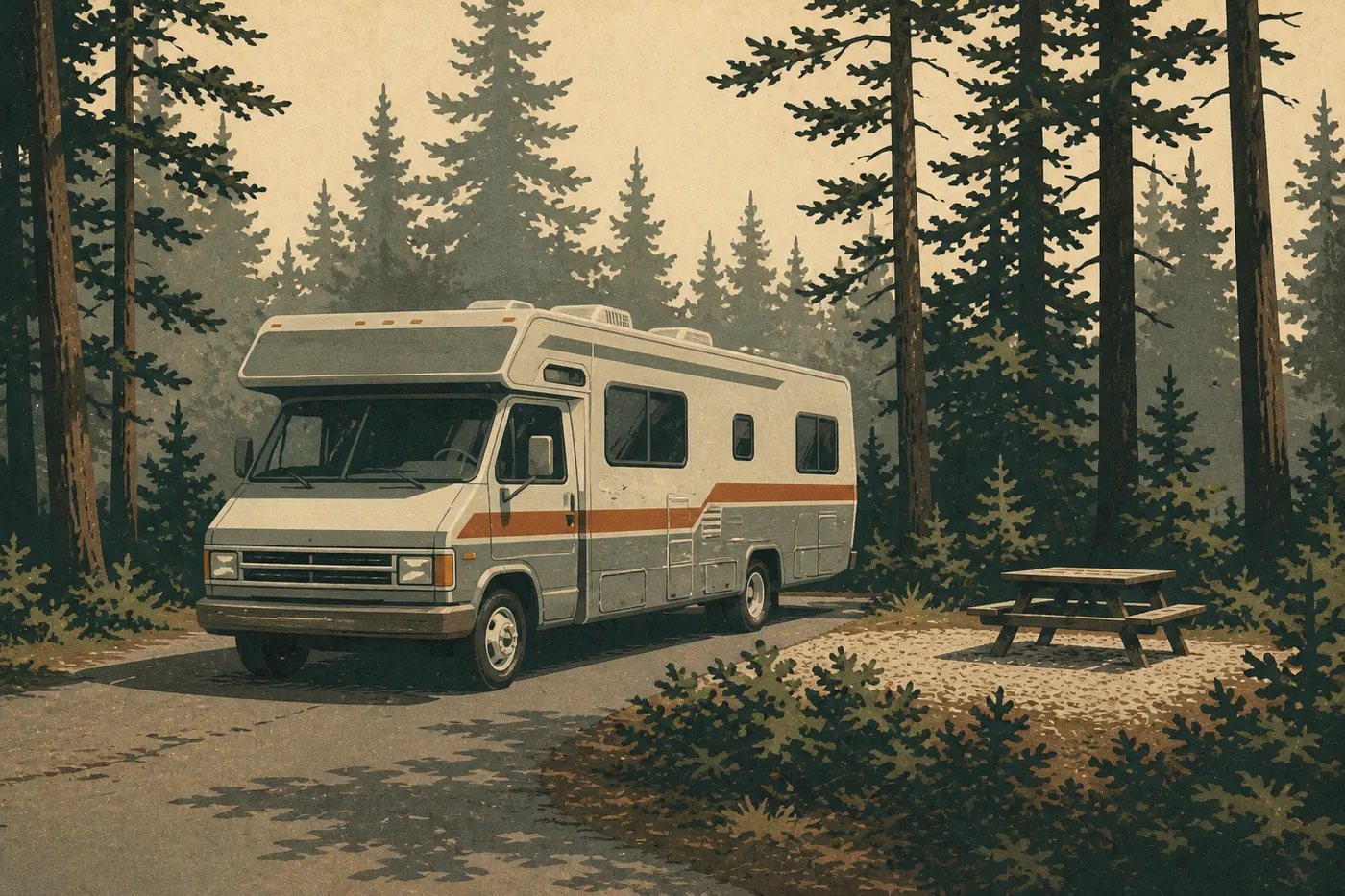
Acadia by RV: Campgrounds, Rules, and Practical Tips
Yes, you can stay in an RV at Acadia National Park. Maine's coastal park is well suited to this kind of trip: the main road network can handle standard-size RVs, and the park has three official campgrounds that accommodate them. The main catch is that sites disappear within minutes when reservations open. Plan ahead, often as early as January for summer.
Can You Drive and Camp in an RV at Acadia?
RVs can travel easily along Park Loop Road, the main route on Mount Desert Island, and on most of the park's roads. Acadia has four official campgrounds, three of which accommodate recreational vehicles. The fourth, Duck Harbor, sits on Isle au Haut and is accessible only by ferry, so it is not an option for an RV stay.
The park entrance fee is $35 per private vehicle, valid for seven days. The annual pass costs $70. For the bigger picture, our complete Acadia guide is the best place to start.
RV Restrictions and Regulated Roads
The main restriction to know about concerns Cadillac Summit Road. Longer vehicles face restrictions there. Check the official limits on the NPS website before you go, since they can change from one season to the next. In summer, a timed entry reservation is required to reach Cadillac Mountain by car or RV ($6).
The carriage roads are strictly reserved for pedestrians, cyclists, and horseback riders. No motorized vehicles are allowed, without exception. Parking along the shoulders of Park Loop Road and in the small picnic areas is not intended for RVs. Stick to the marked campground sites.
One note for visitors familiar with other parks: unlike Zion, with its Mount Carmel Tunnel, or Great Smoky Mountains, Acadia has no tunnel with a critical height restriction. The main challenges are still parking in peak season and length limits on certain roads.
The Park's Official Campgrounds
Blackwoods Campground
On the eastern coast of Mount Desert Island, a few miles from Bar Harbor, Blackwoods is the park's most centrally located campground. It operates year-round, with limited winter access, and accepts RVs without electrical or water hookups. Sites have a maximum vehicle length. Check the Recreation.gov listing for your dates before booking, since the limit varies by site. Generators are allowed during designated hours.
The rate is about $30 per night in peak season. Reservations are required from May through October on Recreation.gov.
Seawall Campground
Seawall is on the western coast, in Tremont, amid conifer forest that feels wilder and less crowded than Blackwoods. The campground usually opens in late May and closes in late September. There are no electrical hookups, but the setting is a world away from the bustle of Bar Harbor. Some sites are reservable, while others are first come, first served. Arrive early in the morning to make sure you get a spot in July and August.
Rates are slightly lower than Blackwoods, depending on the site. A dump station is available on-site.
Schoodic Woods Campground
This is the park's newest campground and by far the best equipped for large RVs. Located on Schoodic Peninsula, about an hour's drive from Bar Harbor, it offers sites with electrical hookups, including 50-amp service at some sites. That sets it clearly apart from the other two NPS campgrounds. Sites are spacious, the adjoining bike trail network is excellent, and crowds are much lighter than on Mount Desert Island. The tradeoff is the one-hour drive to Jordan Pond or Cadillac Mountain.
Rates are higher than at Blackwoods because of the hookups. Reservations on Recreation.gov are recommended.
Duck Harbor Campground
Accessible only by ferry from Bass Harbor, Duck Harbor accepts only campers arriving on foot with a tent or hammock. It is completely unsuitable for an RV stay.
Dispersed Camping and Areas Around Acadia (Boondocking)
Boondocking is almost nonexistent in this region, and it is worth saying that plainly. Unlike the parks of the American West, such as Utah, Nevada, and Arizona, Maine has virtually no BLM land open to free dispersed camping. The Bureau of Land Management mainly manages land in the West. Maine's state forests offer a few parking options, but they are poorly marked and not well suited to large vehicles.
The practical solution is to use private campgrounds around Bar Harbor. Several accept RVs with full hookups, including water, electricity, and sewer, at rates between $50 and $80 per night in summer. They make a convenient base for exploring the park each day. The Acadia lodging guide covers all the alternatives, from hotels to private campgrounds.
For a more self-contained stay, Schoodic Peninsula and the back roads of Hancock County sometimes offer more flexibility. Always check local regulations before spending the night outside a marked campground.
Dump Stations, Water, and Services
Blackwoods and Seawall each have a dump station available to registered campers. Schoodic Woods offers similar services, with potable water included at hookup sites.
Never dump on park grounds. The fine is steep, and Acadia's coastal environment is especially sensitive to pollution. Outside the park, some private campgrounds and gas stations in Bar Harbor offer paid dump services. The Sanidumps and Campendium apps list dump stations within a 12-mile radius.
Which Campground Should You Choose?
- Coastal views and proximity to the heart of the park: Blackwoods. Our pick for a first Acadia trip.
- Quiet and a forest setting: Seawall. A more low-key atmosphere, fewer neighbors, and the island's western side.
- A large RV with electrical hookups: Schoodic Woods, with no competition on that front in the park.
- A family with kids: Blackwoods is more central, and Bar Harbor is 3 miles away for groceries and restaurants.
The Acadia camping guide compares sites and rates for each campground.
Renting an RV to Visit Acadia
Don't have your own vehicle? Most RV rentals come from Boston, about a three-hour drive away, or Portland, Maine, through platforms such as Outdoorsy and RVshare or national agencies such as Cruise America. Expect to pay between $150 and $300 per day, depending on vehicle size and season, not including fuel.
Here are a few things to know before you sign: a Class B camper van or a compact Class C, under 25 feet, handles well on park roads and in campgrounds without hookups. A larger Class A is more comfortable at Schoodic Woods, but makes it harder to reach some parking areas along Park Loop Road. If you're traveling with a dog, check the rental company's pet policy before confirming your booking.
RVs, Pets, Budget, and Reservations: What to Know
Pets: Dogs are allowed in Acadia's campgrounds and must be on a leash no longer than 6 feet. Trail rules vary by trail. The Acadia hiking guide explains which ones allow pets.
Budget: Plan on $22 to $50 per night for an NPS site, depending on the campground and available options. Add $35 for park admission, valid for seven days, and $6 for the timed entry reservation at Cadillac Mountain. Our Rates & passes page covers entrance fees and passes.
Reservations: Blackwoods and Schoodic Woods sites disappear within minutes when reservations open on Recreation.gov, often in January for summer. Turn on availability alerts. At Seawall, first-come, first-served sites are usually claimed before 8 a.m. in July and August.
Season: July and August are the busiest months. Acadia receives more than three million visitors a year. September is our favorite time to visit: crowds thin out, temperatures remain comfortable at 50 to 70°F, and the first fall colors appear. The Acadia seasons guide compares crowds and weather month by month.
In Summary: Our Acadia RV Plan
For a first RV trip, reserve Blackwoods in January, choose a vehicle under 26 feet if possible, and spend a day on Schoodic Peninsula to get away from the crowds on Mount Desert Island. If you have a large RV and need hookups, go straight to Schoodic Woods. Avoid July and August if your dates are flexible. September offers the best balance of mild weather and quieter conditions. Check the length restrictions for Cadillac Summit Road before you leave.
Frequently Asked Questions
How do you camp in Acadia National Park?
Camping at Acadia means staying at one of the NPS campgrounds with a reservation through Recreation.gov: Blackwoods and Seawall on Mount Desert Island, Schoodic Woods on Schoodic Peninsula, and Duck Harbor, for tents only, on Isle au Haut. Dispersed camping is not allowed inside the park.
What's the best place to camp in Acadia National Park?
There is no one-size-fits-all answer. Blackwoods is the most convenient choice for reaching the heart of the park, Schoodic Woods is the clear choice for RVs that need electrical hookups, and Seawall suits visitors looking for quiet and a forest setting.
Do Mount Desert campgrounds have showers?
Blackwoods and Seawall have restrooms with token-operated pay showers. Schoodic Woods is newer and offers more comfortable facilities. Duck Harbor, accessible by ferry, has no showers.
Can you visit Acadia in an RV?
Yes. RVs can travel along Park Loop Road and the main roads without any particular difficulty. Length restrictions apply on Cadillac Summit Road. Check the current limits on the NPS website before you leave.
Can you park an RV anywhere in Acadia?
No. Parking is allowed only in campgrounds and designated parking areas. The shoulders of Park Loop Road and the small picnic areas are not intended for RVs.
How much does an RV campsite cost in Acadia?
Between $22 and $50 per night, depending on the campground and available services, including whether hookups are provided. The park entrance fee, $35 per vehicle for seven days, is added to the site rate. For entrance fees and annual passes, see the national parks Rates & passes page.
When is the best time to visit Acadia by RV?
September offers the best balance: lighter crowds, comfortable temperatures of 50 to 70°F, and the first fall colors. July and August are peak season, busier and more challenging for booking a site. Our When to visit page breaks down the advantages of each season.