

Acadia National Park: The Complete Visitor Guide
Acadia brings together the forests of Maine and the North Atlantic on a granite island where the sea crashes against the cliffs. The park covers Mount Desert Island, five hours north of Boston by car, and is easy to explore in two or three days. People come for sunrise atop Cadillac Mountain, a bracing swim at Sand Beach, a ride along the carriage roads, and popovers with tea beside Jordan Pond. Plan on a full day for the scenic loop, two days if you want to take it easy, and three if you want to do some serious hiking.
This guide follows the order of a real trip plan. We start with logistics such as getting there, costs, and transportation, then move on to what to see in each area, with detailed guides to help you dig deeper as you plan.
Acadia at a Glance: Where the Park Is and How to Get There
The park is in Maine, in the far northeastern United States, on Mount Desert Island. A road connects the island to the mainland, so you do not need to take a ferry for most of the park. The small town of Bar Harbor, at the island's northeastern entrance, serves as home base for most visitors, with shops, restaurants, lodging, and shuttle departures.
From Boston, the most direct route follows I-95 north to Augusta, then Route 3 east to Ellsworth before continuing on to Mount Desert Island. Another option takes I-95 to Bangor, then I-395 and U.S. Route 1A east to Ellsworth. Either way, the drive from Boston takes about five hours. Bangor's airport is the most convenient for domestic flights, less than an hour from the park. Boston remains the most common choice for international arrivals.
The park is open year-round. Hulls Cove Visitor Center, on the north side of the island, is the usual starting point for maps, ranger advice, and visitor information. Its hours vary by season, so check before you leave.
For everything related to getting there, flight options, and car rentals, head to the Acadia Access & Transportation guide. You'll find the day-by-day timing in the Itinerary & Length of Stay guide, and the exact location of each area is shown on the park map.
Entrance Fees, Passes, and Reservations
Acadia charges an entrance fee, and the pass is valid for seven consecutive days. The price depends on how you arrive:
- Private vehicle: $35
- Motorcycle: $30
- Individual pedestrian, cyclist, or passenger: $20 per person
- Park annual pass: $70
School and academic groups, along with some noncommercial groups, may enter free of charge under certain conditions.
One Acadia-specific detail is that the road to the top of Cadillac Mountain requires a paid timed entry reservation ($6 per time slot) in addition to the entrance fee. This system manages crowds during the busy season, especially for the popular sunrises. Time slots sell out quickly, so book ahead as soon as dates become available. If you plan to visit several U.S. national parks during the year, the federal America the Beautiful pass, valid for one year at all parks, is often a better value than the local pass.
The National Park Entrance Fees & Passes page explains entrance fees and annual passes. If you're collecting stamps, the Passport & Stamps page tells you where to get them.
Reservations, Permits, and Rules to Know
Required Reservations
Since the timed entry system was introduced, some areas require a separate timed entry reservation in addition to the entrance fee. Cadillac Summit Road is the main example during the busy season, from June through October. Time slots are available on Recreation.gov and go quickly in July and August, so plan several weeks ahead.
Essential Rules
- Pets: allowed in the park and must be kept on a leash no longer than 6 feet. They're prohibited on most hiking trails and inside NPS buildings.
- Fires: allowed only in designated campground fire rings. They're prohibited everywhere else.
- Drones: prohibited throughout the national park.
- Collecting: do not remove plants, minerals, or any other objects. Follow Leave No Trace principles.
- Speed: obey posted signs, including the 25 mph limit in residential areas around the park.
- Parking: patrols regularly ticket cars parked outside designated areas. During the busy season on Park Loop Road, lots are often full before 9 a.m.
Most hikes do not require a permit. Isle au Haut limits the number of daily visitors, so check directly with Hulls Cove Visitor Center before you go.
Getting Around Acadia
There are three main ways to get around, and the best approach is often to combine them.
Park Loop Road is the park's backbone, a 27-mile scenic loop serving most of the major sites along the island's eastern coast, much of it one-way. It provides the framework for a first day by car.
The free Island Explorer shuttle connects Bar Harbor, campgrounds, beaches, and major attractions in summer, usually from late June through early October. It takes the headache out of parking, which fills up by midmorning at popular spots. Park your car once and let the shuttle handle the rest.
Finally, the carriage roads, vehicle-free roads funded in the early 20th century by John D. Rockefeller Jr., form a roughly 45-mile network dotted with stone bridges. Motor vehicles are prohibited, making them ideal for walking, biking, or a carriage ride.
Our Getting Around page has the shuttle routes, parking details, and tips for avoiding traffic.
How Long Does It Take to Visit Acadia?
Two full days offer the best balance for seeing the essentials without rushing. In one day, you can drive Park Loop Road, stop at Sand Beach, Thunder Hole, and Otter Cliff, and go up Cadillac Mountain. The second day leaves time for a hike, a bike ride on the carriage roads, and a popover break at Jordan Pond.
If you only have one day, focus on the scenic loop and one summit. With three days, add the quieter west side of the island and, perhaps, a trip to Schoodic Peninsula. Our Itinerary & Length of Stay page offers ready-made plans for the time you have.
Plan your visit
What to See and Do in Acadia
Acadia makes the most sense geographically. The park has four areas, from the busiest to the most off-the-beaten-path. The What to Do in Acadia guide covers each activity in detail. Here's the overview.
Road trip journal · 4 areas
The Heart of Mount Desert Island (Park Loop Road)
This is the star area, centered on the scenic loop. Sand Beach is the park's only large sandy beach, tucked between two rocky headlands. The water stays cold even in summer. Just beyond it, Thunder Hole booms when waves rush into a granite fissure. It's most dramatic around high tide. Otter Cliff rises above the ocean and offers one of the finest views on the island's eastern coast.
Farther up, Jordan Pond reflects the rounded hills known as The Bubbles, with a tea house famous for popovers, the airy little rolls served with jam. Finally, Cadillac Mountain, the island's highest point at 1,529 feet, overlooks all of Mount Desert Island. From fall through early spring, its summit is one of the first places in the United States to see the sunrise.
The West Side, the “Quiet Side”
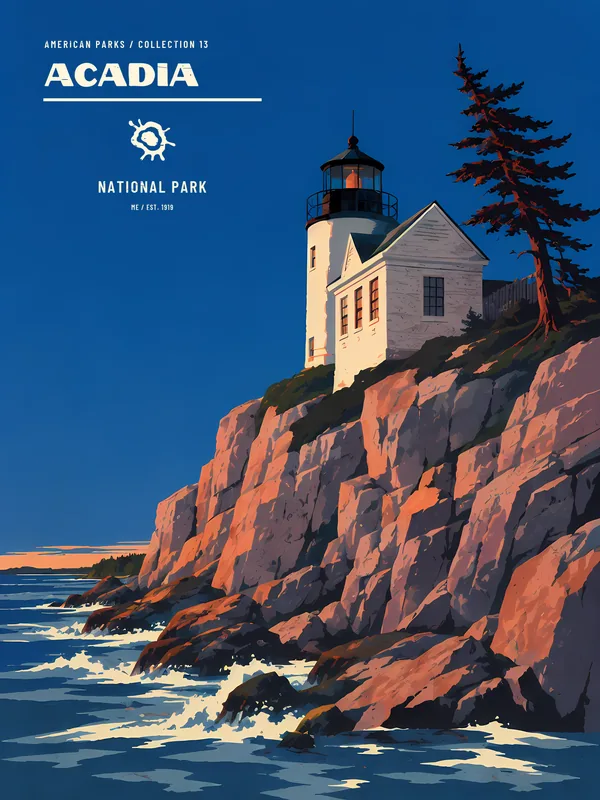
On the west side of the island, around Southwest Harbor and Bass Harbor, the atmosphere is more village-like and much quieter. The small Bass Harbor Head Lighthouse, perched on the rocks, is especially photogenic late in the day. The trails see fewer visitors, which is ideal if you want to escape the summer crowds.
Schoodic Peninsula
The only part of the park attached to the mainland, Schoodic is about an hour's drive from Bar Harbor via Ellsworth. It has a quiet coastal road, wave-battered rocks, and a fraction of the visitors found elsewhere in the park. It's a good choice for a half-day outdoors.
Isle au Haut
The wildest area. Accessible only by boat from Stonington, this island receives only a small number of visitors each day and is explored on foot. It's for travelers seeking complete quiet and willing to deal with somewhat more complicated logistics.
Explore the park
Acadia's Best Hikes
Acadia has trails for every level, from flat coastal walks to climbs with iron rungs. The Ocean Path follows the coast from Sand Beach to Otter Point and is easy as well as spectacular. Beehive and Precipice climb cliff faces equipped with metal rungs. They're thrilling, but avoid them in wet weather or if you're uncomfortable with heights. The trails around Jordan Pond and the carriage roads offer gentle walks for families.
We cover each route, its length, elevation gain, and difficulty in the guide to Acadia's best hikes. For rung routes, always check whether the trails are open. Some close in spring to protect peregrine falcons nesting in the cliffs.
The detailed guide Hiking in Acadia: The Best Trails for Every Ability (+ Difficulty & Access) The best hikes in Acadia National Park, organized by area and difficulty, with… Read the guide →Wildlife and Plants to Look For
Acadia combines boreal forest, bogs, ponds, and coastline, creating a wide range of habitats. At sea, you may spot seals on the rocks and, on boat trips, porpoises or whales offshore. On land, the park is home to white-tailed deer, foxes, beavers, and a rich variety of birds, including peregrine falcons nesting on the Precipice cliffs. In the forest, squirrels and the occasional subtler sign of wildlife remind you that plenty is happening out there.
In fall, maples and birches steal the show. Acadia is one of New England's classic fall foliage destinations. Our Wildlife page covers the best areas and times for watching wildlife without disturbing the animals.
The detailed guide Acadia Wildlife: What Animals You Can See and Where to Find Them Black bears, harbor seals, peregrine falcons, moose, and loons Read the guide →When to Visit Acadia
Acadia has four distinct seasons. Summer, with temperatures from 45 to 86°F, is the busy season: trails are open and shuttles are running, but crowds are heavy and parking lots fill up. Fall, with temperatures around 32 to 70°F, brings colorful foliage, with the first frost usually arriving in mid-October. Winter is harsh and snowy, with temperatures from 14 to 36°F. The first snow can arrive as early as November and last into April, and some roads close. Spring, with temperatures around 32 to 70°F, wakes the park up but remains damp and cool.
In short, the shoulder season from September through mid-October combines mild weather with smaller crowds. Our When to Visit page has month-by-month details, and our Weather page has average temperatures and precipitation.
The detailed guide When to Visit Acadia: Best Time, Seasons, and Crowds September and October are the best times to visit Acadia, with fall colors,… Read the guide →Where to Stay in Acadia
There are three main lodging approaches. Hotels, motels, and inns cluster in Bar Harbor and nearby villages. They're convenient, but book early for summer. Campgrounds within Acadia's boundaries let you sleep close to nature. They fill up months in advance during the peak season. Finally, travelers in RVs will find suitable sites, with some size and equipment restrictions.
Here's the basic breakdown: the Where to Stay guide gives you the big picture, while the Hotels & Lodges, Camping, and RV Camping guides cover each option in detail.
Stay in the park
Around Acadia: Things to Do Nearby
The park doesn't exist in a vacuum. Bar Harbor is worth exploring for its seafood restaurants, where Maine lobster is king. Boat tours for whale watching, fishing, and lighthouses leave from the harbor. On the “quiet side,” the villages of Southwest Harbor and Bass Harbor offer a more authentic New England feel. If you're extending your trip, the Maine coast and the rest of New England are made for a real road trip.
The upcoming Regions and Road Trips pages will place Acadia in a broader itinerary. For meals, the Where to Eat page lists good spots in and around the park.
Our Take: Is Acadia Worth the Trip?
Yes, without question, as long as you prefer coastal scenery to the wide-open spaces of the West. Acadia offers something different: compact, accessible, and cinematic, with granite, forest, and ocean in constant collision. You'll do plenty of walking, not much driving, and the free shuttle makes the logistics surprisingly easy.
Its drawback is also the price of its popularity. In July and August, the major spots are packed and parking lots fill by morning. When we visited in the shoulder season, the park had room to breathe, the fall colors were on display, and the rung trails offered spectacular views without the crowds. Our advice is simple: allow at least two days, visit outside the peak summer season if you can, and book ahead for sunrise on Cadillac Mountain.
This guide is your starting point for putting it all together. Each question has a detailed guide you can follow through the links as you plan.
Frequently Asked Questions
What can you do in Acadia National Park?
In Acadia National Park, you can drive the scenic Park Loop Road, climb Cadillac Mountain, swim at Sand Beach, listen to Thunder Hole, walk the Ocean Path or carriage roads, and enjoy Jordan Pond's popovers. Our What to Do page has the details.
Where is Acadia National Park?
Acadia National Park is in Maine, in the far northeastern United States, primarily on Mount Desert Island, about five hours north of Boston by car. Bar Harbor is the gateway town. See our Access & Transportation page.
What are the best hikes in Acadia National Park?
Acadia's top hikes include the Ocean Path, an easy coastal walk; Beehive and Precipice, iron-rung climbs to avoid in wet weather; and the trails around Jordan Pond. Each trail guide is on our Hiking page.
Is Bar Harbor, Maine, worth visiting?
Yes, Bar Harbor is worth visiting. It's Acadia's gateway town, with lobster restaurants, boat tours, and immediate access to Park Loop Road. It makes an ideal home base, as our Where to Stay guide explains.
The American Parks shop
Bring Acadia home
Our park-inspired creations, made to order and shipped to your door.
Latest park news
- Acadia: Swimming Advisory Posted for Sand Beach LagoonA health advisory targets Sand Beach Lagoon at Acadia, where bacteria levels top safe limits. The beach itself isn't affected.