

Deserts and Canyons in France: Landscapes That Echo the American West
Verdon Gorge, the Provençal Colorado, and the Dune du Pilat: seven French landscapes compared with their American counterparts, with facts, access, and seasons.
By Victoria Boissonade · · 7 min read
Coming back from a road trip through Utah and recognizing something in the cliffs of Verdon is an experience shared by many travelers who have seen both. Geology has carved gorges, limestone pavements, and dunes in France that evoke the American West, but on a very different scale. For each site, we identify its American counterpart and the size gap that photos do not show. The "desert in France" is real, and it often begins much closer than you might think.
What counts as a "desert" in France?
In the strict climatic sense, a desert receives less than 9.8 inches of precipitation per year. No territory in mainland France reaches that threshold. The word comes from the Latin desertus, meaning "abandoned": in French, it refers to a sparsely populated or arid-looking area, with no rainfall requirement.
This loose terminology creates a common confusion: the Bardenas Reales, regularly mentioned in articles about "deserts in France," are in Navarre, Spain, about 56 miles south of Pamplona. They are not French landscapes.
The seven sites below are all in France, accessible, and visually reminiscent of the American West. What almost always distinguishes them from their American counterparts is the same thing: scale.
Verdon Gorge and Ardèche Gorge compared with American canyons
Verdon Gorge stretches for 15.5 miles between Castellane and Lake Sainte-Croix, with cliffs reaching 2,300 feet in places. It is often presented as Europe's largest canyon, a claim that should be treated cautiously: length alone is not enough to support that title. What is certain is the visual impact: turquoise water at the bottom of a limestone cut, and the Martel Trail, which lets you descend into the gorge for about 9 miles from La Palud-sur-Verdon.
Its American counterpart is the Grand Canyon: 277 miles long and up to 6,092 feet deep. The gap speaks for itself. What Verdon offers in return is colorful water, trail access to the canyon floor, and logistics just two hours from Marseille. Access: from Moustiers-Sainte-Marie or Castellane. Best season: May-June and September.
Ardèche Gorge. Thirty miles of limestone gorges, cliffs from 656 to 984 feet high, and the Pont d'Arc, a natural arch about 197 feet across at the entrance to the gorge. The best way to experience it fully is still to paddle from Vallon-Pont-d'Arc, with the option of camping on the inner beaches if you reserve ahead. In the United States, Arches is the obvious comparison for its natural arches: Landscape Arch spans 289 feet. The difference in scale is clear, but the comparison holds.
Provençal Colorado, Mourèze Circus, and the Organs of Ille-sur-Têt: Utah's color palette
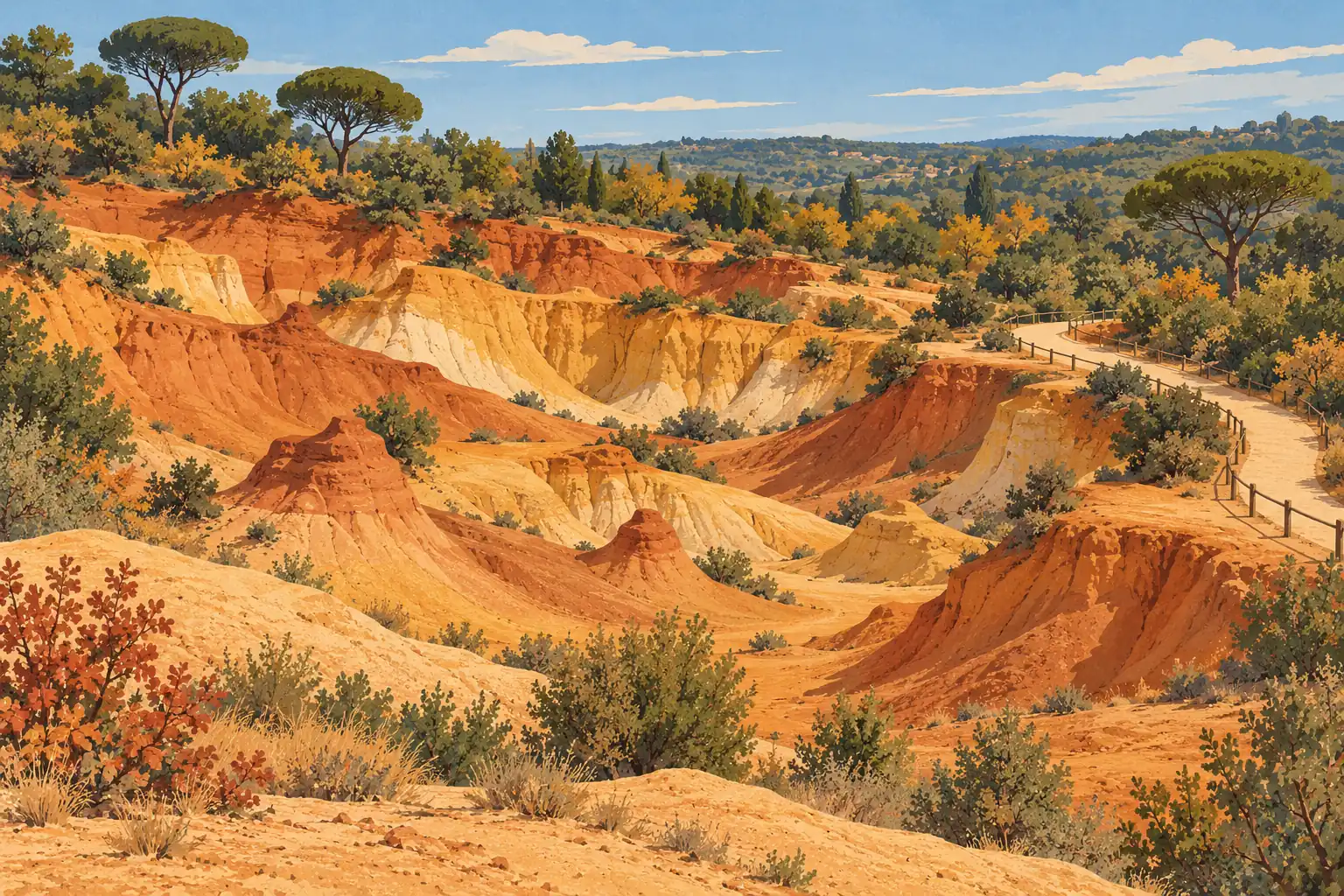
Provençal Colorado (Rustrel, Vaucluse). The former ocher quarries, now protected as a natural site, offer red-orange ground crossed by marked trails ranging from 1.2 to 3.1 miles, depending on the route. Access from Apt takes 15 minutes, and parking is paid. The comparison with Bryce Canyon works because of the warm colors and rock formations; the rust tones also bring Arches to mind. Avoid July and August: the site is overcrowded and too hot.
Mourèze Circus (Hérault). A jumble of gray dolomite rocks eroded into contorted shapes, ten minutes from Clermont-l'Hérault. It is almost entirely absent from the usual comparisons. The closest American counterpart is New Mexico's Bisti/De-Na-Zin Wilderness: the same sense of mineral chaos, the same silence. Admission is free.
Organs of Ille-sur-Têt (Pyrénées-Orientales). Clay and sandstone fairy chimneys formed through millions of years of erosion. They recall the formations of South Dakota's Badlands. Access from Perpignan takes about 30 minutes.
These three sites have in common that they can be visited as day trips from a major city and are almost entirely absent from general travel guides.
Agriates Desert, Larzac Plateau, and Valley of Wonders: French-style aridity
The Agriates Desert (Haute-Corse) takes its name in the Latin sense: an abandoned, rocky space with a dry appearance. The maquis is dense, the beaches of Saleccia and Lotu are among Corsica's finest, and no paved road leads there. Access: a boat shuttle from Saint-Florent (20 to 25 minutes) or a three-hour walk from the trailhead. Best season: May-June, before the summer crowds. The atmosphere recalls the Great Basin Desert (Nevada, Oregon): low vegetation and a mineral horizon. If you want to experience a change of scenery in nature in Europe without crossing the Atlantic, the Agriates rank among the Mediterranean coast's most surprising destinations.
Larzac Plateau (Aveyron). A limestone plateau at 2,300 to 2,625 feet, with steppe and Templar farmhouses, offering a Colorado Plateau feel without the cliffs.
Valley of Wonders (Mercantour). At 6,560 to 8,200 feet, a limestone pavement etched with thousands of rock carvings, accessible only in July and August with an accredited guide.
Dune du Pilat: 328 feet compared with the Great Sand Dunes' 751 feet
The Dune du Pilat (La Teste-de-Buch, Gironde) is Europe's tallest dune. Its length remains steady at around 1.7 miles; its height varies because the dune is shifting: sources give figures between 328 and 361 feet depending on the year. The 2025 measurement was 334 feet, so we round it to about 330 feet.
Its American counterpart: Great Sand Dunes in Colorado, 751 feet at their highest point and covering about 30 square miles. More than twice as high and over fifty times larger.
Access from Arcachon (3.7 miles), paid parking, and a walk-up only. The site is very crowded in July and August. Recommended season: May-June or September.
Our take: Verdon for the emotion, the United States for the scale
For a first canyon experience: Verdon Gorge. Two hours from Marseille, 2,300-foot cliffs, and turquoise water make it the only French site that can hold its own against a major American canyon in terms of verticality. Not length: 15.5 miles compared with 277 miles for the Grand Canyon.
For a family outing: Dune du Pilat. Easy access, no physical difficulty, and about 330 feet of open sand.
For authenticity: the Agriates Desert in May and June, with the beaches of Saleccia and Lotu and no roads or cars.
What we do not recommend: Provençal Colorado and Verdon in July and August, when crowds and heat combine. Retz Desert, often included in these lists, is an eighteenth-century landscaped park: despite its name, it has nothing to do with arid landscapes.
The clear conclusion: no French landscape matches the American scale. For the true vertigo of Utah's great dunes or canyons, a road trip through the American West permanently resets your sense of scale.
Frequently asked questions
Which French landscape looks most like a desert?
The Agriates Desert in Haute-Corse is the French landscape that most resembles a desert in visual terms: rocky maquis, beaches inaccessible by car, and a mineral horizon. For a visual resemblance to the American West, Verdon Gorge remains the benchmark.
Are the Bardenas Reales in France?
No. The Bardenas Reales are in Navarre, Spain, about 56 miles south of Pamplona. They are frequently mentioned in articles about deserts near France, but they are Spanish.
What season should you choose for Verdon Gorge?
May, June, and September are the best months for Verdon Gorge. In July and August, the canyon is very crowded and temperatures often exceed 95°F.
Is Dune du Pilat Europe's tallest dune?
Yes, Dune du Pilat is Europe's tallest dune, at about 330 feet (334 feet measured in 2025). Because the dune is shifting, its height varies slightly from year to year.