
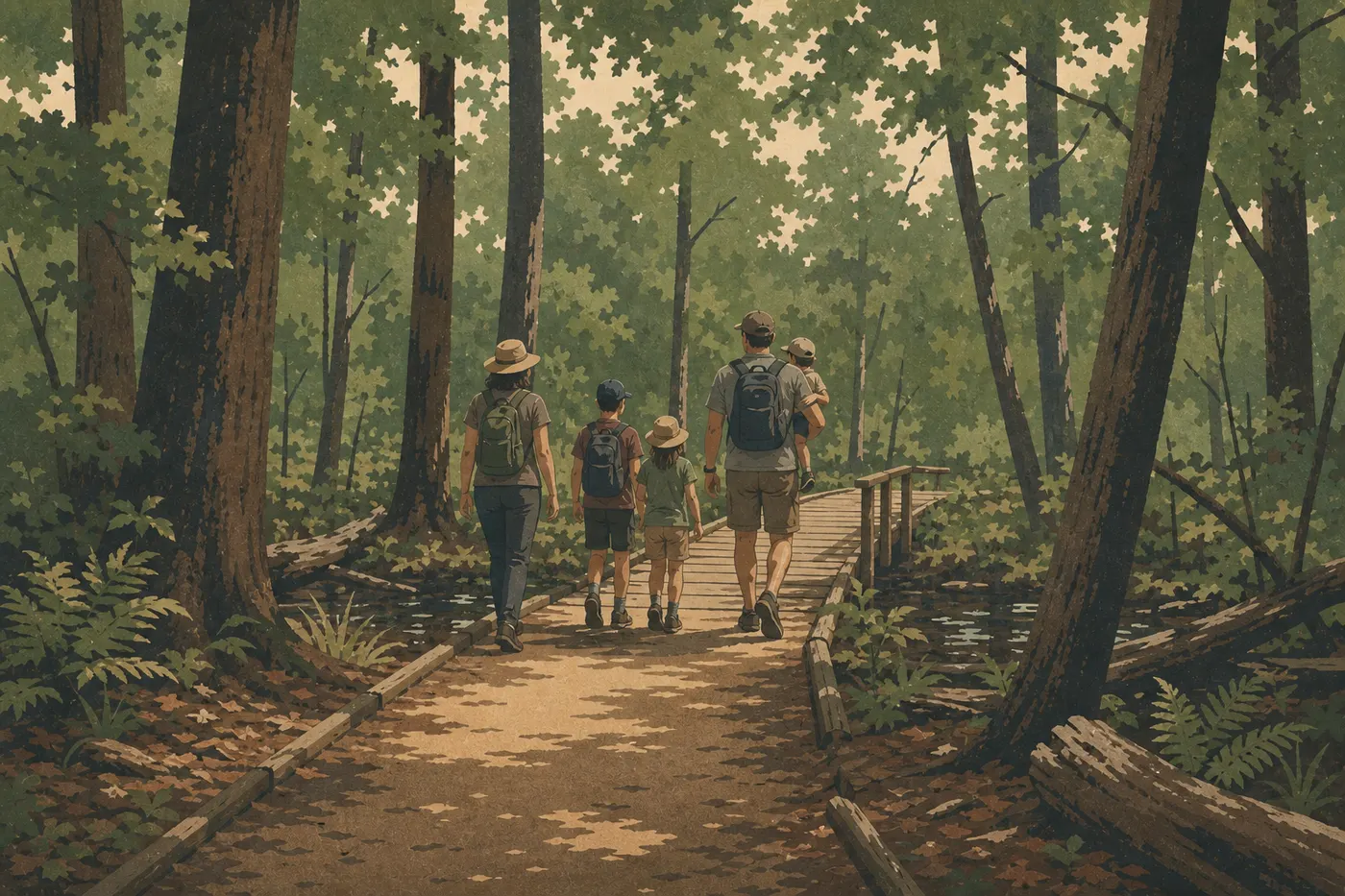
Shenandoah with Kids: What to Do and How to Plan Your Trip
Shenandoah is one of the most accessible national parks on the East Coast. Less than two hours from Washington, D.C., its Blue Ridge ridges offer striking views, wildlife that's easy to spot, and trails for every level of little legs. Yes, Shenandoah works for kids as young as 3 or 4 on easy hikes, and even for babies if you stick to Skyline Drive and its overlooks. The only real challenge with young children is the summer heat and July-August humidity, which can make longer outings exhausting. Pick the right time, and this park becomes a terrific place to play outdoors.
Why Visit Shenandoah with Kids
The convenient location. The park lies about 75 miles west of Washington, D.C., and 81 miles from Richmond. No transatlantic flight or overnight plane ride is needed. It's an easy East Coast road trip, which makes it one of the first nature getaways for many American families.
The scenic drive is an activity in its own right. Skyline Drive follows the ridgeline for 105 miles, from the Front Royal entrance in the north to Rockfish Gap in the south. More than 75 overlooks are accessible directly from a parking area. That's a big advantage with young or tired kids. Stop, take in the view, and keep going. You don't need to spend six hours hiking to feel like you've experienced the park.
Wildlife without the effort. White-tailed deer along the road, groundhogs on rocky outcrops, and wild turkeys in clearings are all common sights in Shenandoah, especially at dawn and dusk. Kids love turning it into a scavenger hunt. When we visited in October, we saw three deer in less than an hour along the road without ever leaving the car.
Forests to explore in every season. The park covers nearly 309 square miles of deciduous forest. Fall brings spectacular color. In spring, wildflowers carpet the forest floor. In summer, the tree cover offers welcome relief from the valleys below.
Is Shenandoah Good for Kids? What Age Is Best?
Shenandoah works for children of any age as long as you adjust the itinerary.
From birth. Skyline Drive, the overlooks, visitor centers, and picnic areas are accessible to everyone. Restrooms are available at the main stops.
From ages 3-4. Short, flat trails with less than 0.6 miles and almost no elevation gain are within reach. Fox Hollow Trail, starting at Dickey Ridge Visitor Center in the northern section, is a good example. The trail is even, the distance is manageable, and the forest setting begins right away.
From ages 6-7. Kids can take on 2- to 3-mile loops with moderate elevation gain, such as Stony Man Trail. The round-trip hike is less than 1.6 miles and leads to open views of the Appalachians from quartzite cliffs.
For teenagers. Nearly every trail in the park is accessible, including the sections of the Appalachian Trail that cross Shenandoah for about 106 miles.
When to Visit as a Family (The Easiest Season with Kids)
Our recommendation is September-October or May. In fall, temperatures cool to 59-68°F on the ridges during the day, summer crowds thin out, and the foliage puts on a show kids remember for years. In May, wildflowers are at their best, temperatures stay mild, and the campgrounds aren't full yet.
Summer is possible, but heat and humidity regularly reach 86-95°F in the valleys in July and August. Expect temperatures about 9°F cooler on the ridges, though that's still demanding with young children. Crowds peak, and campgrounds fill up weeks in advance.
Winter brings snow and ice to Skyline Drive, which may close in bad weather. With young kids, another season is clearly the better choice.
For month-by-month guidance, see our guide to the best times to visit Shenandoah.
How Many Days Should You Plan for a Family Trip?
Two days is the minimum if you don't want to rush through everything. Three days is ideal. That gives you time for Skyline Drive, two or three short hikes, the Junior Ranger program, and a half-day to wander at your own pace.
Typical three-day itinerary:
- Day 1: Enter through Front Royal, drive the northern section of Skyline Drive, visit Dickey Ridge Visitor Center, hike Fox Hollow Trail, have a picnic, and stop at your first overlooks.
- Day 2: Explore the central section, Big Meadows, and Stony Man Trail, then do the Junior Ranger program at Harry F. Byrd Sr. Visitor Center.
- Day 3: Take the southern section as far as Loft Mountain, then leave through Rockfish Gap toward Charlottesville or Luray.
If you've only got one day for an outing from D.C., focus on the central section around Big Meadows. That's where you'll find the highest concentration of things to see and do.
Our Shenandoah itinerary guide offers detailed plans based on how much time you have.
What to Do in Shenandoah with Kids: Our Picks
Here are the park's family-friendly essentials. For a complete list of activities, see all the things to do in Shenandoah.
A road trip on Skyline Drive. The 105-mile drive has a 35-mph speed limit, with overlooks where you can stop whenever you like. Give the kids a checklist of things to spot from the back seat, such as deer, groundhogs, raptors, and chipmunks. It turns the drive into an active game.
Big Meadows. This broad central plateau has a lodge, a campground, a visitor center, and a large meadow where deer regularly gather in the evening. This is often where kids get their first close-up encounters with wild animals.
Overlooks at sunset. Several overlooks offer views of the valleys or the Appalachian range during golden hour. Hazel Mountain Overlook and Hawksbill Gap both offer wide panoramas, just a few minutes from the parking area.
The visitor centers. The two main centers, Dickey Ridge in the north and Harry F. Byrd Sr. at Big Meadows, offer interactive exhibits, relief maps, and introductory films. Starting there gives kids some context before they head out on the trails.
Easy Family Hikes (Short, Little Elevation Gain, Stroller-Friendly)
Shenandoah has more than 500 miles of trails in all. Here are three trails that work well for families with young children or kids who aren't used to hiking.
Fox Hollow Trail (northern section, starting at Dickey Ridge Visitor Center) A loop of about 1.9 miles with little elevation gain through pleasant woods. Along the way, you'll find the remains of an old farm, including dry-stone walls and an old orchard. Kids enjoy looking for these traces of the past. The trail is generally even and suitable for a sturdy all-terrain stroller.
Story of the Forest Trail (central section, starting at Harry F. Byrd Sr. Visitor Center) A 1.2-mile loop through the forest designed to introduce children to the Appalachian forest ecosystem. Educational signs line the trail. The route is wide and flat, making it stroller-friendly.
Stony Man Trail (central section, parking at mile 41.7 on Skyline Drive) A roughly 1.5-mile round trip with about 330 feet of elevation gain. The payoff at the top is an open view of Virginia's valleys from quartzite cliffs. Kids who are used to walking can handle it from around age 6.
For a wider selection and elevation profiles for each trail, see our selection of Shenandoah hikes.
The Junior Ranger Program
The National Park Service Junior Ranger program is one of the park's best free activities for kids roughly ages 5 to 12. The idea is simple: pick up a booklet at the visitor center, complete activities such as nature observations, quizzes, and drawings, then show it to a ranger, take the pledge, and receive an official badge.
At Shenandoah, booklets are available at Dickey Ridge Visitor Center in the northern section and Harry F. Byrd Sr. Visitor Center in the central section. Activities cover the park's geology, wildlife, plants, and human history.
It's a practical way to keep kids engaged throughout the trip. Every outing becomes a chance to complete another page. Pick up the booklet on your first day so you can plan your outings around it.
Staying Safe with Kids
Black bears. Shenandoah is home to a population of black bears. Direct encounters are uncommon, and bears generally aren't aggressive, but you still need to follow a few basic rules. Never leave food in the car, store supplies in the bear boxes provided at campgrounds, and keep children close on the trails. Teach them never to run toward a wild animal or approach one for a photo.
Speed limits. The speed limit on Skyline Drive is 35 mph, dropping to 28 mph in some areas. The limit exists because wildlife regularly crosses the road. Follow it carefully, especially at dawn and dusk.
Summer heat. In July and August, the heat index can exceed 86°F even on the ridges. Hit the trail before 9 a.m. or after 5 p.m., bring at least 0.5 liters of water per person per hour, and cover children's heads and necks.
Trails with elevation gain. Some trails drop sharply toward ravines. Hold young children's hands on exposed sections. Rocky overlooks rarely have guardrails.
Summer storms. Because the ridges range from 2,300 to 3,900 feet, thunderstorms can develop in less than an hour. Check the forecast before every outing and bring a light windbreaker even on a sunny day. Our Shenandoah weather guide provides detailed month-by-month guidance.
Where to Stay with Kids (In or Around the Park)
The park offers lodge accommodations and several campgrounds. Outside the park, you'll find many options in the valleys, especially in Luray and Front Royal.
Big Meadows Lodge (central section): Cabins and rooms in the forest, right inside the park. It's the most convenient option for families who want to stay in the heart of the park without setting up a tent.
NPS campgrounds. Four campgrounds in the park are open to families: Mathews Arm, Big Meadows, Lewis Mountain, and Loft Mountain. Big Meadows has the most amenities, including showers and a nearby store. Reservations are essential from May through October.
For a complete selection with rates and booking advice, see our Shenandoah lodging guide and the park campground guide.
Meals and Breaks with Kids
In the park. Food options are limited. Big Meadows Lodge has a restaurant that's open seasonally. Elkwallow Wayside in the northern section serves sandwiches and snacks. Overall, the park isn't set up like a resort, so bring supplies.
Picnics. This is the easiest way to eat with kids. Numerous areas along Skyline Drive have tables and restrooms. Lewis Mountain Picnic Grounds and Big Meadows Picnic Area are among the most popular and best equipped.
Resupplying. The Big Meadows store covers the basics, including canned goods, snacks, and drinks. For a fuller grocery run, the towns of Luray and Front Royal at the park entrances have supermarkets and restaurants. Fill your coolers before entering the park.
Family Budget
Park entrance. Entry costs $30 per vehicle and is valid for 7 days. Children 15 and under enter free.
The America the Beautiful pass. It's worth considering if you'll visit several national parks during the year: $80 provides unlimited access to all federal recreation sites for 12 months. After two visits, it has already paid for itself. Our National Park Fees & Passes page explains entrance fees and passes.
Additional costs to budget for: lodging, gas for Skyline Drive, about 5.3 gallons for a leisurely full round trip, food for meals in the park, and any paid activities outside the park, such as Luray Caverns.
Things to Combine with Shenandoah When Traveling with Kids
Luray Caverns. About 20 minutes from the Thornton Gap entrance, these underground caverns are one of Virginia's most visited attractions. The giant stalactites and the lithophone organ amaze kids, and the guided tour lasts about 75 minutes. It's a private attraction with a separate admission fee.
Charlottesville and Monticello. Nineteen miles south of the Rockfish Gap entrance, the college town of Charlottesville provides access to Monticello, Thomas Jefferson's estate and a UNESCO World Heritage Site. For kids curious about American history, it's an instructive half-day.
Shenandoah Valley. The valley west of the park is home to farms, orchards, and farmers' markets. With kids, a farm visit or seasonal fruit picking makes a good break between two days of hiking.
For suggestions for complete regional circuits, explore our Regions and Road Trips guides.
Shenandoah with Kids: Is It Worth It?
Absolutely. Shenandoah isn't the most spectacular national park in the American West, and that's not what it's trying to be. What it offers families is a rare combination: exceptional access from D.C. and the East Coast, a scenic drive that works as an activity in its own right, short and varied trails, wildlife you can spot without much effort, and a well-established Junior Ranger program. Young children ages 3 to 8 can enjoy it just as much as teenagers as long as you adjust the pace. This is a park you experience at your children's pace, not in spite of them.
Frequently Asked Questions
Is Shenandoah good for kids and families?
Shenandoah is an excellent fit for families. Skyline Drive is easy to explore by car, with overlooks at every stop. Short trails work for little ones from ages 3 or 4, wildlife is easy to spot, and the Junior Ranger program is free. The park works for babies, too, if you stick to scenic drives.
Is Shenandoah worth visiting?
Shenandoah is worth the trip, especially for families based on the East Coast. Less than two hours from Washington, D.C., it's one of the most accessible federal parks in the United States, with plenty of experiences and limited logistical effort.
What's the best time to visit Shenandoah?
For families, September-October, with fall foliage and mild temperatures, and May, with wildflowers and fewer visitors, are the most comfortable times. For full month-by-month details, see our When to Visit page.
What is there to do in Shenandoah with kids?
Skyline Drive, the overlooks, short hikes such as Fox Hollow Trail, Story of the Forest Trail, and Stony Man Trail, the Junior Ranger program, wildlife watching, and forest picnics are the main family activities. Our Things to Do page covers all the park's activities.
How long does it take to visit Shenandoah with kids?
A weekend, or 2 days, is enough for a first visit. Three days lets you combine Skyline Drive, hikes, and the Junior Ranger program without rushing. Our Itinerary & Trip Length page offers plans for different amounts of time.