
Shenandoah National Park: The Complete Visitor Guide
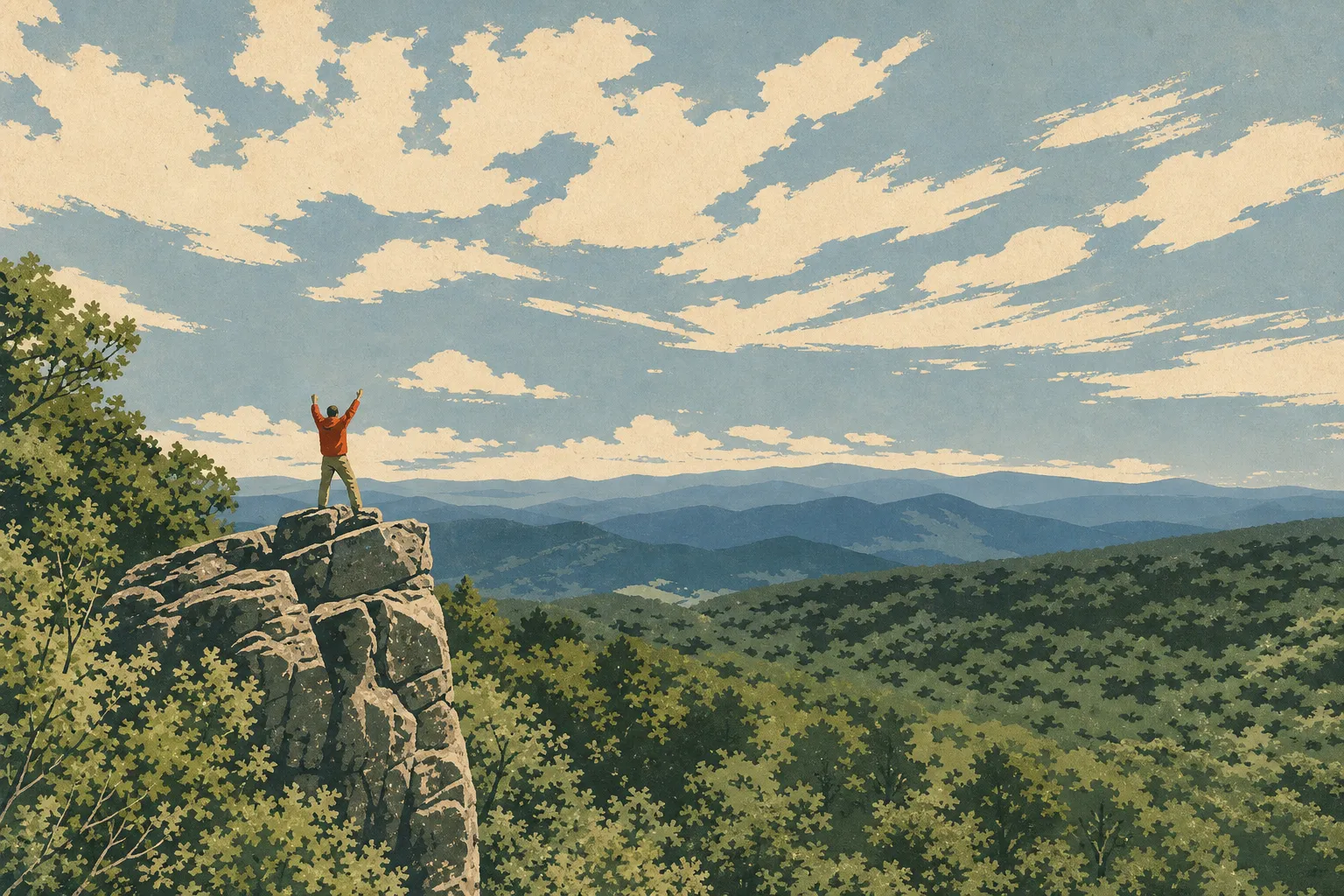
Shenandoah is a long, forested ridge in the Blue Ridge Mountains, crossed end to end by a single road, with one overlook after another every two or three miles. The park stretches about 105 miles from north to south, west of Washington, making it one of the easiest nature escapes to reach from the East Coast. In practice, one day is enough to drive Skyline Drive and take in two or three overlooks. Two days give you time for a real hike and a night in the park. Here's how to plan it.
Shenandoah at a Glance: Where the Park Is and How to Get There
The park occupies a narrow strip of the Blue Ridge Mountains in Virginia, west of the nation's capital. Everything revolves around one main route, Skyline Drive, the scenic road that runs the full length of the park from north to south.
There are four entrances along the road:
- Front Royal, the northern entrance at mile 0 of Skyline Drive;
- Thornton Gap, near US 211;
- Swift Run Gap, near US 33;
- Rockfish Gap, the southern entrance, which connects to the Blue Ridge Parkway.
These four access points naturally divide the park into three main areas: the north, around Front Royal; the central area, around Skyland and Big Meadows; and the south, beyond Swift Run Gap. This layout shapes the entire visit, and we'll come back to it below.
You navigate by milepost. Numbered markers run along Skyline Drive from 0 at Front Royal to 105 at Rockfish Gap. Each point of interest and trailhead is marked with its milepost number. Write them down. It's the easiest way to make sure you don't miss anything.
Entrance Fees, Passes, and Reservations
Your Shenandoah entrance fee is valid for 7 consecutive days. The National Park Service sets the following rates:
- $30 per passenger vehicle, the most common rate regardless of the number of passengers;
- $25 per motorcycle;
- $15 per person entering on foot or by bicycle.
If your road trip includes several American national parks, the America the Beautiful pass quickly pays for itself. For Shenandoah alone, there's also a $55 annual park pass, which makes sense if you plan to return several times during the year.
Unlike some crowded parks, Shenandoah doesn't require a timed entry reservation. You don't need to book a time slot months ahead. Just show up and pay at the entrance. The only reservations to watch are for lodging and, during certain periods, the Old Rag hike, which we'll get to shortly.
Reservations, Permits, and Rules to Follow
What to Reserve in Advance
You don't need a reservation to enter the park. Two other things do require advance planning, though, or you could be in for an unpleasant surprise:
- Campgrounds: Most park campgrounds, including Mathews Arm, Big Meadows, Lewis Mountain, and Loft Mountain, can be reserved through recreation.gov. During an October visit, I found Big Meadows full several weeks out. During fall foliage season, don't leave it to chance.
- Old Rag Mountain: A paid day hike permit is required for this hike year-round. Reserve it through recreation.gov. Slots fill quickly as soon as spring weekends begin, so check availability as soon as your date is set.
Special Permits
- Backcountry camping: You need a free wilderness permit to camp outside developed campgrounds. Get one at visitor centers or by phone, not online.
- Fishing: Fishing is allowed in some park waterways as long as you have a valid Virginia fishing license.
Rules to Follow
- Pets: Allowed on most trails, but they must be kept on a leash no longer than 6 feet. They're prohibited in designated picnic areas and in the backcountry.
- Drones: Prohibited throughout the national park, without exception.
- Picking and collecting: Prohibited. That includes plants, rocks, and fossils.
- Fires: Allowed only in NPS-provided grills at campgrounds and picnic areas. Wildfires are prohibited.
- Speed limits: 35 mph on Skyline Drive and 25 mph on interior secondary roads.
How to Get Around Shenandoah
At Shenandoah, you get around by car. That's it. There isn't a shuttle system like there is at Zion. Skyline Drive is the park's only public road, so you'll drive it in your own vehicle.
The road has its own rules. The speed limit is 35 mph from end to end, and that's no formality. The road is winding, wildlife crosses it, especially deer at dawn and dusk, and overlooks attract cars that slow down or pull over. Give yourself plenty of time. Driving the full 105 miles without stopping takes at least 3 hours, and nobody comes to Shenandoah to drive straight through.
Two important things to know before you go:
- Parts of Skyline Drive close during severe weather, including snow, ice, and heavy fog. The park stays open and you can hike in on foot, but the road may be closed. Check road conditions before heading up in winter.
- There are no gas stations on Skyline Drive. Fill up before you enter.
How Much Time Do You Need to Visit Shenandoah?
How much time do you need to visit Shenandoah? Plan on at least one full day, or two days if you want to take your time. Here's how to make it work with the time you have.
- Half a day: Enter through Front Royal or Rockfish Gap, drive part of Skyline Drive, stop at three or four overlooks, and take a short walk. It's not ideal, but it's possible, especially if Shenandoah is just a stop between Washington and the Blue Ridge Parkway.
- One full day: Drive all or most of Skyline Drive, with a midday hike to a waterfall or an accessible summit. This is the most common option, and it already gives you a good overview of the park.
- Two days and one night in the park: This is the right pace. Break up the drive, take on a major hike such as Old Rag, enjoy a sunrise or sunset from an overlook, and avoid feeling rushed.
Since the park is long and narrow, the time you need mainly depends on how many areas you want to cover. You don't need to do everything. It's better to enjoy one area properly than rush through all three.
Plan your visit
What to See and Do in Shenandoah
The visit unfolds from west to east and north to south, one area at a time. We'll take them in order along Skyline Drive.
Road trip journal · 3 areas
The Northern Area, from Front Royal to Thornton Gap
This is the entrance closest to Washington, so it is often the first stop of the day. The north is the wildest and quietest of the three areas, with fewer headline attractions but overlooks that open onto the Shenandoah Valley on one side and the Piedmont on the other. This is also where you'll start the climb to Old Rag Mountain, the park's best-known hike, with a demanding ascent, rock scrambles, and a full-day loop. This isn't a casual walk. Bring water, wear sturdy shoes, and start early, since access is regulated during busy periods.
The Central Area: Skyland and Big Meadows
This is the park's hub, and probably where you'll spend the most time. Skyland is the highest point along Skyline Drive, with a historic lodge, panoramic views, and trailheads for summits such as Stony Man. A little farther south, Big Meadows is Shenandoah's logistical center, with a large open meadow, which is unusual in this heavily forested park, a visitor center, a campground, lodging, and several hikes starting right nearby, including the descent to Dark Hollow Falls. Choose this area if you can only see one.
The Southern Area, from Swift Run Gap to Rockfish Gap
The southern third is the quietest and most heavily forested. There are fewer facilities, more solitude, and a beautiful string of overlooks all the way to Rockfish Gap, where Skyline Drive hands off to the Blue Ridge Parkway. It's the natural continuation if you're driving south into the Appalachians.
One thread connects all three areas: Skyline Drive itself and its dozens of developed overlooks. You don't have to choose between driving and sightseeing. Here, the road is the attraction, with pullouts where the view opens up just a few steps from your car.
Explore the park
Shenandoah's Best Hikes
Shenandoah has more than 500 miles of trails, including a long stretch of the Appalachian Trail running through the park from north to south. Three types of hikes come up most often:
- Summits and ridgelines: Old Rag and Stony Man for panoramic views, with a real elevation gain;
- Waterfalls: Dark Hollow Falls, a short, accessible hike from Big Meadows, plus Rose River and Whiteoak Canyon for more ambitious hikers;
- Easy walks to an overlook: From a few hundred yards to 1.2 miles, perfect at the end of the day.
Every route has its own details. You'll find distances, elevation gains, difficulty ratings, and trail maps on our Hiking page. One general tip: start early for Old Rag and the popular waterfalls. Trailhead parking lots fill up quickly on weekends.
The detailed guide Shenandoah Hiking: Best Trails for Every Skill Level The best hikes in Shenandoah National Park, organized by area and difficulty,… Read the guide →Wildlife and Plants to Look For
Shenandoah is a temperate forest park, and you can see wildlife without making any special effort. The signature animal is the white-tailed deer, common along Skyline Drive at dawn and dusk. Slow down so you don't hit one. The park also has a healthy black bear population, and sightings are common, especially in spring and summer. Keep your distance, never feed bears, and store all food out of reach, both in your car and at camp.
As for birds, the park is a well-known migration corridor for raptors in the fall. The plant life changes completely with the seasons, too, from carpets of wildflowers in spring to dense green forests in summer and the blaze of fall color, which remains the busiest season.
The detailed guide Shenandoah Wildlife: What Animals to See and Where to Find Them A guide to Shenandoah's deer, black bears, wild turkeys, peregrine falcons, and… Read the guide →When to Visit Shenandoah
Shenandoah moves through four distinct seasons. Spring brings mild temperatures, rain, and the first wildflowers. Summer offers lush green forests, but it can be hot and very humid. Fall brings cooler air and the famous foliage display that draws the most visitors. Winter can bring snow and ice, along with partial closures of Skyline Drive.
One detail to keep in mind is that the park stretches nearly 100 miles, so weather can vary a lot from one end to the other. It's also generally 9 to 11°F cooler at higher elevations than in the valley below. Dress in layers, even in summer.
The detailed guide When to Visit Shenandoah: Best Seasons and Month-by-Month Guide The best times to visit Shenandoah are May to early June and mid-September to… Read the guide →Where to Stay in Shenandoah
Staying in the park changes everything. You can enjoy sunrise and sunset without driving back and forth from the valley. There are three main options:
- Historic lodges, at Skyland, the highest option with views, and at Big Meadows, for those who want a real bed;
- Park campgrounds, several of them along Skyline Drive, including the central, well-equipped Big Meadows Campground;
- The backcountry, for self-sufficient hikers with a permit.
Book early for peak fall season. Supply is limited and rooms and sites go quickly.
Stay in the park
Around Shenandoah: Things to Do Nearby
Shenandoah naturally leads into the surrounding area. To the south, the Blue Ridge Parkway takes over from Skyline Drive at Rockfish Gap and heads toward the Great Smoky Mountains. It's one of the most scenic sequences of scenic roads on the East Coast. At the foot of the park, the Shenandoah Valley is dotted with small towns, caverns, and wineries. Washington is also close enough to combine nature and a city trip in the same visit.
Our Take: Is Shenandoah Worth Visiting?
Yes, as long as you know what you're looking for. Shenandoah doesn't have Yellowstone's geysers or the West's canyons. It's a park of forested ridges, a succession of overlooks, and temperate forest, and it's very easy to reach from the East Coast. Its strength is precisely that accessibility: a beautiful scenic drive, hikes for every level, wildlife you can see without wearing yourself out, and rare proximity to a major city. For a first taste of America's national parks, a stop between Washington and the southern Appalachians, or an autumn weekend spent chasing fall color, it delivers. Visitors looking for dramatic rock scenery may prefer the West. Those who enjoy hiking and quiet drives will be right at home.
The rules to know before you go, including hiking safety, wildlife, fires, and permits, are gathered above in the Reservations, Permits, and Rules to Follow section.
Frequently Asked Questions
How much time do you need to visit Shenandoah?
Plan on at least one full day to visit Shenandoah, or two days if you want to take your time. One day lets you drive Skyline Drive and take one hike. Two days add a major hike, a night in the park, and a sunrise or sunset without rushing.
How much is the entrance fee for Shenandoah?
The Shenandoah entrance fee is $30 per passenger vehicle and is valid for 7 days. The fee is $25 per motorcycle and $15 per person entering on foot or by bicycle. A $55 annual park pass is available, while the America the Beautiful pass is a better deal if you're visiting several parks.
Can you visit Shenandoah by car?
Yes. A car is the only way to visit Shenandoah. Skyline Drive is the park's only public road, and there is no shuttle system. The speed limit is about 35 mph, and there are no gas stations along the road, so fill up before you enter.
When is the best time to visit Shenandoah?
The best time to visit Shenandoah depends on what you're looking for. Fall is best for foliage color and draws the most visitors. Spring brings wildflowers and mild temperatures. Summer brings green forests but hot, humid weather. Our When to Visit page has the month-by-month details.
Which area is best for visiting Shenandoah?
For a first visit, the central area around Skyland and Big Meadows is the best choice. That's where you'll find the most overlooks, nearby trailheads, lodging, and the visitor center. The north is wilder, while the south is quieter and more heavily forested.
Is Shenandoah worth visiting?
Yes, especially if you're looking for forested ridges and easily accessible overlooks near Washington and the East Coast. Come for Skyline Drive, hikes for every level, and wildlife you can see without much effort, rather than the dramatic rock scenery found in the American West.
The American Parks shop
Bring Shenandoah home
Our park-inspired creations, made to order and shipped to your door.
Latest park news
- Shenandoah: Active Wildfire in the South District, Trails and Access Stay OpenA roughly 1.26-acre fire is burning near the Stull Run Trail in Shenandoah's south district. Here's what it means for your visit.
- Shenandoah: Rain, Wind, and Downed Trees Mean Caution on Skyline DriveHeavy rain and high winds can bring trees down on Skyline Drive at Shenandoah, so here's what to know before you hit the road.