
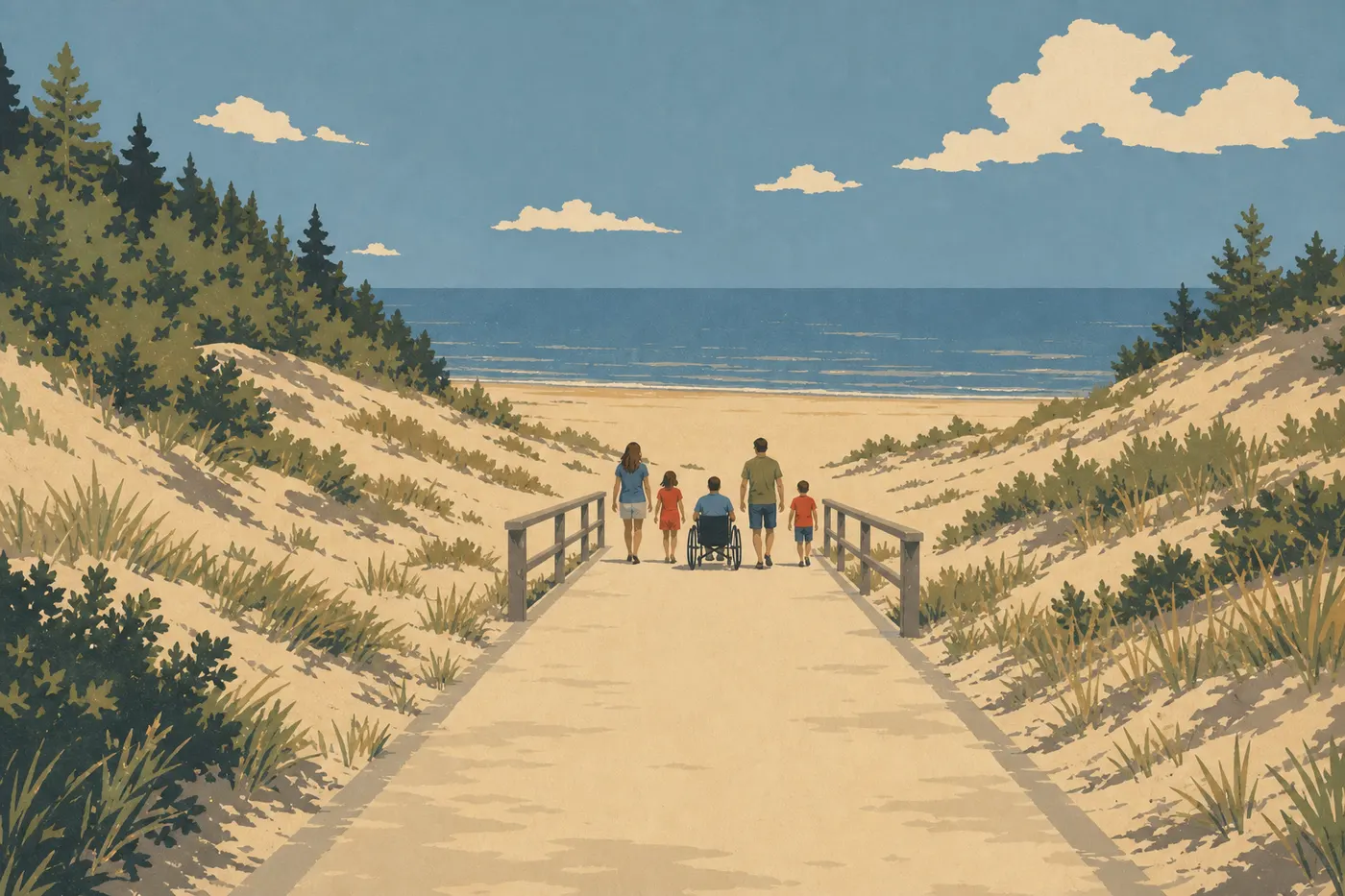
Indiana Dunes with Kids: What to Do and How to Plan Your Visit
Indiana Dunes is a national park made for families. Less than 90 minutes from Chicago, it combines sandy beaches on Lake Michigan, dunes to run down, short forest trails, and surprising biodiversity, all in a compact area where you never spend more than a few miles driving between activities. A child who walks confidently will feel at home here from age 4. With a child carrier, the flat areas work for even the youngest visitors.
Why Visit Indiana Dunes with Kids
The park's strength for families is its variety of terrain within a short distance. In one day, you can go from a lakeside beach to an oak forest, then from a marsh alive with birds to a dune standing dozens of feet tall. You don't have to drive for an hour between sites. Most family activities are clustered around the central area, just a few minutes away by car.
Kids also love how hands-on this place feels. The dune sand is fine and pale, Lake Michigan is calm enough for a first freshwater swim, and birds are easy to watch as soon as you move away from the busiest beaches. On our last visit, I saw a group of preschoolers competing with teenagers to race down the nearest dune, which says a lot about the site's universal appeal.
Another practical advantage is the price. Indiana Dunes remains one of the least expensive national parks to visit in the Great Lakes region, with a per-vehicle fee that works especially well for larger families.
Is Indiana Dunes Good for Kids? What Age Is Best?
Indiana Dunes works very well for families. The terrain is mostly flat or gently rolling, distances are manageable, and developed beaches offer a secure setting during the season. For babies and toddlers ages 0 to 3, the park works well with an all-terrain stroller on compacted beaches and flat trails. By ages 4 or 5, most kids can handle the short trails without much trouble.
One drawback for families with babies is that the dune trails aren't suitable for strollers. Bring a child carrier for sandy uphill sections.
Swimming in Lake Michigan is open to all ages, but it requires constant adult supervision. See the Safety section.
When to Visit with Kids
For families, June through late August is the ideal window. Beaches are open, Lake Michigan's water reaches more comfortable temperatures around 68°F in July, and ranger programs are in full swing. July is the hottest month, with average highs around 81 to 82°F. June is the wettest month, with high average rainfall, so have a backup plan for a rainy morning, such as visiting the visitor center or taking a trip to Michigan City.
Spring, from April through May, suits families who prefer fewer crowds and want to see bird migration. The park is one of the Midwest's best birdwatching spots. Fall brings striking colors to the forest. The park stays open in winter, but water activities close and the dunes can become icy.
Our When to Visit page explains conditions month by month and helps you choose a time that works with your school schedule and reservations.
How Many Days Do You Need with Kids?
Plan on at least two days for a satisfying family visit: one day for the beach and free time on the dunes, and one day for trails and the Junior Ranger program. If Chicago is part of your itinerary, three days give you room to breathe.
Some families visit Indiana Dunes as a day trip from Chicago. It's doable, but the pace can feel demanding with young children. Our Itinerary and Length guide suggests sample days based on the children's ages.
What to Do at Indiana Dunes with Kids: Our Picks
Lake Michigan Beaches
West Beach is the ultimate family choice. There's a managed parking area, a lifeguard station in season, restrooms, and picnic tables. The beach is broad and sandy, and the lake's waves stay moderate, much smaller than ocean waves, which reassures kids who aren't used to swimming in open water. Other beach access points exist along the park, including Portage Lakefront and Dunbar Beach, but West Beach has the best family facilities.
Running Down the Dunes
Climb a 100- to 165-foot dune and run back down. That's what nine out of ten kids do within 15 minutes of arriving. The large dunes open to the public are free to access. Wear closed-toe shoes because the sand can become scorching in mid-July.
Mount Baldy is a living dune that is gradually moving toward the forest. Access is subject to strict safety rules after sinkhole incidents. Check with the visitor center for current access conditions before adding it to your family itinerary.
The Visitor Center
Free and stroller-accessible, the Indiana Dunes Visitor Center, on Indiana State Road 49 near Chesterton, is the logical starting point for a family visit. Pick up the Junior Ranger booklet, trail maps, and ranger program schedules here. The exhibits on dune geology and biodiversity appeal to kids ages 6 or 7 and up.
The Century of Progress Homes
Few national parks contain World's Fair homes. The four Century of Progress homes, brought over from Chicago's 1933 World's Fair, offer an unexpected cultural angle and a welcome shady break in July. It's a 45-minute detour that works well for kids curious about architecture or history.
For all the park's sites and activities, our guide to things to see and do at Indiana Dunes covers each area in detail.
Easy Family Hikes (Short, Little Elevation Gain, Stroller-Friendly)
Indiana Dunes offers several short trails that work well for kids:
Calumet Trail: about 2.5 miles round-trip over flat to gently rolling terrain, through oak forest and prairie. Suitable for an all-terrain stroller. Ideal for kids ages 3 to 8 who are starting to hike. Interpretive signs line the route.
Dune Succession Trail: a short trail of about 0.9 miles with signs explaining the dunes' ecological succession, from bare sand to mature forest. It's a great way to show kids how a beach can become a forest within a few decades. A few gently sloping sections aren't stroller-friendly.
Bailly/Chellberg Trail Loop: a little longer and more varied, it passes through areas connected to the region's early farms. Best for kids ages 8 and up who can maintain an effort over several miles.
Dune Ridge Trail: the most spectacular trail for views of Lake Michigan, but its sandy climb takes energy. Allow about 45 minutes round-trip for well-shod kids ages 7 to 10.
Our Indiana Dunes hiking guide lists all the trails with distances, elevation gains, and difficulty levels.
The Junior Ranger Program
The NPS Junior Ranger program is one of Indiana Dunes' best family features. Kids fill out an activity booklet with field observations, quizzes, and drawings during their visit. Then they show it to a ranger at the visitor center, take the Junior Ranger pledge, and receive their official badge.
The booklet is free at the visitor center, with several levels for different ages, starting at about age 5. The badge ceremony takes five minutes and is one of those simple moments that sticks with kids far longer than you expect.
Here's a practical tip: pick up the booklet when you arrive in the morning. Some activities require observing things along the trail, such as animal tracks and types of vegetation. If you wait until late in the day, you won't have time to go back outside and complete the missions.
Safety with Kids
Lake Michigan Currents
Families who have only spent time around calm bodies of water often underestimate Lake Michigan's longshore currents and rip currents. If the current is strong, swim parallel to the shore instead of trying to fight your way back toward it. Follow the warning flags at West Beach. A red flag means no swimming, while a yellow flag means use caution. Never let a child enter the water without adult supervision, even in shallow areas.
Mount Baldy and Sinkholes
In 2013, a child was swallowed by a sinkhole that opened beneath his feet on Mount Baldy. It was caused by decaying tree roots buried under the sand. He was rescued alive, but the incident led to repeated closures and restrictions in the area. Before taking your kids to Mount Baldy, check access conditions at the visitor center. Some areas remain off the marked route, and you must follow the restrictions exactly.
Heat and Hydration
In July and August, the sand's surface temperature can exceed 104°F. Kids dehydrate faster than adults. Bring at least 1 liter of water per child for a half-day, and regularly look for shade or the lake to cool off.
Plants and Wildlife
The park has poison ivy. Learn to recognize it with your kids before taking any trails outside developed areas. Coyotes are present but generally avoid busy areas. Never feed wildlife. It's a universal NPS rule, and it's especially important here because deer have grown accustomed to approaching picnic areas.
Rangers at the visitor center can explain the current precautions based on conditions that day.
Where to Stay with Your Family (In or Around the Park)
The park has family-friendly campgrounds, including Dunewood Campground, the most convenient option for combining camping with easy beach access. Families who prefer a roof over their heads can find hotels and rentals in Chesterton, Portage, and Michigan City, all within 20 minutes of the park entrances.
Chicago is still a possible base for families with a car who want to combine both destinations. Allow 1.5 to 2 hours depending on traffic, and more on weekends.
Our Where to Stay page and Camping guide compare options based on family needs, including amenities, advance reservations, and access with young children.
Meals and Breaks with Kids
The park doesn't have a restaurant. The golden rule is to bring a picnic. Tables are available near West Beach, the visitor center, and several parking areas. A well-stocked cooler is the most reliable option with kids.
For a break in town, Chesterton, just steps from the main entrance, has several cafés and casual restaurants. Michigan City to the east has more choices. Food trucks sometimes set up at West Beach on summer weekends, but don't count on them when planning your day.
Family Budget
Admission costs $25 per vehicle and is valid for 7 days. For a family of four, that works out cheaper per person than the individual $15 per-person rate. The America the Beautiful pass costs $80 per year and covers Indiana Dunes and all federal national parks. It pays for itself as soon as you visit a second park that year.
Children under 16 enter all U.S. national parks free, which makes a significant difference for larger families.
Our Fees and Passes page explains pass options, free admission, and NPS free-entry days, several of which fall during the school year.
What to Combine Around Indiana Dunes with Kids
Chicago's proximity is the biggest advantage. The Field Museum, Shedd Aquarium, and Museum of Science and Industry are less than 1.5 hours from the park. Many families plan a 4- to 5-day Chicago and Indiana Dunes road trip, visiting the dunes at the beginning or end depending on the season.
To the north, Michigan's beaches extend the Great Lakes experience. To the southeast, South Bend, including the Notre Dame campus, and Fort Wayne round out a more cultural Midwest itinerary.
Our Region and Road Trip guides offer combinations that have been tested with kids.
Indiana Dunes with Kids: Is It Worth It?
Yes, clearly, and often more than expected. Indiana Dunes surprises families who treat it as a stopover on the way to Chicago. They arrive for a morning and leave two days later with a Junior Ranger badge, sand-filled shoes, and plans to return in the fall for the colors. The park checks every box: accessible, varied, easy on little legs, and rich enough for every child to find something they enjoy. The beach, the dunes to run down, and Lake Michigan make it hard to find a more effective destination for a multigenerational group.
Frequently Asked Questions
Is Indiana Dunes good for kids?
Indiana Dunes works very well for kids. Seasonal lifeguarded beaches, open dunes to climb, and the Junior Ranger program make it accessible from ages 4 or 5, with a child carrier useful in the flat areas.
How much time should you plan for Indiana Dunes?
Two days allow for a complete, relaxed family visit: one day for the beach and dunes, and one day for trails and Junior Ranger activities. A single day works as a day trip from Chicago, but it feels short with young children.
Is Indiana Dunes free?
Admission to the national park costs $25 per vehicle and is valid for 7 days, or $15 per person entering on foot. Children under 16 enter free. With the $80-per-year America the Beautiful pass, admission is covered for the entire season at all national parks. For entrance fees and annual passes, see the National Parks Fees and Passes page.
Is Indiana Dunes stroller-accessible?
Some areas work with an all-terrain stroller, including compacted beaches, the visitor center, and flat trails such as Calumet Trail. The dune trails themselves, with their sandy slopes, aren't suitable for a standard stroller. A child carrier remains the best option for dune sections.