

Indiana Dunes National Park: The Complete Visitor Guide
Indiana Dunes is the Midwest's surprise: sand dunes, beaches, and forest packed along Lake Michigan's southern shore, just an hour's drive from Chicago. The site became the 61st U.S. national park on February 15, 2019, after decades as a national lakeshore. People come to walk barefoot beside a lake as vast as a sea, climb shifting dunes, and watch birds. Plan on a full day for the highlights, or two if you want to slow down. Here's how to organize your visit, area by area.
Indiana Dunes at a Glance: Where the Park Is and How to Get There
The park stretches along Lake Michigan's southern shore in northwestern Indiana, between the cities of Gary and Michigan City. It includes nearly 15.5 miles of beaches and shoreline, interrupted by industrial areas. The park isn't one continuous block; it's a patchwork of areas connected by roads. Chicago is about an hour west, making this an easy nature escape from the city.
By car, several major routes serve the park: Interstate 94, the Indiana Toll Road (Interstate 80/90), U.S. Highways 12 and 20, and Indiana State Road 49. The main starting point is the Indiana Dunes Visitor Center on State Road 49, near Porter. That's where you'll get maps, the day's hours, and current access conditions. The South Shore Line commuter train connects Chicago with several stops near the park, which is a convenient option if you don't have a car. For detailed approach routes and parking information for each area, see our guide to getting to Indiana Dunes.
Entrance Fees, Passes, and Reservations
The good news is that much of Indiana Dunes is free to access. Many beaches, trails, and areas are free to visit, with no entrance station. Entrance fees apply mainly at West Beach, the park's most developed area, where parking is paid and seasonal.
The official NPS fees are:
- Private vehicle: $25, valid for 7 days.
- Motorcycle: $20.
- Pedestrian or bicyclist: $15 per person.
- Park annual pass: $45, which pays for itself on your second visit by car.
If you're visiting several U.S. parks during the year, the $80 America the Beautiful pass is still the best value and covers entry here. Our Fees & Passes page explains entrance fees and passes, including commercial rates for groups. Collectors can pick up the official stamp at the visitor center; see our Passport & Stamps page.
Reservations, Permits, and Rules to Follow
Reservations and Permits
You don't need a reservation to enter the park or access the beaches. For camping, reserve a site at Dunewood Campground through Recreation.gov, especially if you're planning a weekend from June through August. Sites fill quickly.
Park hikes don't require permits. For special uses such as organized events, filming, or scientific research, contact park administration directly. If you collect national park stamps, our Passport & Stamps page explains what's available at the Indiana Dunes Visitor Center.
Essential Rules
- Pets: allowed in the park, but prohibited on beaches and most trails. Keep them leashed at all times in permitted areas, with a maximum leash length of 6.5 feet.
- Fires: allowed only at campsites with a designated fire ring. Fires are prohibited on the beach and outside developed areas.
- Drones: prohibited without prior authorization from the park.
- Collecting: leave everything where you find it, including plants, rocks, and fossils. That includes dune sand. What you take away, the park loses.
- Alcohol: allowed in picnic areas and campsites. Prohibited at West Beach.
- Off-trail travel in the dunes: fragile dune areas are clearly marked. Walking off-trail damages stabilizing vegetation and speeds up erosion.
Getting Around Indiana Dunes: Roads, Areas, and Beaches
You visit this park by car. Since there's no internal shuttle, driving is the most flexible way to move from one area to another. Beaches, bogs, and forests are spread across about 18.6 miles from east to west. Each area has its own parking lot, often a small one that fills quickly on summer weekends.
One useful through route is U.S. Highway 12, which follows the lake and connects most beach access points. By bike, the Calumet Trail and Dunes Kankakee Trail connect several destinations without getting back in the car. For area-by-area planning, parking, and bike connections, head to our Getting Around page.
How Much Time Do You Need for Indiana Dunes?
A day is enough for the essentials: one beach, one dune to climb, and one forest trail. It's an ideal day trip from Chicago. With two days, you can add the bogs, bird-watching, and sunrise over the lake without rushing. Beyond that, the park makes a relaxed base for exploring the Great Lakes region.
Our advice is to arrive early in summer to find a parking spot at the beaches, then save the afternoon for the shady, wooded areas. To build an hour-by-hour plan based on your available time, see our dedicated Itinerary & Timing page.
Plan your visit
What to See and Do at Indiana Dunes
This is the heart of the visit. The park feels like a collection of areas, each with its own character: beach, shifting dune, bog, or forest. Here's how to divide it up.
Road trip journal · 4 areas
West Beach and Lake Michigan Beaches
West Beach is the most complete area, with a large beach staffed by lifeguards in season, changing rooms, and the Dune Succession Trail. The trail climbs the dune on wooden stairs before descending on the forest side. Elsewhere, Porter Beach, Kemil Beach, and Central Avenue Beach offer wilder, quieter access points. Lake Michigan stays chilly even in summer. It's refreshing for a quick dip, less appealing for a long swim.
Mount Baldy, the Shifting Dune
Mount Baldy is a shifting dune that advances a few yards each year, driven by the wind and slowly swallowing the forest behind it. Be careful: access to the summit is regulated and often limited to ranger-led tours because of incidents involving unstable pockets of sand. Never venture beyond authorized areas, and obey closure signs.
Cowles Bog, Pinhook Bog, and Wetlands
The park also hides less obvious natural treasures. Cowles Bog combines marsh, forest, and dunes on a demanding loop. Pinhook Bog is an exceptionally rare floating bog in the region. It's protected and accessible only with an escort to preserve its fragile ecosystem. These habitats explain the park's biological richness: more than 1,100 plant species coexist here, putting Indiana Dunes among the most diverse units in the national park system.
Historic Farms and Forests
The Chellberg Farm and Bailly Homestead area tells the story of the region's Swedish pioneers and early French settlers along shady trails. Miller Woods, to the west, alternates between wooded sandy ridges and wetlands, making it an ideal place for early-morning wildlife watching.
Every area deserves time. For a complete, season-by-season list of activities, see our up-to-date Things to Do page. To choose loops that match your experience, head to our Indiana Dunes hikes.
Explore the park
The Best Hikes in Indiana Dunes
The park has about 31 miles of trails, ranging from easy flat walks to climbs through sand that are much harder than they look. Our must-dos include the Dune Succession Trail at West Beach, a short loop with sandy elevation gain; the Cowles Bog loop to the lake; and the Pinhook Bog Trail for its bog atmosphere. A word from experience: walking in loose sand doubles the effort, so bring water even for short distances. Our dedicated Hiking page covers distances, elevation gains, and difficulty levels.
The detailed guide Hiking in Indiana Dunes: The Best Trails for Every Skill Level The best Indiana Dunes trails by area, difficulty, and length, with practical… Read the guide →Wildlife and Plants to Look For
Indiana Dunes is a major birding destination. Sitting on a major migration corridor along Lake Michigan, the park sees more than 350 bird species pass through over the seasons, with spectacular peaks in spring and fall. Look up and you'll spot terns, herons, warblers, and migrating raptors.
On the ground, the mix of habitats, including dunes, marshes, forests, and prairies, shelters foxes, white-tailed deer, turtles, and unusual plant life. Dune cactus grows alongside boreal bog plants, a rare botanical contrast at this latitude. Find detailed viewing times and locations on our Wildlife page.
The detailed guide Indiana Dunes Wildlife: Animals to See and Where to Find Them White-tailed deer, great blue herons, coyotes, and monarch butterflies Read the guide →When to Visit Indiana Dunes
Summer, from June through August, is peak season. The water is accessible and beaches have lifeguards, but parking lots fill by morning. Spring and fall are our favorite seasons, with soft light, bird migrations, and thinner crowds. In winter, the park takes on a polar feel, with ice sculptures along the shore and trails that remain usable but slippery.
As for weather, July is the hottest month, with a record high of 106°F in 1934. January is the coldest, reaching as low as -26°F in 1985. June is the wettest, averaging about 4.6 inches of rain. We cover each month in our When to Visit page and provide detailed climate data on the Weather page.
The detailed guide When to Visit Indiana Dunes: The Best Time to Go The best times to visit Indiana Dunes are May and September-October for nature… Read the guide →Where to Stay Near Indiana Dunes: Hotels and Campgrounds
The national park operates just one campground, Dunewood Campground, tucked into the forest and open seasonally. For a real bed, stay in nearby towns. Chesterton, Porter, Michigan City, and Valparaiso offer motels and hotel chains at reasonable prices. Many visitors even sleep in Chicago and make a day trip to the park. Here's where to find each option:
- Overview and tradeoffs: our Where to Stay guide.
- Traditional lodging: the Hotels & Lodges and Camping pages.
- RV travel: our RV Camping page for sites and suitable services.
Stay in the park
Around Indiana Dunes: Things to Do Nearby
The national park borders Indiana Dunes State Park, which is managed by the state. It has the area's highest dunes and the famous 3 Dune Challenge, a loop that links three sandy summits with a separate entrance fee. To the west, Chicago offers a day in the city. To the east, Michigan City and its shoreline extend the road trip along the lake. Indiana Dunes is part of the Great Lakes region and works well as a stop on a lakeside road trip.
Before you leave, take one last look at our Practical Information, Rules & Safety page for lifeguarded swimming, closed areas such as Mount Baldy, bog protection, and leash rules for dogs. For food in the park or nearby, we've gathered our recommendations on the Where to Eat page.
Our Take: Is Indiana Dunes Worth the Trip?
Yes, as long as you know what you're looking for. Don't expect Western canyons. Indiana Dunes offers something else: a vast lakeshore, surprising biodiversity, and unbeatable proximity to Chicago. For a nature escape from the city, a break on a Great Lakes road trip, or a beach-and-forest day with the family, it's an excellent choice. When we visited one May morning, the silence of the dunes, broken by migrating birds, was enough to win us over. For the full planning picture, dip into our themed guides as needed.
Frequently Asked Questions
Is Access to the Indiana Dunes Free?
Access to the Indiana Dunes is free in much of the national park. Many beaches and trails have no entrance station. The entrance fee, $25 per vehicle, applies mainly to the developed West Beach area. Keep in mind that nearby Indiana Dunes State Park has its own fees.
Which Part of Indiana Dunes Is Best?
The best part of Indiana Dunes depends on what you want. Choose West Beach for a full-service beach and a dune climb, Cowles Bog for a nature hike, Mount Baldy for the shifting dune with regulated access, or Miller Woods for early-morning birding. We compare every area on our Things to Do page.
How Much Time Should You Plan for Indiana Dunes?
Plan on a full day for the Indiana Dunes essentials, including a beach, a dune, and a trail. Allow two days to add bogs and bird-watching without rushing. Our Itinerary & Timing page offers sample plans for different amounts of time.
What Notable Movies Were Filmed at Indiana Dunes?
The question actually refers to “Indian Dunes,” a former filming ranch in California, which shouldn't be confused with Indiana Dunes National Park in Indiana. Indiana's national park is known for its natural scenery and biodiversity, not for a film history.
The American Parks shop
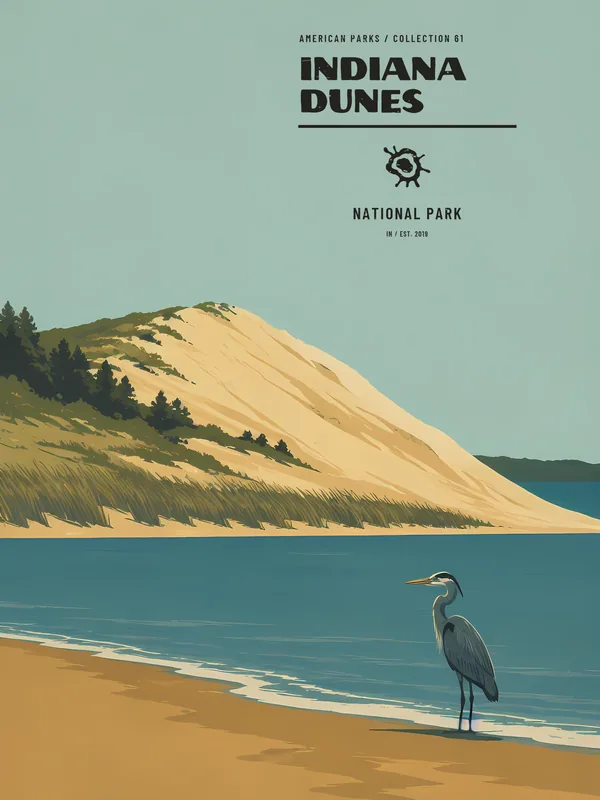
Bring Indiana Dunes home
Our park-inspired creations, made to order and shipped to your door.
Latest park news
- Indiana Dunes: Part of the Bailly / Chellberg Trail Closed Through Late OctoberSections of the Bailly / Chellberg Trail, including the stairs, are closed through October 30, 2026, for a boardwalk replacement.
- Indiana Dunes: West Beach Road Closed for Construction, Plan a DetourThe main road to West Beach is closed for railroad-crossing construction, so here's the detour to know before you head over.
- Indiana Dunes: Tolleston Dunes Trail Closed for Chainsaw ClearingThe Tolleston Dunes Trail is closed while crews clear the path, with reopening expected in the next one to two weeks.