

Dry Tortugas National Park: The Complete Visitor Guide
Dry Tortugas is the hardest national park in Florida to reach, and probably one of the most surprising in the United States. Seven small sand-and-coral islands sit 70 miles west of Key West in the Gulf of Mexico, with a 19th-century brick fortress at their center that seems to float on turquoise water. You can't get there by car or on foot. Your options are a boat or a seaplane. That's what makes this place so distinctive, and why it takes some planning.
The short version: Plan on a full day from Key West to explore Fort Jefferson, snorkel around the reefs, and set foot on a deserted beach. Admission is $15 per person. You can get there by ferry, which takes about 2.5 hours, or by seaplane, with a 40-minute flight. The park is open 24/7, but transportation logistics shape the whole visit, so book well ahead.
Dry Tortugas at a Glance: Where the Park Is and How to Get There
The park sits at the very end of the Florida Keys, 70 miles west of Key West, which is already at the southern tip of Florida. You're in one of the most isolated corners of the U.S. national park system. There are no roads, bridges, or stores here. Just the sea, a few small islands, and the fort.
Ponce de León named the island chain “Tortugas” (turtles) in 1513 because sea turtles were so abundant there. “Dry” was added later to nautical charts to warn navigators that there was no fresh water. That detail says almost everything about the place. Here, everything has to be brought in, including the water you drink.
In practical terms, you can reach Dry Tortugas in three ways: the concession-operated ferry that leaves Key West every day, a seaplane, or your own boat, including a charter. We cover each option, along with schedules and prices, in our guide to getting to Dry Tortugas.
Entrance Fees, Passes, and Reservations
Admission to the park is $15 per person and is valid for seven days. The good news is that admission is almost always included in the ferry or seaplane ticket, so you usually won't pay anything separately when you arrive. If you're coming in your own boat, however, you'll need to pay it yourself.
The America the Beautiful pass, the annual national parks pass, covers this fee. Even so, it's worth checking when you book your transportation to see how the pass is handled. Our national parks Fees and Passes page explains entrance fees and passes.
Transportation is the real expense, not admission. Seats on both the ferry and seaplane are limited and fill quickly, especially during the busy winter and spring seasons. Book several weeks ahead, or even several months ahead for peak periods. And don't forget the collectors: the fort has a cancellation station where you can add to your passport, as we explain on our Passport and Cancellations page.
Reservations, Permits, and Rules to Follow
What to Reserve Ahead of Time
The concession-operated ferry requires a reservation, especially from January through May. Garden Key's 10 campsites, which are first-come, first-served even in the age of online reservations, fill up quickly for weekends and American school breaks.
Private boats that want to anchor at Garden Key or Loggerhead Key must get an anchoring permit from the NPS. Contact the park directly for availability and permitted areas.
Essential Rules to Know
No collecting: You can't take any coral, shells, or historic artifacts with you. Fort Jefferson is a 19th-century military site and national historic landmark. Touching the structures is prohibited.
Fishing: Fishing is allowed in certain areas with a valid Florida state license. Research Natural Areas are clearly marked. Do not enter them, even by kayak.
Fires and drones: Campfires are prohibited. Drones require a specific NPS permit. Without one, drone use is prohibited.
Pets: Pets are allowed aboard private boats, but they can't come ashore on the islands.
Diving: The reef around Garden Key is protected. Anchoring on or touching living coral is prohibited. Use only the designated mooring buoys.
Getting Around Dry Tortugas: Ferry, Seaplane, or Boat
Once you've figured out how to get there, getting around is easy. The park is tiny, and you can do everything on foot. Here are the three ways to arrive.
The ferry is the most common option. The trip from Key West takes about 2.5 hours, and breakfast and lunch are often included, along with snorkeling gear. You'll spend the morning and early afternoon on the island before heading back. It's the most comfortable way to enjoy a full day without the stress.
The seaplane connects Key West with Garden Key in about 40 minutes. Along the way, you'll get striking aerial views of the reefs, shipwrecks, and the fort. Options include half-day and full-day trips. It's more expensive than the ferry, but some visitors find the time saved and the flyover worth the extra cost.
Your own boat or a charter gives you the freedom to stay longer, anchor offshore, and even camp. You'll need to be completely self-sufficient. There is no fuel, water, or resupply on the island.
Once you're there, there are no shuttles or vehicles. You walk. The longest distances are measured in hundreds of yards. Our Getting Around guide has all the details on schedules and connections.
How Long Does It Take to Visit Dry Tortugas?
For most visitors, Dry Tortugas is a one-day trip. That's the schedule imposed by the ferry and seaplane, and it's plenty of time to tour the fort, swim over the coral, and walk along the beach. With the ferry, plan on about four to five hours on the island. A seaplane trip may give you a little less or a little more time, depending on the package you choose.
If you want a different experience, there's only one option: camp for a night on Garden Key. Waking up on a deserted island, without crowds or artificial light, completely changes the experience. The campground is basic, and you'll need to be fully self-sufficient. We cover the requirements, number of sites, and logistics on our Garden Key camping page.
As for the bigger picture, Dry Tortugas almost always fits into a longer trip through the Keys or Florida. To work the day into your itinerary, see our Itinerary and Timing page.
Plan your visit
What to See and Do in Dry Tortugas
The park covers just a few small islands, but each has its own character. Here's how to divide your time, area by area.
Road trip journal · 3 areas
Fort Jefferson on Garden Key
This is the heart of the visit and the main landing point. Fort Jefferson is a massive coastal brick fortress built beginning in 1846 to control shipping in the Gulf of Mexico. The structure was never completed or seriously tested in battle, and it served as a military prison during the Civil War. The result is a complex made of several million bricks, a moat surrounding the walls, and a high walkway along the ramparts with sweeping views of the island chain.
Allow one to two hours to explore it: the inner courtyard, vaulted casemates, cannons, and rampart walk. This is where the park's history comes to life, and the signs explain both the engineering and the site's life as a prison.
Snorkeling and Diving
The water around Garden Key is shallow, warm, and clear. The old moat wall and pilings act as an artificial reef, attracting tropical fish, coral, and sometimes a turtle. You don't need to be an experienced diver. A simple mask and snorkel are enough from the beach. Ferry trips provide the gear.
Scuba divers, on the other hand, come by boat to explore more distant reefs and shipwrecks. We bring together the sites, required skill level, and precautions in our guide to activities in Dry Tortugas.
The Other Islands
Loggerhead Key, the largest island in the chain, has a lighthouse and can only be reached by private boat. Bush Key, next to Garden Key, is a bird nesting area closed to the public for part of the year. You often view these islands from a distance, but they are part of the scenery and help explain the site's natural richness.
Explore the park
Hiking and Walks in Dry Tortugas
Let's be clear: Dry Tortugas isn't a hiking destination. The islands are too small for true trails. What you'll do here are walks: around the outside of Fort Jefferson at water level, along the ramparts, and back and forth along Garden Key's beach. On Loggerhead Key, which you can reach by private boat, a few paths lead to the lighthouse.
The appeal isn't elevation gain. It's walking above the sea on walls more than 170 years old. We describe these routes, their duration, and their accessibility on our Hiking page.
Wildlife and Plants to Watch For
Dry Tortugas is a sanctuary, especially for birds and sea turtles. In spring, Bush Key hosts large nesting colonies of terns. The park is a major stopover for migratory birds crossing the Gulf. Birders and curious visitors sometimes come just for this spectacle.
Below the surface, the island chain still lives up to its name because sea turtles remain common here. Coral reefs, tropical fish, rays, and, if you're lucky, a turtle grazing on the seafloor make underwater life the park's second face, just as important as the fort. We explain what to see, where, and when on our Wildlife page.
The detailed guide Dry Tortugas Wildlife: What Animals to See and Where to Find Them Sea turtles, frigatebirds, brown boobies, barracudas, and stingrays Read the guide →When to Visit Dry Tortugas
The climate is subtropical, with temperatures generally ranging from 59 to 90°F year-round. Two seasons shape the calendar. Winter, from December through March, is milder and drier, but also windier. The sea gets rougher, and trips can be choppy or even canceled. Summer, from June through November, is hot and humid, with a risk of isolated thunderstorms and tropical storms.
For many visitors, spring is the best window: calmer seas than in the middle of winter, manageable heat, and birds in the middle of nesting season. Every season has its advantages, though. We break things down month by month, including wind and wildlife calendars, on our When to Visit page, with temperature and marine-condition reports on our Weather page.
The detailed guide When to Visit Dry Tortugas: Best Time, Weather, and Seasons The best time to visit Dry Tortugas is April through early June Read the guide →Where to Stay in Dry Tortugas
On the island itself, there's only one option: camping on Garden Key, with basic facilities and complete self-sufficiency. You bring everything, including water. There are few sites, and reservations go through your transportation provider, but a night under the stars at the foot of the fort stays with you. Find details and advice on our Camping page.
For everything else, Key West is the obvious base for ferry and seaplane departures. You'll find hotels, guesthouses, and rentals at every price point, along with campgrounds and RV areas along the Keys route. We compare neighborhoods and properties in our Where to Stay guide, with property details on our Hotels and Lodges, Camping, and RV Camping pages.
Stay in the park
Around Dry Tortugas: Things to Do Nearby
No one comes to the Keys just for Dry Tortugas. The park is the highlight of a longer trip. Key West, your departure port, deserves at least a day for its historic district, sunsets at Mallory Square, and end-of-the-road atmosphere. Drive north on US 1 toward the mainland and the Florida Keys roll out with beaches, snorkeling spots, and fishing villages.
Less than two hours north by car is another Florida giant: Everglades National Park, with its wetlands, alligators, and mangroves. The two parks work very well together on one itinerary. You'll find these combined routes in our road trips and our Florida regional guides.
Our Take: Is Dry Tortugas Worth the Trip?
Yes, as long as you know what you're signing up for. This isn't a convenient visit. It takes a full day, a substantial transportation budget, and advance reservations. In return, you get what few parks can offer: a spectacular fortress surrounded by Caribbean water, snorkeling that's accessible to everyone, deserted beaches, and the rare feeling of being truly far from everything.
When we visited, the contrast stayed with us: the somewhat lengthy crossing, then the fort appearing on the horizon, followed by the sudden silence of an island without cars or crowds. If you're in the Keys and the sea is calm, go for it. If your schedule is already tight or the forecast looks bad, it's better to skip the trip than endure a miserable crossing. For help deciding, see our Practical Information, Rules, and Safety and When to Visit pages.
Frequently Asked Questions
How Do You Get to Dry Tortugas?
You can reach Dry Tortugas only by sea or air from Key West: by concession-operated ferry, which takes about 2.5 hours, by seaplane, with a flight of about 40 minutes, or by private boat. No road or bridge connects the park to the mainland. Book your transportation in advance because seats are limited.
How Do You Get to Dry Tortugas?
To get to Dry Tortugas, first make your way to Key West at the southern tip of Florida, then board the daily ferry or a seaplane. The park lies 70 miles west of Key West in the Gulf of Mexico. Our Getting There and Transportation page compares schedules, prices, and options.
How Much Does It Cost to Enter Dry Tortugas?
Admission to Dry Tortugas costs $15 per person, is valid for seven days, and is covered by the America the Beautiful pass. The fee is generally already included in your ferry or seaplane ticket. See our Fees and Passes page for details.
How Long Do You Need to Visit Dry Tortugas?
Plan on a full day to visit Dry Tortugas, including about four to five hours on the island with the ferry. That's enough time to see Fort Jefferson, snorkel, and walk along the beach. To experience the place more fully, the only way to extend your stay is to camp for a night on Garden Key. See our Itinerary and Timing page.
What Is the Most Beautiful Place in the Keys?
The best place in the Keys depends on what you're looking for, but Dry Tortugas stands out for its isolation and one-of-a-kind setting: a historic fortress surrounded by turquoise water, far from any road. Key West wins visitors over with its atmosphere, while the other Keys offer their own snorkeling spots. We compare them in our Florida regional guide.
Is Dry Tortugas Worth It?
Dry Tortugas is worth it if you're looking for a rare experience and the weather cooperates. The spectacular fortress, accessible snorkeling, and deserted beaches justify the day and transportation costs. If your trip is very short or the sea is too rough, though, it's better to postpone. Our “Our Take” section above can help you decide.
The American Parks shop
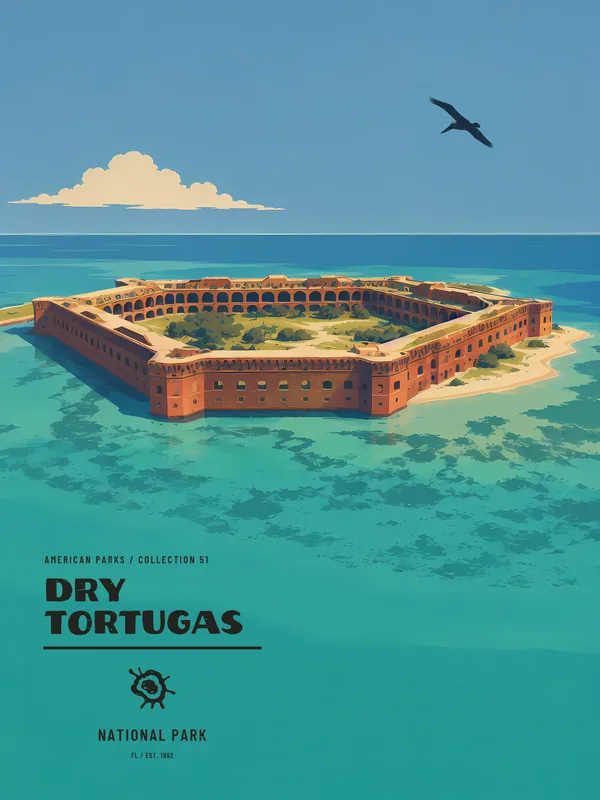
Bring Dry Tortugas home
Our park-inspired creations, made to order and shipped to your door.
Latest park news
- Dry Tortugas: Most of Bush Key Reopens, One Area Still Closed for FrigatebirdsMost of Bush Key at Dry Tortugas is open to you again, but a few areas stay off-limits to protect nesting frigatebirds.
- Dry Tortugas: Fort Jefferson Briefly Closed September 15 for a Helicopter OperationOn September 15, a helicopter operation closes Fort Jefferson for about an hour sometime between 7 and 11 a.m. Here's what it means for your visit.
- Dry Tortugas: Fort Jefferson's moat wall under repairSections of Fort Jefferson's moat wall are closed for post-hurricane repairs, with marked-off work zones to respect on site.