

Day Trips from Las Vegas: Hoover Dam, Valley of Fire, and the Grand Canyon
From Red Rock Canyon to the Grand Canyon South Rim, compare distances, drive times, seasons, and practical tips for day trips from Las Vegas.
By Jocelyn Pion · · 12 min read
Las Vegas is also a convenient base for exploring the American West. Just 30 miles from the Strip, Hoover Dam spans the Colorado River between Nevada and Arizona. Red Rock Canyon is 19 miles away, while the Grand Canyon South Rim, the NPS-managed national park, is a 4.5-hour drive. The trips below are listed from the Strip in order of increasing distance. Activities in the city, including the Strip and Fremont Street, are covered in our Las Vegas guide.
Day Trips from Las Vegas: Distances and Drive Times
| Trip | Distance | Drive time | Recommended time | Season |
|---|---|---|---|---|
| Red Rock Canyon | 19 miles | 30 min | half-day | year-round (morning in summer) |
| Hoover Dam and Lake Mead | 30 miles | 45-55 min | half-day to full day | year-round |
| Valley of Fire | 53 miles | 1 hour | full day | September to May |
| Grand Canyon West | 134 miles | 2.5 hours | full day | year-round |
| Death Valley | about 140 miles | 2.5 hours | full day | October to April only |
| Zion | 171 miles | 2 hours 45 min | full day or 1 night | year-round |
| Grand Canyon South Rim | 273 miles | 4.5 hours | long day or 1 night | year-round |
In summer, heat is the first factor to consider when planning these trips. Death Valley regularly tops 113°F from June through August: the NPS advises against hiking above 100°F and closes certain areas. Red Rock Canyon and Valley of Fire remain accessible during this period, but only in the morning, before 10 a.m. Hoover Dam is largely covered and can be visited year-round. Thanks to its elevation of 6,900 feet, the Grand Canyon South Rim has reasonable temperatures even in the middle of summer.
Red Rock Canyon: 30 Minutes Away, but Reservations Are Required
Just 19 miles from the Strip via US-159, Red Rock Canyon is the quickest day trip from Las Vegas. The national conservation area is managed by the Bureau of Land Management (BLM), not the NPS, but the America the Beautiful Pass is valid there. The 13-mile Scenic Drive follows the red sandstone formations of the Mojave Desert on a one-way loop. No major hike is required: the road alone offers views of white limestone cliffs and red layers sculpted over millions of years. Short trails, including Calico Hills and Keystone Thrust, round out a half-day visit.
Timed reservations have been required since 2022. Reservations are required from October 1 through May 31, from 8 a.m. to 5 p.m., and must be booked on recreation.gov. Outside that period, entry is open without advance reservations. Time slots fill up quickly in April, May, and October.
The vehicle fee is about $20, excluding passes, plus a $2 online reservation fee. Check blm.gov before your visit. In summer, leaving before 8 a.m. helps you avoid both the heat and sold-out time slots. A car is essential: no regular transit connects the Strip with Red Rock Canyon. To rent a car in the United States, rental agencies are available directly at Harry Reid Airport, 3 miles from the Strip.
Hoover Dam and Lake Mead: The Classic Day Trip
Construction of Hoover Dam began in 1931 and finished in 1936, two years ahead of schedule. Around 21,000 workers worked on the project in summer temperatures reaching 118°F. The Bureau of Reclamation records 96 accidental deaths at the site. The often-quoted figure of 112 includes deaths that occurred before the official start of construction or outside the construction zone. Franklin Roosevelt dedicated the dam on September 30, 1935. One often-forgotten detail: from 1933 to 1947, the dam was officially called "Boulder Dam," after it was renamed by Secretary of the Interior Harold Ickes. Congress restored the name "Hoover Dam" by resolution in 1947.
The dam in numbers. It is 726 feet high, 1,244 feet long, 656 feet wide at the base, and 45 feet wide at the top. About 3.24 million cubic yards of concrete were used, weighing nearly 7.7 million tons. Upstream, Lake Mead is the largest reservoir in the United States, holding about 8.7 cubic miles at full capacity.
Three ways to visit. General access is free and includes parking, crossing by car or on foot, and views from the railings. Opened in 1995, the Visitor Center has a permanent exhibit on construction and the turbines for about $15 per person in 2026, with no reservation required. The Power Plant Tour provides access to the interior galleries and operating turbines. It costs about $25 per person in 2026, with the price to be confirmed on usbr.gov. This third option is the most complete way to understand how the dam works, and the partly air-conditioned route is welcome even in midsummer.
The Mike O'Callaghan - Pat Tillman Bridge, opened in 2010, crosses the Black Canyon 886 feet above the Colorado River and is 1,900 feet long overall. From the bridge deck, the view looks straight down onto the downstream face of the dam with no obstruction. It is accessible on foot from the parking lot, and the round trip takes 20 to 30 minutes.
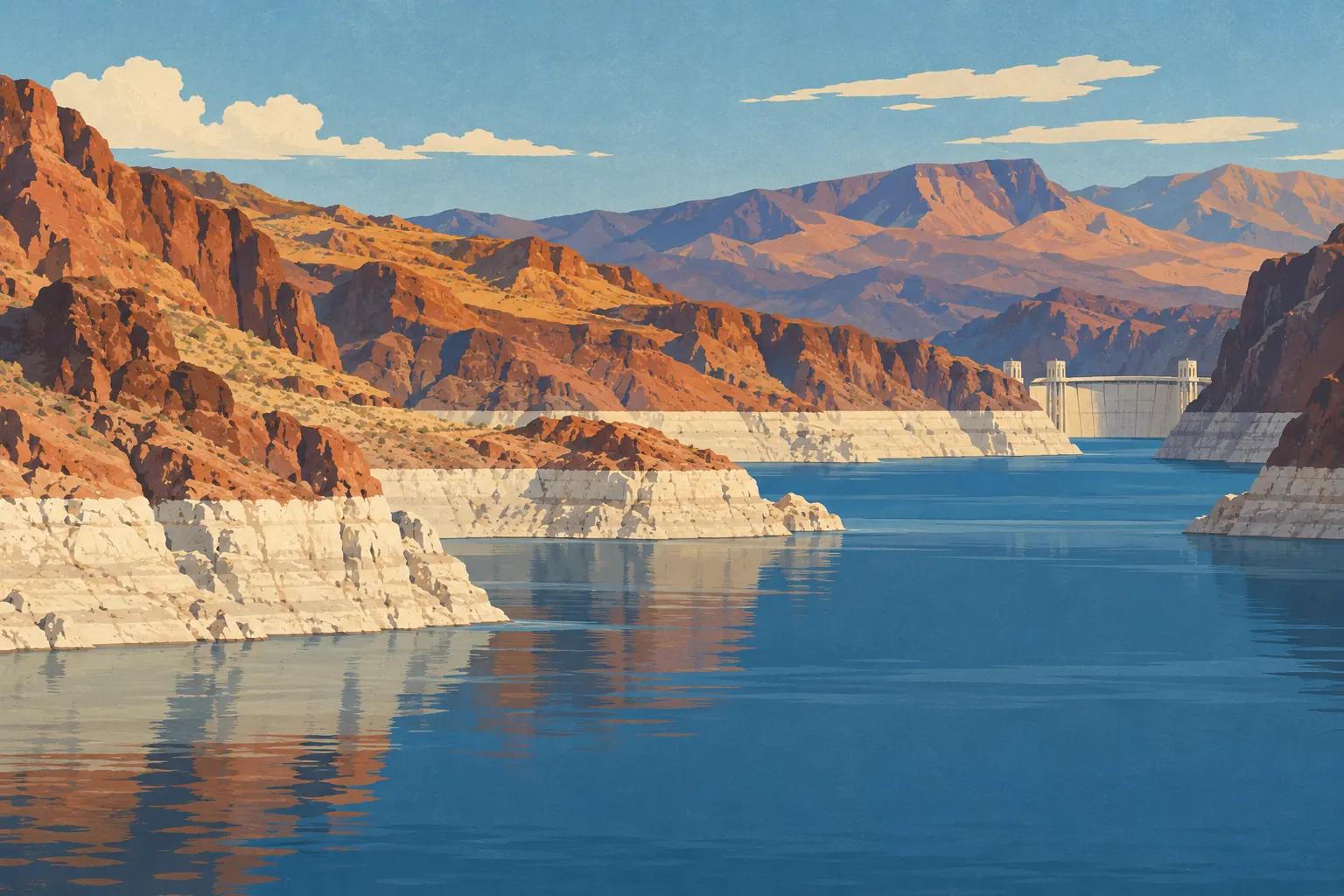
Lake Mead and the drought. According to Bureau of Reclamation data, the lake level has dropped by about 164 feet since 2000. The white limestone "bathtub rings" along the shores are visible to the naked eye from the dam and bridge. They mark the high-water line reached by the reservoir when it was at its fullest. Las Vegas has reduced its water consumption by about 26% despite tripling its population since the 1980s, according to figures from the Southern Nevada Water Authority.
Getting there. Take US-93 toward Boulder City from the Strip. The drive is 30 miles and takes 45 to 55 minutes in light traffic, or 70 to 80 minutes during rush hour. Organized half-day tours from the Strip cost roughly $60 to $70 per person, depending on the operator (2026 rates).
Valley of Fire: Red Sandstone and Petroglyphs One Hour from Las Vegas
About 53 miles away via I-15 N and NV-169, Valley of Fire is a Nevada state park, not an NPS national park, so the America the Beautiful Pass is not valid there. The entrance fee is about $15 per vehicle with out-of-state plates. Check parks.nv.gov before your visit. The 150-million-year-old Aztec sandstone formations take on orange, ocher, and purple hues depending on the time of day.
What you will see. The petroglyphs along Mouse's Tank Trail were carved about 2,500 years ago by Basketmaker peoples and later by ancestral Puebloans. Arch Rock and Elephant Rock are accessible from the parking lot without a long hike. Fire Wave, a 1.5-mile round trip, leads to rippled pink and white layers. White Domes, a 3.1-mile loop, is the most popular complete trail.
Allow three to four hours on site for the main attractions. From June through September, afternoon temperatures exceed 113°F. Do not leave your vehicle between 11 a.m. and 4 p.m.
Valley of Fire and Hoover Dam lie in opposite directions from Las Vegas: northeast for Valley of Fire via I-15 N, and southeast for the dam via US-93. Combining both in one day by returning through the city is possible if you leave at 6 a.m., but exhausting. It is better to choose one or the other. Organized tours to Valley of Fire from the Strip are uncommon, so a car is essential.
Grand Canyon: West Rim or South Rim, Two Very Different Experiences
The most common planning mistake on a road trip from Las Vegas is assuming that "Grand Canyon West" and "Grand Canyon South Rim" refer to the same place. They are not two entrances to the same park. They are separate destinations managed by two different organizations.
Grand Canyon West (Skywalk). It is 134 miles from Las Vegas, a 2.5-hour drive. The site is managed by the Hualapai Nation on its tribal land. It is not an NPS national park, and the America the Beautiful Pass is not valid. The Skywalk is a U-shaped glass walkway suspended above the canyon. A pass including the Skywalk costs about $68 to $99 per person in 2026, depending on the package. Confirm current prices on grandcanyonwest.com. The view looks toward the canyon's west side, not the classic overlooks at the South Rim. Organized day tours from the Strip visit this site, making it the practical option for travelers without a car or with only one day available.
Grand Canyon South Rim. It is 273 miles from Las Vegas, a 4.5-hour drive. This is Grand Canyon National Park managed by the NPS, the Grand Canyon most people picture. The America the Beautiful Pass is valid and saves $35 per vehicle. Mather Point, Desert View Drive, and Bright Angel Trail make up the essentials of a day visit. Bright Angel Trail descends into the canyon for those who want to hike.
The South Rim is possible in a single day from Las Vegas, but exhausting: about 547 miles round trip, leaving before 6 a.m. and returning after 10 p.m. We recommend spending a night in Tusayan, 0.6 miles from the south entrance, or Flagstaff, 1 hour southeast. Two days give you time to watch the sunrise over the canyon and hike part of Bright Angel Trail.
Death Valley and Zion: Trips for Experienced Road Trippers
These two destinations are for travelers who are already comfortable with a full day of driving and want to link several national parks from Las Vegas.
Death Valley. About 140 miles via US-95 N and CA-190, or a 2.5-hour drive. This is an NPS national park, and the America the Beautiful Pass is valid. Badwater Basin at 282 feet below sea level, the lowest point in North America, Zabriskie Point, and the Mesquite Flat Sand Dunes are the signature sights. Death Valley is also the hottest place in the world by air temperature: 134.1°F at Furnace Creek on July 10, 1913. Visiting from June through September is strongly discouraged: temperatures above 113°F pose a genuine risk to life, and the NPS closes some areas. Best season: November through April.
Zion. About 171 miles via I-15 N, or a 2-hour-45-minute drive. This NPS national park in southern Utah has one of the country's busiest red sandstone canyons. Angels Landing has required a permit since 2022, awarded through a lottery on recreation.gov. The Narrows and Emerald Pools are accessible without a permit outside flood periods. From March through November, the shuttle is mandatory in the canyon, and cars remain at the Visitor Center. A day trip from Las Vegas is possible, but two days offer a much more relaxed pace for the main trails.
Our Take: Hoover Dam First, South Rim for National Park Fans
First trip, half a day available. Hoover Dam, without hesitation. It is 30 miles away, a 45-minute drive, and accessible year-round. The Power Plant Tour, at about $25, gets you out of the heat and into the interior galleries. It is the most iconic trip from Las Vegas and the easiest to combine with an arrival or departure at the airport.
Full day, limited budget. Visit Hoover Dam in the morning, using the free access at the top, then Valley of Fire in the afternoon, returning through Las Vegas between the two destinations. Plan to leave by 7:30 a.m. at the latest. Valley of Fire costs about $15 to enter, while access to the top of the dam is free.
Families with children. Red Rock Canyon, with its accessible driving loop and no need for a major hike, or Hoover Dam, for its educational side and the Visitor Center exhibit on construction.
What we do not recommend. Death Valley from June through August: the NPS has documented a genuine risk to life, with no room for compromise. Grand Canyon West (Skywalk) if you have a car and two days available: you might as well drive the 273 miles to the South Rim, the actual national park. Driving to the South Rim and back in one day from Las Vegas means about 547 miles behind the wheel for only a few hours on site. It is exhausting, and you will not really get to enjoy the canyon.
National park fans. The South Rim, 273 miles and 4.5 hours away, with a night in Tusayan or Flagstaff. The America the Beautiful Pass pays for itself starting with the second park of the trip.
Frequently Asked Questions
Is Hoover Dam in Nevada or Arizona?
Hoover Dam straddles both states in the Black Canyon of the Colorado River. The west bank is in Nevada, near Boulder City, and the east bank is in Arizona. The top marks the boundary between the two states and two time zones: Pacific Time to the west and Mountain Time to the east.
Can you visit Hoover Dam without a guide?
Yes. Access to the parking lot and the top of the dam is completely open. The Visitor Center, about $15 per person in 2026, can be visited without a reservation. Only the Power Plant Tour, about $25 per person in 2026, with the price to be confirmed on usbr.gov, is guided and requires a ticket purchased in advance.
What is the difference between Grand Canyon West and Grand Canyon South Rim?
They are separate destinations. Grand Canyon West is managed by the Hualapai Nation on tribal land outside the NPS system, 134 miles from Las Vegas. Grand Canyon South Rim is Grand Canyon National Park, managed by the NPS, 273 miles away, or a 4.5-hour drive from the Strip.
What condition is Lake Mead in during 2026?
Lake Mead's level has dropped by about 164 feet since 2000, according to Bureau of Reclamation data. The white limestone rings along the shores, known as "bathtub rings," are visible to the naked eye from the dam. The structural drought affecting the American West is the main cause.