

What to Do in Las Vegas: the Strip, Fremont Street, and Downtown
The Strip, Downtown, Sphere, museums, and resort fees: our guide to planning 2 to 4 nights in Las Vegas before or after the national parks.
By Jocelyn Pion · · 22 min read
Las Vegas welcomed 40.8 million visitors in 2023 in the Mojave Desert, according to data from the Las Vegas Convention and Visitors Authority, and lies less than three hours by car from the first major national parks of the American West. The city has two very distinct faces: the Strip, a ribbon of themed casinos that concentrates major productions from around the world, and Downtown, the historic district where the city began. Two to four nights are enough to explore it properly, before or after the parks. To reach Las Vegas from Paris, our guide to cheap flights from Paris to Las Vegas and Los Angeles covers the most interesting open-jaw combinations.
Las Vegas at a glance: a city born in the desert in 1905
Las Vegas is a young city, founded in 1905 as a railroad stop in a desert that had little to offer beyond open space. Nevada legalized gambling in 1931, changing everything: money poured into the desert, and the first major casino hotels began to rise.
In 1946, Bugsy Siegel opened the Flamingo, the first luxury casino hotel on what would become the Strip. That same year, the Golden Nugget opened a few miles north, in the area that would become Downtown. The “Welcome to Fabulous Las Vegas” sign, now the city’s iconic photo stop, was installed at the south entrance to the Strip in 1959.
The 1950s and 1960s belonged to the Rat Pack (Frank Sinatra, Dean Martin, Sammy Davis Jr.), the rise of musical residencies, and the Strip’s growing influence as a global destination. Las Vegas established itself as the entertainment capital of the world, an economy built on casinos but expanded to shows, dining, and conventions.
On October 1, 2017, a gunman fired from a window at Mandalay Bay, killing 58 people and injuring more than 500 at an outdoor concert. The Community Healing Garden in the 18b Arts District, opened five days later, remains a quiet memorial a few blocks from Fremont Street.
Today, Las Vegas is also a natural gateway to the national parks: Zion is 2.5 hours by car from the Strip, Death Valley is also 2.5 hours away, and the Grand Canyon South Rim is four hours away.
The Las Vegas Strip: exploring the themed casinos from end to end
The Strip is Las Vegas Boulevard for roughly 4.3 miles, from Mandalay Bay in the south to the STRAT (formerly the Stratosphere) in the north. This stretch contains the world’s largest hotels, themed casinos, and nearly all of the city’s nightlife.
How to visit. Walking around in the evening is the essential Strip experience. Allow 1.5 to 2 hours to cover half of it without entering the properties, and longer if you stop for free shows. In summer, temperatures regularly exceed 104°F: save your walk for after dark and hydrate before heading out. From November to April, daytime temperatures of 59 to 68°F and cool evenings make strolling very pleasant. You can start in the south (Mandalay Bay, Luxor, New York-New York) or in the center (Bellagio, Caesars Palace), depending on where you are staying.
The themed casinos worth stopping at. Luxor is a 36-story black pyramid visible from the airport; at night, a laser shoots from its peak and can be seen for dozens of miles across the desert. New York-New York recreates the Manhattan skyline with a replica of the Statue of Liberty and a roller coaster that loops around the outside of the hotel. Paris Las Vegas features replicas of the Eiffel Tower and the Arc de Triomphe, along with a paid observation deck at the top of its tower replica. The Venetian imitates Venice with gondolas on indoor canals, painted ceilings, and shopping arcades. Caesars Palace offers the Forum Shops, a mall with spectacular Roman-inspired decor. MGM Grand is one of the world’s largest hotel complexes, with more than 6,000 rooms.
Mandalay Bay, at the southern end, is the casino from which the 2017 shooting was carried out. The building has remained open; a brief, respectful mention is enough if you pass by.
Gambling is not required. You can enter casinos to see their interiors, watch the tables, have a drink, or eat without placing a bet. Drinks are free for gamblers: a few dollars in a slot machine are enough to qualify. You can spend an entire evening exploring the Bellagio, Venetian, and Caesars lobbies without gambling at all.
The Linq and the High Roller. In the middle of the Strip, the Linq Promenade is a pedestrian street running perpendicular to Las Vegas Boulevard, lined with restaurants and bars. At its far end stands the High Roller, a Ferris wheel 551 feet tall and the world’s highest when it opened in 2014. One rotation takes about 30 minutes.
Free parking on the Strip. At the time of our check, Treasure Island, Sahara, and Circus Circus offered free parking to visitors. These hotels’ pricing policies may change, so check the terms before parking there.
The Bellagio fountains and the Strip’s free shows
The Strip offers a full slate of entertainment without spending a dollar. These free moments are often what travelers remember most after their stay.
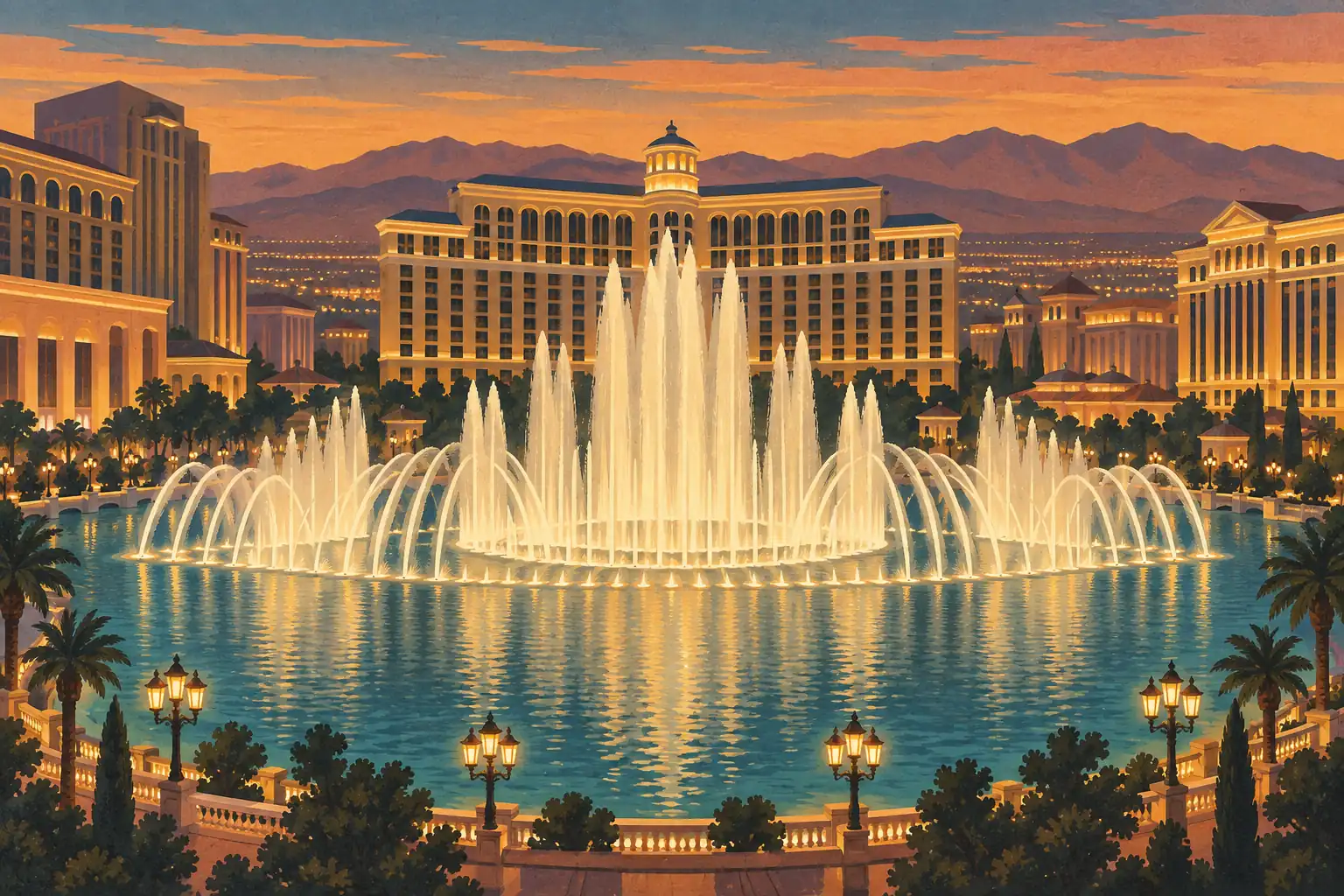
The Bellagio fountains. The artificial lake in front of the Bellagio is the setting for a choreographed sound-and-light show: hundreds of water jets rise in time with music played outdoors, with the most powerful reaching up to 459 feet. The show repeats every 30 minutes in the afternoon and every 15 minutes in the evening, starting around 8 p.m. Access from the Las Vegas Boulevard sidewalk is completely free. It is one of the Strip’s most popular free attractions, and one of the few worth staying up until midnight for.
Fall of Atlantis at Caesars Palace. Inside Caesars Palace’s Forum Shops, Fall of Atlantis uses animated statues and lighting effects to depict the fall of Atlantis around a large central pool. The show lasts about ten minutes and runs roughly every hour from Thursday through Monday (closed Tuesday and Wednesday). Access is completely free from the shopping mall.
The Flamingo Wildlife Habitat. Behind the Flamingo hotel, an outdoor landscaped area is home to a small colony of flamingos and tropical birds. Access is free from the hotel lobby, which is open during the day. Calm, unexpected, and green amid the neon, it is a contrast few travelers expect on the Strip.
Circus Circus. This casino away from the center of the Strip offers free circus performances in a large indoor venue, with jugglers, trapeze artists, and acrobats throughout the day and early evening. The atmosphere is considerably more accessible and family-friendly than that of the grand resorts in the center.
The illuminated facades at night. Walking around and taking in the Cosmopolitan’s giant digital billboards, the Wynn’s lights, or Luxor’s laser is an experience in itself. Las Vegas Boulevard at night is an open-air gallery of light. All these free attractions can be explored on foot in half a day.
Fremont Street and Downtown: the Las Vegas of the early days
About 1.9 miles north of the STRAT is Downtown, the city’s first district, founded long before the Strip and radically different in atmosphere.
Downtown and the Strip, two different worlds. The Strip is modern, polished, and designed for mass international tourism. Downtown is older and more compact, with more locals and less vertical density. Travelers who spend only one evening there often regret it. These two sides of Las Vegas complement each other: spending one night in each gives you a much more accurate picture of the city.
Fremont Street Experience. The heart of Downtown is Fremont Street Experience: a 1,378-foot LED canopy suspended about 65 feet above the pedestrian street. At night, sound-and-light shows run several times an evening, free to watch from the street. Historic casinos line it: the Golden Nugget, founded in 1946, Binion’s, and Four Queens. The atmosphere is more down-to-earth, table minimums are lower, and drinks cost less than at the Bellagio.
SlotZilla. Two zip lines cross Fremont Street Experience: the Zipline, 77 feet high in a seated position, and the Zoomline, at a height equivalent to 11 stories, in a horizontal position. The activity costs extra and is best enjoyed in the evening, when the canopy’s light shows are running beneath participants’ feet.
Gold & Silver Pawn Shop. This pawn shop is known as the setting for Pawn Stars, which has aired since 2009. Hundreds of visitors come every day, often forming a line outside. The interior is smaller than the television images suggest, but the address is part of Fremont Street’s cultural circuit.
Little White Chapel. Just a short walk from Fremont Street, this wedding chapel operates 24/7. Express ceremonies take place with or without an appointment, starting at a few hundred dollars. It embodies the pop-culture dimension Las Vegas has built around American civil weddings.
18b Arts District. A few blocks west of Fremont Street, the 18b Arts District brings together art galleries, artists’ studios, independent cafes, and large-scale murals. It is one of the few places in Las Vegas where you can feel a permanent neighborhood life distinct from tourism. The Community Healing Garden, opened on October 6, 2017, in memory of the shooting victims, is located here.
Parking Downtown. Parking at the Golden Nugget cost about $10 per day according to rates observed in 2024, compared with $20 to $35 in the garages of the Strip’s major hotels. That is a practical reason to choose Downtown as your overnight base.
The Sphere: the immersive experience that opened in October 2023
East of the Strip, behind the Venetian, stands the Sphere: a 367-foot spherical entertainment venue built by Sphere Entertainment Co. and opened in October 2023. Its exterior is covered with a giant LED screen visible from Las Vegas Boulevard, displaying animations after dark.
The interior is built around a hemispherical immersive screen described as the world’s largest indoor screen by surface area and resolution. The seats are equipped with haptic feedback, vibrations synchronized with the sound and images, to intensify the immersive feeling.
Postcard from Earth. The first content created specifically for the Sphere is an approximately 50-minute immersive film by director Darren Aronofsky, titled Postcard from Earth. It takes viewers through the planet’s great natural landscapes, from the ocean floor to the deserts. For travelers planning a road trip through the parks, it is a visual prologue in a format unlike any other.
Concert residencies. The Sphere also hosts residency concerts, including U2’s opening run. Capacity is about 17,600 seats, according to figures released at the opening. Residencies change with the seasons: check the official website before your visit, as tickets often sell out several weeks in advance.
Prices. Tickets for immersive content generally range from about $60 to $200, depending on the seating and the program. Residency concert prices vary more widely. These figures have been reported since the venue opened in 2023 and should be confirmed before your visit.
The Sphere embodies what Las Vegas does better than anywhere else: inventing an experience that existed nowhere else, in a building that had never been built. Its absence from most travel guides published before 2024 is one of the clearest reasons to take the time to plan your stay using recent sources.
Neon Museum and Mob Museum: two museums that tell the city’s story
Travelers who limit Las Vegas to the Strip miss two of the country’s most original museums, both located Downtown.
Neon Museum. Founded in 1996 and open to the public since 2012, the Neon Museum gathers signs salvaged from demolished or renovated hotels and casinos in an open-air “boneyard.” More than 250 signs are on display, from 1930s neon to giant signs from the 1990s. The collection includes the former facade of the 1955 Moulin Rouge Hotel, Las Vegas’s first integrated hotel.
The recommended option is a guided night tour: the best-preserved signs are lit up, the atmosphere is unique, and the photos are much better than during the day. Reservations are required in high season and recommended year-round. Allow about one hour for the guided tour and $20 to $35 admission, depending on the package (check neonmuseum.org before your visit, as prices change).
Mob Museum. Housed in the former federal courthouse built in 1933, the Mob Museum (National Museum of Organized Crime and Law Enforcement) traces the history of organized crime in the United States across three floors, from Prohibition to the present. Original artifacts, seized weapons, investigation files, and recreated evidence tell the story of the rise of the Mafia and major FBI investigations dating back to Al Capone.
One unusual detail: an artisanal distillery occupies the building’s basement. It is open to visitors and produces alcohol using methods inspired by Prohibition-era stills. Allow two to three hours and about $38 admission (confirm on themobmuseum.org). The museum is open every day.
These two museums are routinely overlooked by first-time visitors who pack their schedule with the Strip. Yet they provide the historical backbone that explains what you see throughout the rest of the city.
Shows, nightlife, and weddings
Las Vegas is the city of live entertainment. Dozens of productions coexist on the Strip at any given time, from the most accessible to the most exclusive.
Cirque du Soleil. Two Cirque du Soleil productions have maintained permanent residencies on the Strip for more than 20 years. “O” at the Bellagio is an aquatic show: the stage alternates between a pool holding about 1.5 million gallons (5.7 million liters) and a dry platform, with acrobats, divers, and contortionists. “KÀ” at MGM Grand is a war-themed production with monumental mechanical sets. Prices generally range from $80 to $250 depending on the show and seats, starting at $120 for “O” (confirm on the hotels’ official websites, as prices vary by program and season).
Musical residencies. Las Vegas invented the long-term residency model: an artist performs dozens of consecutive nights in the same venue for an audience that comes from everywhere. Celine Dion, Elton John, Britney Spears, Adele, and Lady Gaga have headlined the Strip’s major venues at different times. The lineup changes each season: check the calendars for the main venues (Dolby Live at MGM, the Colosseum at Caesars) if a concert is a priority for your itinerary.
Nightlife. The Strip’s clubs are among the largest venues of their kind in the world. XS at the Wynn is one of the most frequently mentioned. Admission is generally charged for men (between $20 and $50 depending on crowds and the night), while it is discounted or free for women depending on each venue’s policies.
Pinball Hall of Fame. For an unusual hour-long break, the Pinball Hall of Fame houses more than 700 working vintage pinball machines, open to everyone for a few coins per machine. Admission is free; the machines take quarters. It is a noisy, playful museum that is popular with families and between visits.
Weddings. Las Vegas hosts several dozen weddings a day. The process is legal within a few hours: obtain a license from the Clark County Clerk’s Office, then hold the ceremony at a partner chapel. Little White Chapel and Chapel of Flowers are the best-known addresses. Ceremony packages start at a few hundred dollars. The city requires no waiting period or publication of banns, making it the best-known American city for quick weddings.
Resort fees: understanding the real price of a night in Las Vegas
The resort fee is the first surprise for travelers booking a Las Vegas hotel: the price shown on booking platforms is not the amount you will actually pay. A mandatory surcharge is added to your bill upon arrival.
What it is. The resort fee is a fixed line item on your hotel bill, set by the property and not open to negotiation. It theoretically covers pool access, the fitness center, Wi-Fi, and sometimes local calls. In practice, it became widespread on the Strip in the 2010s as a systematic additional revenue stream.
The amounts. In 2026, resort fees on the Strip range from $45 to $55 per night before taxes. Luxury hotels (Bellagio, ARIA, Wynn, Caesars, Venetian) generally charge $55, while mid-range properties (MGM Grand, Mandalay Bay) are around $45. With Nevada’s local taxes (about 13%), that means $50 to $65 more per night depending on the hotel. Downtown, fees are considerably lower: between $15 and $25 at most properties.
Indicative ranges (2025-2026 data, to be checked when booking):
| Hotel type | Advertised nightly rate | Resort fee + taxes | Actual nightly total |
|---|---|---|---|
| 3-star Strip (weekday) | $80 - $120 | $50 - $60 | $130 - $180 |
| 4-star Strip (weekday) | $150 - $220 | $60 - $70 | $210 - $290 |
| 3-star Downtown (weekday) | $60 - $90 | $20 - $30 | $80 - $120 |
These ranges are indicative. Prices vary widely depending on dates, ongoing events, and availability.
Weekend prices soar. On Friday and Saturday nights, room rates can be two to three times higher at the same hotel than in midweek. The resort fee stays fixed, but the room itself becomes much more expensive. Staying Sunday through Thursday lets you pay the Strip’s lowest prices.
What booking platforms do not show. Sites such as Booking and Expedia display the room rate excluding the resort fee. This surcharge often appears only at the final booking stage or directly upon arrival at the hotel. Read each property’s terms before confirming. Resort fees are generally nonrefundable even in the event of a late cancellation.
How to compare honestly. Two weekday nights Downtown save $50 to $90 in resort fees alone compared with the same stay on the Strip. With parking at $10 per day at the Golden Nugget versus $20 to $35 on the Strip, the total difference can reach $150 to $200 for a couple staying two nights.
Getting around between the Strip and Downtown
Walking on the Strip. Walking is the natural way to get around in the evening. Allow 1.5 to 2 hours to go from Mandalay Bay to the STRAT without stopping. Keep in mind that distances look shorter than they are. Pedestrian bridges between hotels often add five to ten minutes to a trip. In summer, the heat makes daytime walking exhausting.
The Las Vegas Monorail. It runs along the east side of the Strip, with seven stations from MGM Grand to the STRAT. A single ride costs about $6, and a day pass about $13. It is useful for avoiding a walk from one end of the Strip to the other, but it serves only the east side of the boulevard and reaches neither the airport nor Downtown.
Strip to Downtown. The STRAT and Fremont Street are about 1.9 miles apart. For most visitors, especially in the evening, this is too far to walk. An Uber or Lyft costs between $5 and $10, depending on the time and demand.
From the airport. Harry Reid International Airport (LAS) is south of the Strip, about 3.1 miles from Mandalay Bay. An Uber or Lyft costs about $15 to $25, depending on the time. Shared shuttles cost about $10 to $15 per person but stop at several hotels. An official taxi costs about $20 to $30, before tip.
Rental cars. A car is not recommended for a stay on the Strip. Parking is paid at nearly every hotel ($20 to $35 per day), traffic is heavy on Friday and Saturday nights, and almost all activities can be reached on foot. A car is necessary for reaching the national parks from Las Vegas, but not for sightseeing in the city.
How many nights, and where to place Las Vegas on a parks road trip
Recommended length. Two nights cover the essentials: the Strip on the first evening and Downtown on the second. Three nights give you time to add the Sphere or one of the two Downtown museums without rushing. Four nights or more are truly worthwhile only for a residency concert or Cirque du Soleil show you want to include in your itinerary.
Before or after the parks.
Before the parks: if your flight arrives in Las Vegas, start with the city before heading to the parks. Las Vegas is about 2.5 hours by car from Zion National Park, a natural starting point for a Utah itinerary. From Zion, continue to Bryce Canyon, Capitol Reef, Canyonlands, or Arches depending on the length of your road trip. This is the smoothest direction if your outbound flight lands in Las Vegas.
After the parks: if you are returning from Utah or Arizona, Las Vegas is a natural decompression stop before your flight home. From the Grand Canyon South Rim, allow about four hours by car. From Death Valley, about 2.5 hours. Ending with the city provides a bright urban counterpoint after days in desert landscapes.
Open-jaw. The most flexible combination is flying into Las Vegas and departing from Los Angeles (or the reverse). This avoids backtracking and lets you cover the parks of Nevada, Utah, and Southern California in one direction. Our guide to Paris-Las Vegas flights details fare combinations for this type of itinerary. For a complete road trip through the American West, Las Vegas is one of the most convenient logistics hubs: a wide choice of flights from Europe, immediate car rentals at the airport, and hotels in every price range.
Avoid weekends. If you can choose your dates, do not arrive on a Friday night. Crowds increase sharply, room prices rise as well, and the Strip becomes difficult to navigate by car or on foot.
The season. From November to April, temperatures are ideal for sightseeing (59 to 68°F during the day, with cool but manageable evenings). From May to October, temperatures regularly exceed 104°F, with a record high of 117°F during the most intense heat waves. Nearby parks (Zion, Bryce Canyon) are also much more pleasant during the shoulder seasons.
Excursions around Las Vegas. Red Rock Canyon, Valley of Fire, Hoover Dam, and the Grand Canyon: these day trips from Las Vegas will be covered in our dedicated guide to excursions from Las Vegas, coming soon.
Our take: three weekday nights, from November to April
Las Vegas does not tolerate loose budgeting. It can be inexpensive or very expensive depending on your dates and neighborhood, and resort fees make a real difference to the final bill.
For a couple on a road trip. Three nights from Sunday to Wednesday, in a Downtown hotel (resort fees of $20 to $25 per night compared with $50 to $65 on the Strip). Two evenings on the Strip for the Bellagio fountains, themed casinos, and Fremont Street. One paid activity chosen according to your interests: the Sphere for the technology, the Neon Museum for the history. This plan covers the essentials without going overboard.
For a family with children. Two nights are enough. The Strip and Fremont Street offer few activities specifically designed for children over an extended stay. Circus Circus remains the most accessible option: free circus shows, an indoor arcade, and free parking (check when booking). A hotel with a pool is a practical selection criterion, especially from May to October.
For a small budget. Stay Downtown during the week and prioritize free activities: the Bellagio fountains, Fremont Street Experience, the Flamingo Wildlife Habitat, and exploring casino interiors. Choose just one paid activity based on your personal interests.
What we do not recommend. Weekends, when room prices triple on the Strip and pedestrian traffic becomes exhausting. Summer temperatures above 104°F, unless you plan to stay exclusively in air-conditioned spaces. Four nights or more if no concert or event justifies it.
What most comparison sites do not calculate. Resort fees add $50 to $65 per night on the Strip. For two nights as a couple, that is a $100 to $130 line item missing from the advertised rate. Budget for it before choosing your hotel.
Frequently asked questions
How many days do you need to visit Las Vegas?
Two nights let you see the essentials: the Strip in the evening and Downtown the next day. Three nights give you time to add the Sphere or a museum (Neon Museum or Mob Museum) without rushing. Four nights or more are justified only for a residency concert or sporting event.
What is a resort fee, and how should you plan for it?
The resort fee is a mandatory surcharge charged by the hotel and not included in the rate shown on booking platforms. On the Strip, expect $45 to $55 per night before taxes in 2026, plus local taxes, for an additional $50 to $65 per night. Downtown, resort fees range from $15 to $25. The practical solution is to read the hotel’s terms before confirming and include this amount in your total budget.
Can you enjoy a stay in Las Vegas without gambling?
Yes, with no restrictions. The Bellagio fountains, Fremont Street Experience, casino interiors, the Flamingo Wildlife Habitat, the 18b Arts District, the Neon Museum, and the Mob Museum do not require any gambling. Gambling is one option among many, not a condition for enjoying the city.
Is it better to visit Las Vegas before or after the national parks?
If your flight arrives in Las Vegas, start in the city and then continue to Zion or the Utah parks. If you are returning from the Grand Canyon or Death Valley, Las Vegas is a natural decompression stop before your flight home. With an open-jaw itinerary (arriving in Las Vegas and returning from Los Angeles, or the reverse), both options fit into a route without backtracking.