

Camping in America's National Parks: Choosing the Right Tent or RV Site
Reservations, water, site sizes, late arrivals, and food storage: what to check when choosing a national park campground and planning a camping trip without surprises.
By Erika Müller · · 12 min read
A great view alone doesn't make a great campsite: you also need room for your tent, access to water, and enough time to arrive before you're setting up in the dark. Camping in America's national parks is mostly about matching your overnight plans and gear to local rules. We favor choices that make the next day easier over those that simply look good in a photo.
Which campground fits your camping style?
A campground doesn't necessarily come with hot showers. In a national park, a developed campsite might have a picnic table, fire ring, and restrooms but no electricity or showers. Start by identifying the services you actually need, then consider how far you'll be from the area you plan to visit.
Developed campgrounds keep logistics simple. You stay at a designated site with the amenities listed by the operator. This is our recommendation for getting your bearings on a first road trip. Check the drive to trailheads or shuttle stops: a campground near the park entrance isn't necessarily close to tomorrow's activities.
Primitive campgrounds suit self-sufficient travelers. The label primitive campground is a reason to check the amenities, not an invitation to assume you can camp wherever you like. Reservations may still be required, and there may be toilets but no drinking water. An unpaved access road may also be unsuitable for your vehicle or off-limits under your rental agreement.
Backcountry camping makes an overnight stay part of a hike. The backcountry lies away from the usual developed facilities. It isn't a backup campground when roadside campgrounds are full. At Yosemite, an overnight wilderness stay requires a specific permit. Route requirements, food storage, and equipment need their own planning.
Dispersed camping is an option only where it's allowed. The Bureau of Land Management, or BLM, manages public lands separate from national parks. Dispersed camping is available in many areas, subject to local restrictions and with no guaranteed services. Check the specific location, permitted routes, closures, and waste rules with the local office. A pin shared on an app doesn't replace that research.
Choosing between a campground, motel, and lodge involves a different set of trade-offs. To compare those options and nearby towns to use as a base, keep our guide to staying in motels, campgrounds, or lodges near the parks handy. Here, we pick up once you've decided to camp.
Book your stay using the right reservation calendar
Start on the park's official website under “Plan Your Visit,” then “Eating & Sleeping” or “Camping.” This helps you identify the correct operator. Many campgrounds take reservations through Recreation.gov, but not all use that platform. Some are run by a concessioner identified on the park website.
Each campground has its own calendar. The idea that everything opens for booking six months ahead doesn't hold up. Yosemite's Upper Pines uses a different system: reservations open five months ahead, on the 15th of each month at 7 a.m. Pacific time. Other campgrounds in the same park offer shorter booking windows, including 14 days before arrival. Check your chosen campground's official calendar before setting an alert, and check the listed time zone instead of assuming a fixed time difference from home.
On Recreation.gov, set up your account before reservations open. Search for your dates using the correct equipment type, then open the individual campsite listing, not just the campground page. An available site is useful only if it accommodates your group and gear. Read the restrictions before paying, including the change and cancellation policies.
| Information to have ready | What to check before paying |
|---|---|
| Dates and number of nights | Operating season, reservation release schedule, maximum stay |
| Campers | Site capacity, group site requirements |
| Tent | Tent pad dimensions, number of tents allowed, any walk-in access |
| Vehicle and trailer | Permitted vehicle type, length limit, available parking |
| Essential services | Listed drinking water, restrooms, hookups, and dump station |
| Arrival | After-hours check-in procedure, instructions if you're delayed |
Reservations or first come, first served? A first-come, first-served campground assigns sites according to its on-site procedures. You have no guarantee before you arrive. At Joshua Tree, Hidden Valley, Belle, and White Tank operate this way, while other campgrounds accept reservations. The park warns that these unreserved sites are highly competitive. Arriving early may help, but no magic arrival time guarantees an opening.
For a night that the whole trip depends on, we choose a reservation. For a flexible stop, first come, first served can work if you have a legal backup and enough time to reach it. If everything is full, look for cancellations or expand your search area instead of counting on an improvised parking spot.
For detailed campground selections, use the local guides: our pages on Yosemite campgrounds and Yellowstone campgrounds help you identify the different areas. Always return to the campground's official listing to confirm a booking window or opening date.
Water, restrooms, and site dimensions: look beyond the photo
For tent camping, start with the tent pad. A site's occupancy limit doesn't tell you whether your large family tent will fit in the designated space. Check the dimensions and site description. Also find out whether you can park beside the site or need to carry bags, a cooler, and equipment. Arriving with young children takes different planning than a lightly packed overnight trip for two.
For an RV, check the exact site. The term RV, short for recreational vehicle, covers a wide range of sizes. A campground's advertised maximum vehicle length doesn't mean every site can accommodate that vehicle. Read any instructions about trailers and combined length in the listing. Letting your vehicle stick out into the roadway isn't an acceptable workaround.
Read the hookup details separately: electricity, water, and sewer connections are different services. A shared water spigot doesn't mean you can leave a hose connected to your site. A dump station doesn't mean each site has its own sewer connection, either. Upper Pines, for example, lists drinking water and a dump station within the campground but offers no individual hookups.
For help choosing a vehicle or understanding the rental agreement, see our guide to renting an RV in the USA. Your campsite choice then needs to match the vehicle you actually booked, not a rough vehicle category you considered early in the planning process.
Check water and restrooms separately. Vault toilets don't imply sinks or drinking water. At Joshua Tree, Jumbo Rocks has no water, and none of the park's campgrounds have showers. That's why we check these two details before looking at the scenery. Compare Joshua Tree campgrounds based on how self-sufficient you'll be, then check official alerts for service updates before arrival.
Finally, separate the nightly campsite rate from other expenses. A campsite reservation doesn't automatically include park admission. Reservation, change, or cancellation fees may apply. Compare the final total and the terms shown for your dates, rather than treating a rate you found for another campground as a universal budget.
Prepare for arrival and the night ahead before leaving the road
Even with a confirmed reservation, read the park and campground alerts again before you drive. The NPS recommends having a backup plan for closures, bad weather, or unusable campsites. Check road access, too: an open campground may still be unreachable along your planned route if the road is closed.
Plan for a late arrival. Rules vary. At Upper Pines, arriving after the entrance kiosk closes means you must register, then return to the kiosk the next morning. At Joshua Tree, the park says campgrounds have no formal check-in procedure. In either case, missing the first night without notifying the operator may put your reservation at risk under local policies. Save the operator's phone number before you lose cell service.
Download your confirmation, campground map, site number, and access instructions. The NPS app lets you download information for offline use. Keep a light within reach so you don't have to empty the trunk to find it, along with evening clothes and supplies for a simple meal. We prefer arriving in daylight, with time to get oriented and store food properly.
Choose sleeping gear for the overnight forecast, not the afternoon weather. Check conditions at the campground's elevation, especially in the mountains. Match your sleeping bag, insulated sleeping pad, and clothing to the expected temperatures. The NPS also advises accounting for wind, rain, snow, and extreme temperatures. If conditions exceed what your equipment or group can handle, change your plans.
In an RV, don't assume that a lack of hookups means you can run your generator all night. Generator hours are regulated locally. For planning stops and driving routes rather than choosing campsites, use our Western U.S. RV loop as an itinerary guide.
Food, wildlife, and fires: good habits at camp
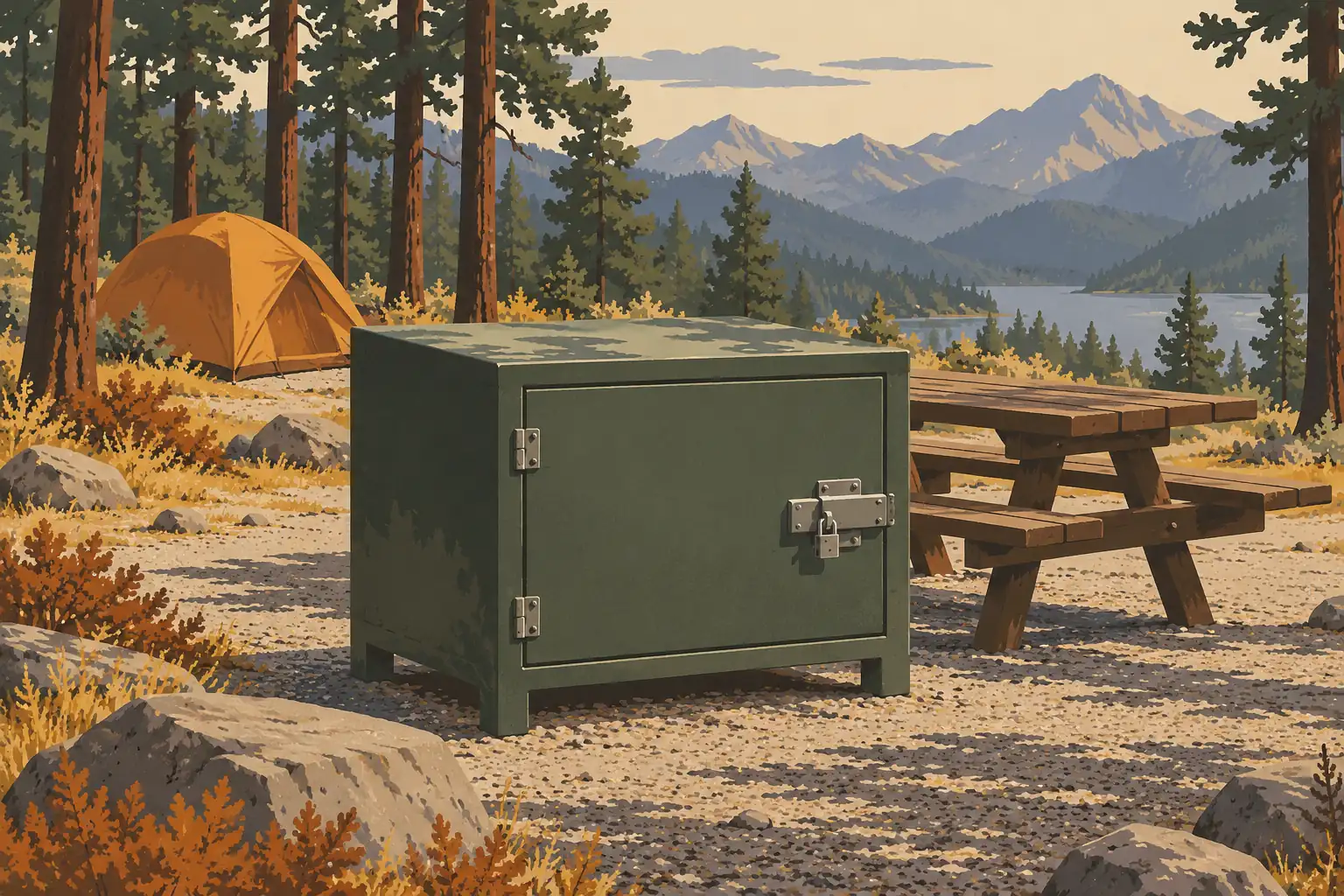
Put things away as soon as you set up, not just at bedtime. In bear country, “food” means more than sandwiches: the NPS also includes drinks, trash, coolers, toiletries, and other scented items. Don't keep these in your tent. Clean your utensils and check for crumbs on the table and around your site.
A car isn't an approved storage option everywhere. Some parks allow storage in a closed vehicle under certain conditions; others require the provided lockers. The Upper Pines reservation listing says to leave no food in vehicles and to use the food storage locker. Yosemite's NPS rules do distinguish cars from fully hard-sided RVs, however: food may be stored out of sight in those RVs, with doors, windows, and vents closed while you're away. This exception doesn't apply to soft-sided vehicles. If you're traveling by RV, confirm the rules for your vehicle and site with the operator. If you're tent camping with a car, use the campground locker.
Don't feed any animals. Ravens and rodents may also go after your supplies: Joshua Tree requires food and trash to be protected in a secure container or vehicle. A clean camp protects your gear and, more importantly, helps keep wildlife from associating campers with food.
A fire ring doesn't mean fires are allowed. Check current restrictions with the park or campground operator. They may vary with the season and weather conditions. If a ban is in effect, read how it applies to each type of cooking equipment instead of assuming charcoal or a camp stove is exempt.
When fires are allowed, use the designated fire rings and follow local rules. Buy firewood near the campground to limit the spread of pests. Don't gather wood without checking whether it's permitted. Keep water within reach, never leave a fire unattended, and extinguish the coals completely before going to bed or leaving. Don't burn trash or food scraps.
On BLM land, the same care starts with the local office's rules on access, fires, length of stay, and human waste disposal. An appropriate toilet setup is part of being self-sufficient. Dispersed camping takes more than finding a spot without a “No Camping” sign.
Our take: reserve the nights your trip depends on
First trip or family vacation. We'd choose a reservable developed campground that explicitly lists drinking water and restrooms. Never assume that means showers are available. We advise against relying on an unreserved campground after a long drive: finding a site shouldn't become the evening's main activity.
Self-sufficient couple with a tent. We'd choose a primitive campground if its location makes sightseeing easier and we've planned for the lack of water. Great scenery doesn't make up for an access road your rental car can't handle. At Joshua Tree, staying at Jumbo Rocks means getting your water before setting up camp.
RV trip. We'd first identify sites that fit the vehicle, then check for the services we need. At Upper Pines, a dump station doesn't mean individual hookups. We'd rather choose a site that works for the next day's plans than pay for a service we don't need.
Flexible itinerary on a tight budget. We'd save first-come, first-served or dispersed camping for stops where changing areas is manageable. We don't recommend treating either as an automatic solution when a park is full. A good balance means reserving the essential nights and leaving some flexibility for the others.
Frequently asked questions
Do all campgrounds need to be booked six months ahead?
Not all campgrounds open for reservations six months ahead. The schedule depends on the campground, even within the same park. Upper Pines opens five months ahead on a monthly schedule, while other Yosemite campgrounds release sites closer to arrival. Check each campground's official listing.
Does arriving early guarantee a first-come, first-served site?
Arriving early doesn't guarantee a first-come, first-served site. Your chances depend on actual vacancies and local site assignment procedures. Have a permitted backup you can reach before dark, rather than just a list of campgrounds that might also be full.
Can you sleep in your vehicle in a park parking lot?
You can't assume sleeping in your vehicle in a park parking lot is allowed. At Yosemite, sleeping in a vehicle requires staying in a campsite where you're registered. Joshua Tree prohibits overnight stays in vehicles along roads and in pullouts.
Do all park campgrounds have water and showers?
Not all park campgrounds have water and showers. Check these services separately for each campground. At Joshua Tree, Jumbo Rocks has no water, and none of the park's campgrounds have showers. Alerts may also report service outages.
Can you keep food in your car overnight?
Whether you can keep food in your car overnight depends on park and campground rules. At Yosemite, food must not remain in a car after dark: use a locker. Fully hard-sided RVs have separate requirements, which you should confirm for your site. Don't assume the rules you followed the night before apply in the next park.