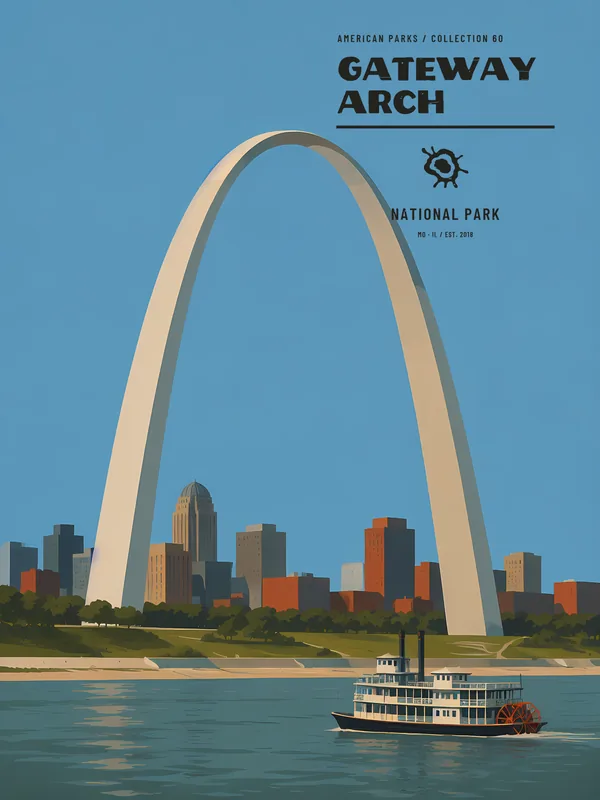

Gateway Arch National Park: The Complete Visitor Guide
Gateway Arch is the most unusual national park in the American system. There is no summit to climb and no forest to cross, just a 630-foot steel arch rising along the banks of the Mississippi River in the heart of St. Louis, Missouri. People come for one specific experience: riding to the top of the world's tallest arch, then understanding why this metal ribbon tells the story of America's westward expansion. It's a compact urban park that takes half a day to visit. In other words, it fits easily into a Midwest road trip.
In brief: Plan on half a day, or 3 to 4 hours, to see everything, including the ride to the top. The park is downtown, admission is free, and you only pay for the ride inside the arch and certain activities. Book your ride time ahead during the busy season, or you may find the doors closed.
Gateway Arch at a glance: Where the park is and how to get there
The park occupies a narrow strip along the river on the west bank of the Mississippi River, right in downtown St. Louis. At about 0.14 square miles, it's the smallest national park in the United States. This is a long way from the wide-open spaces of Wyoming. Here, the arch rises between skyscrapers and the river, with an unmistakably urban setting.
Architect Eero Saarinen designed the arch, and construction was completed in 1965. The site, long known as Jefferson National Expansion Memorial, became a national park on February 22, 2018. Its mission is to commemorate the westward expansion of the United States, with St. Louis as the gateway to the West, which explains the name.
To get there, St. Louis has an international airport, St. Louis Lambert International Airport, connected to downtown by MetroLink light rail. The Laclede's Landing station provides the most direct arrival point for the arch. By car, Interstate 44 and Interstate 70 run along the park. Parking is available in downtown garages a few minutes' walk away. You'll find details on routes, MetroLink lines, and parking in our Gateway Arch access guide.
Admission prices, passes, and reservations
The good news for your budget is that admission to the park, access to the riverfront, and the museum are free. You only pay for activities.
The ride to the top of the arch, called Tram Ride to the Top, requires a timed entry reservation and starts at about $19 per adult. Your ticket is for a specific time slot. You choose a departure time, and the tram carries you to the top. In summer and on weekends, these time slots fill quickly. We recommend booking online several days ahead, especially if your schedule is tight.
The America the Beautiful pass, which covers admission to most national parks, does not cover the ride inside the arch. That remains a separate charge. It makes sense, since admission to the park itself is already free. Our National Park Fees & Passes page explains entrance fees and annual passes.
Reservations, permits, and rules to follow
A reservation is required for the ride to the top. You can buy Timed Entry Reservations for the tram online at gatewayarch.com or at the ticket window, depending on availability. During the busy season, from June through August and on Memorial Day and Labor Day weekends, morning time slots sell out within a few hours. Book at least 48 hours ahead to avoid surprises.
No permit is required for the outdoor grounds or the museum.
Security screening at the entrance. To enter the Visitor Center and the trams, you'll go through airport-style security, including bag screening and a metal detector. Allow an extra 10 to 15 minutes during peak times.
Rules to follow:
- Drones are prohibited throughout the park, without exception.
- Smoking, e-cigarettes, and vaping are prohibited inside buildings.
- Pets are allowed on the outdoor lawns when leashed, but they are not allowed in the Visitor Center, museum, or trams.
- Large bags, including suitcases and oversized backpacks, are not allowed inside buildings.
How to get around Gateway Arch
You can explore the entire park on foot, which is one of its main advantages. Everything is concentrated within a few hundred yards along the river. From the entrance to the underground Visitor Center beneath the arch itself, you can reach the museum, ticket windows, and the two legs of the arch where the trams depart.
The ride takes place in small egg-shaped capsules that hold five people each. The trip to the observation platform takes about four minutes. If you're claustrophobic or tall, be prepared: the space is tight, the windows at the top are small, and you have to lean over to look out at the city. This isn't a standard elevator.
Around the arch, the Gateway Arch Riverfront lets you walk or bike along the Mississippi River. Our Getting Around page covers pedestrian routes, accessibility, and connections to old St. Louis.
How much time do you need to visit Gateway Arch?
Plan on half a day for a complete visit without rushing. More specifically, allow about an hour for the museum, an hour for the ride to the top, including the wait and your time slot, and the rest for wandering along the riverfront or walking over to the nearby Old Courthouse.
If you're short on time and only want to see the arch, an hour and a half is enough once you've reserved your time slot. Add a river cruise and the park's movie theater, and you can easily fill a full day. Gateway Arch works just as well for a morning stopover as for a relaxed overnight stay. Our Gateway Arch itinerary guide lays out several visit scenarios based on your schedule and travel style.
Plan your visit
What to see and do at Gateway Arch
The park is small but packed with things to see. Here's how we break down the visit on the ground.
Road trip journal · 4 areas
The arch and the ride to the top
This is the heart of the park. The arch stands 630 feet tall and is just as wide at its base, a perfect stainless-steel curve that changes color with the light. At the top, the observation platform offers sweeping views of St. Louis on one side and the Mississippi River and Illinois on the other. When we visited in the late afternoon, the low light on the river was worth the ticket by itself. You can see a long way, and the city spreads out below you like a model.
The Museum at the Gateway Arch
Located beneath the arch, this free, modern museum tells the story of westward expansion, the construction of the monument, and the history of the Indigenous peoples displaced by that expansion. The exhibits are interactive and well designed for kids. They provide the context that's missing when you look at the arch without knowing its history. Allow an hour to see it all.
The Old Courthouse
Just steps from the arch, the Old Courthouse is part of the park. This is where the Dred Scott case, a landmark trial in the history of slavery in the United States, was heard. The domed building is free to visit and rounds out the site's historical story.
The riverfront and Mississippi River cruise
At the foot of the arch, stairs lead down toward the river. Paddlewheel boats offer narrated cruises of about an hour on the Mississippi River, a great way to see the arch from the water. Cruises cost extra and are often included in combination tickets.
You'll find details on each activity, including our favorites and the pitfalls to avoid, in our Gateway Arch activities guide.
Explore the park
The best walks at Gateway Arch
Let's be honest: people don't come to Gateway Arch to go hiking. The park has no wilderness trails in the traditional sense, just paved paths along the Mississippi River. The Riverfront Trail lets you walk or bike along the river for several miles, with the arch as a backdrop. It's flat, urban, and pleasant at sunset.
For anyone who really wants to walk, the best options are elsewhere, in the large regional parks and nature preserves around St. Louis. We list the park's walking loops and nearby nature alternatives on our Hiking page.
The detailed guide Gateway Arch Hikes and Walks for Every Experience Level A practical guide to walks around Gateway Arch, along the Mississippi River,… Read the guide →Wildlife and plants to look for
As you'd expect in an urban park, wildlife keeps a low profile. The landscaped riverfront mainly attracts birds associated with the river, including herons, cormorants, terns, and a good variety of migratory birds that follow the Mississippi corridor in spring and fall. The lawns and planted groves around the arch attract squirrels and small songbirds. Don't expect bears or bison. Nature here is tamed, landscaped, and designed as a setting for the monument. We describe the species to look for and the best times to see them on our Wildlife page.
The detailed guide Gateway Arch Wildlife: Which Animals to See and Where to Find Them Bald eagles in winter, peregrine falcons, herons, and bats make Gateway Arch… Read the guide →When to visit Gateway Arch
St. Louis has a pronounced continental climate, with cold winters and hot, humid summers. In January, the average temperature is around 30°F. In July, it climbs to about 81°F, with plenty of summer humidity. Spring, from April through May, averages 57°F to 66°F, while fall, from September through October, averages 59°F to 70°F. These seasons offer the best balance of mild weather, soft light, and lighter crowds than midsummer.
Sunshine follows the seasons. Barely half the days are clear in winter, compared with about two-thirds in summer. The arch is open year-round except on Thanksgiving, Christmas, and January 1, so the main question is what will feel comfortable for you. Our When to Visit page and Weather page cover temperatures, rain, and crowds month by month.
The detailed guide When to Visit Gateway Arch: Best Times, Weather, and Seasons When should you visit Gateway Arch? April-May and September-October offer mild… Read the guide →Where to stay near Gateway Arch
There are no accommodations inside the park, so downtown St. Louis is where you'll stay. Downtown, a few minutes' walk from the arch, is home to chain hotels and a few distinctive properties in restored historic buildings. Historic Laclede's Landing along the riverfront has a livelier atmosphere in the evening.
For a greener setting or an RV trip, you'll need to leave the city. Campgrounds are found on the outskirts, on both the Missouri and Illinois sides. We compare neighborhoods, price ranges, and the best options in our Lodging guide (Where to Stay page), with details by type in our Hotels & Lodges, Camping, and RV pages.
Stay in the park
Around Gateway Arch: Things to do nearby
The arch is quick to visit, so take the opportunity to explore St. Louis and its surroundings. In the city, Forest Park has a well-regarded zoo, an art museum, and a history museum, all free, enough to fill a day. Beer lovers can make the pilgrimage to the historic downtown brewery. For dessert, the city claims frozen custard as a local specialty worth seeking out.
Farther afield, Gateway Arch fits naturally into a road trip along legendary Route 66, of which St. Louis is one stop, or a drive up the Mississippi River. We connect these itineraries with the other Midwest parks in our Region sections and Road Trip pages.
Our take: Is Gateway Arch worth the trip?
Yes, as long as you know what you're coming for. Gateway Arch isn't a nature park. It's a monument paired with a history museum. If you're crossing Missouri or following Route 66, it's a worthwhile stop. The ride to the top is a one-of-a-kind experience, the view is wide open, and the museum gives meaning to the parts of America's westward expansion you may never have learned in school.
On the other hand, don't drive several hundred miles out of your way just for the arch. You can see it in half a day, and it won't fill an entire trip on its own. Our advice is to include it in a visit to St. Louis, reserve your ride time ahead, and leave time for the riverfront at sunset. That's when the monument shows its full scale. Use our Itinerary & Time page to build your schedule.
Frequently asked questions
Do you have to pay to go inside the St. Louis arch?
Entry to the park and the Museum at the Gateway Arch is free. You only pay for the ride to the top. The Tram Ride to the Top ticket starts at around $19 per adult and requires a timed reservation. Access to the riverfront and the Old Courthouse is free.
Is there anything inside Gateway Arch?
Yes. Inside Gateway Arch, you'll find a tram and an observation platform at the top. Small capsules carry visitors 630 feet upward in about four minutes, to a room with small windows overlooking St. Louis and the Mississippi River. Beneath the arch, a large free museum completes the visit.
Why is Gateway Arch so special?
Gateway Arch is special because it's the tallest arch in the world, reaching 630 feet. Eero Saarinen designed it, and construction was completed in 1965. It symbolizes St. Louis's role as the gateway to America's westward expansion. Its stainless-steel curve and panoramic observation platform make it a unique monument.
Can you visit Fort St. Louis?
There is no Fort St. Louis to visit in Gateway Arch. The confusion comes from the city's history. St. Louis was founded in 1764 as a French trading post. You can explore that past at the Museum at the Gateway Arch and the Old Courthouse, which tell the story of St. Louis's origins and expansion.
The American Parks shop
Bring Gateway Arch home
Our park-inspired creations, made to order and shipped to your door.