

National Parks in France and the United States: 11 vs. 63, Two Philosophies
France's 11 national parks and the NPS's 63: inhabited zones versus wilderness, free entry versus passes, and which French park speaks to Western travelers.
By Jocelyn Pion · · 9 min read
France has protected its natural areas since 1963, while the United States has done so since 1872. Between those two dates, two very different models took shape: 11 French national parks where villages, livestock, and cultivated land coexist with a protected core area, versus 63 American parks shaped by the ideal of wilderness, where permanent human presence is excluded in principle. For anyone planning a road trip through the American West, understanding how the French model works permanently changes the way you see what a national park is.
France's 11 national parks: born in 1963, from Vanoise to French Guiana
The law of July 22, 1960, established the legal framework. The first two parks were created in 1963: Vanoise in Savoie and Port-Cros, a Mediterranean island in the Var department. The Pyrenees (1967), Cévennes (1970), Écrins (1973), and Mercantour (1979) completed the metropolitan network over the next two decades. Overseas territories joined later: Guadeloupe in 1989, followed by Réunion and French Guiana's Amazonian Park in 2007, and Calanques in 2012. The most recently created park is Forêts, established in 2019: beech and oak forests in Champagne and Burgundy, and the first lowland national park created in mainland France.
| Park | Created | Location | Dominant environment |
|---|---|---|---|
| Vanoise | 1963 | Savoie, Alps | High alpine mountains |
| Port-Cros | 1963 | Var (island) | Marine and island environment |
| Pyrenees | 1967 | Hautes-Pyrénées, Pyrénées-Atlantiques | Mountains |
| Cévennes | 1970 | Lozère, Gard, Hérault | Human-shaped landscape |
| Écrins | 1973 | Hautes-Alpes, Isère | High alpine mountains |
| Mercantour | 1979 | Alpes-Maritimes, Alpes-de-Haute-Provence | High alpine mountains |
| Guadeloupe | 1989 | Guadeloupe (Caribbean) | Tropical volcanic forest |
| Réunion | 2007 | Réunion (Indian Ocean) | Volcanic landscape |
| French Guiana | 2007 | French Guiana | Amazon rainforest |
| Calanques | 2012 | Bouches-du-Rhône | Marine and limestone environment |
| Forêts | 2019 | Champagne, Burgundy | Lowland forest |
The largest is French Guiana's Amazonian Park: 8.4 million acres, including 4.9 million acres in a strictly protected core area. In mainland France, Écrins and Vanoise are among the largest. Across the entire network, there are more than 12.4 million acres, or about 8% of French territory, more than 10 million visitors each year, and 6,276 miles of marked trails.
Cévennes holds a special position among the eleven: its core area belongs to a different IUCN category from the other ten parks, which explains how inhabited villages and livestock farming coexist with strict protection. This model lies at the heart of the philosophical difference between the two systems, explored in the next section.
About sixty regional nature parks coexist with France's national parks. They are managed by local authorities and have no protected core area: they are an entirely separate category, with no direct equivalent in the American system.
Yellowstone, the NPS, and America's 63 national parks: a different scale
Yellowstone, created in 1872, is the world's first national park. Vanoise followed 91 years later. The National Park Service (NPS), founded in 1916, now administers America's 63 national parks and more than 400 federal sites, including monuments, natural areas, historic sites, and recreation areas.
The scale makes the gap clear. Wrangell-St. Elias in Alaska covers 13.1 million acres by itself, more than the entire French network combined. Other American parks are more modest, but the median size of the NPS network still dwarfs France's mainland parks. This disparity is partly a result of when the parks were created: the American West was still being settled when Yellowstone was designated, and the available land faced none of the property constraints found in twentieth-century Europe.
The founding philosophy rests on the ideal of wilderness: a natural area should be preserved without permanent human presence, an inheritance from nineteenth-century preservationism. It is this concept, rather than size alone, that structurally separates the two models.
Inhabited zones or wilderness: why French parks include villages
The French model grew out of the reform introduced by the 2006 biodiversity law. Each park is organized into two zones: a strictly protected core area and a membership area where municipalities that sign the park charter maintain their economic activities. Farming, livestock raising, and crafts legally coexist with conservation in these peripheral areas.
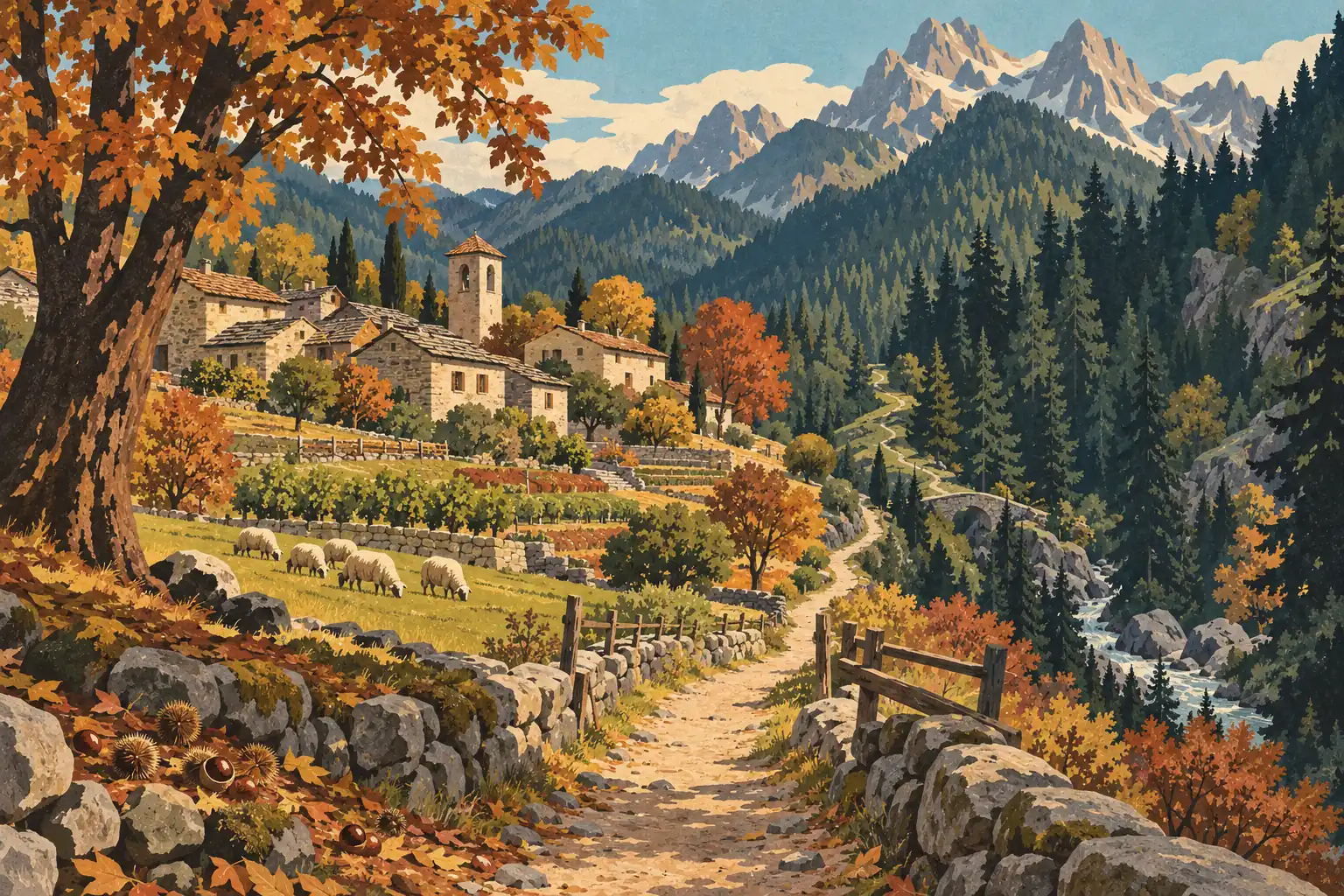
Cévennes is the clearest example. Among the eleven national parks, Cévennes stands apart because it is classified as an IUCN Category V landscape, shaped by human activity, while the other ten use the standard Category II classification. Villages, livestock, and chestnut groves occupy the core area: this is not an abandoned zone, but precisely a landscape shaped by centuries of settlement, which is what gives it its heritage value.
On the American side, the wilderness doctrine has a documented historical downside. The creation of Yellowstone and Yosemite in the nineteenth century involved displacing Indigenous communities that lived on those lands, a dark chapter in an effort whose long-term preservation goals were sincere.
The difference is concrete for visitors: in France, a long-distance hiking trail can pass through an inhabited hamlet in the middle of a core area; in the United States, gateway towns are consistently outside park boundaries. France also has three strict nature reserves where no human activity is permitted: these are the French areas closest to the American ideal of wilderness.
Free entry in France, mandatory passes in the United States
Access to French national parks is free: there is no entrance fee and no pass is required, regardless of the season or which entrance you use.
American parks work differently. The vast majority charge an entrance fee: between $15 and $35 per vehicle for seven days, depending on the park. The America the Beautiful Pass, priced at $80 per year, is valid at all 63 parks and more than 2,000 federal sites. On a road trip that includes three or more fee-based parks, the pass costs less than paying the individual entrance fees.
In the United States, entrance fees fund road maintenance, campgrounds, rangers, and visitor facilities. This partly explains why infrastructure is denser in NPS parks than in the core areas of French national parks.
In France, the model relies on public funding and local economic benefits. The “Esprit parc national” label lists, according to 2026 OFB data, more than 1,200 products from the regions around the eleven parks and more than 600 beneficiaries among producers and craftspeople in the membership areas.
French parks that will speak to Yellowstone or Yosemite fans
No French park is a replica of an American park. But several share a landscape character or type of experience that will resonate with a road-tripper returning from the West.
| French park | American park reference | Shared feature |
|---|---|---|
| Vanoise | Rocky Mountain | High alpine mountains, glaciers, hiking above 9,843 feet |
| Calanques | Channel Islands | Semi-marine park, limestone cliffs, marine wildlife, limited access |
| Cévennes | Shenandoah | Human-shaped landscape, historic pastoralism, ridge hiking |
| French Guiana's Amazonian Park | Denali | Immense scale, expedition-style access, intact ecosystem |
| Forêts | Congaree | Lightly visited lowland forest, ancient woodland atmosphere |
| Écrins | Grand Teton | High rocky peaks, mountaineering, vertical landscape |
The comparison is an entry point, not a promise of equivalence. Depending on the park, the French scale is 10 to 100 times smaller: a hiker returning from Yellowstone or Yosemite will be struck by the contrast, but will recognize the same logic of zoned protection and the same types of marked trails.
Two cases deserve clarification. Calanques is a hybrid park, created in 2012 in an area under intense urban pressure, with Marseille immediately adjacent, an exceptional underwater ecosystem, and access that is sometimes regulated in summer. French Guiana's Amazonian Park, by contrast, cannot be visited like a park in the American West: access requires several weeks of preparation and expedition-style logistics.
For French landscapes that visually recall the West but fall outside national park status, our article on deserts and canyons in France covers gorges, dunes, and rock formations beyond the national parks.
Our take: start with Vanoise to understand the American scale
Couples or families planning their first road trip through the West. Visit Vanoise or Calanques before you leave. Entry is free, compared with $80 for the American pass, access is self-guided, and the experience of a French national park sets expectations before you encounter the American scale.
Traveling on a tight budget. Free entry changes the math: in France, the park itself costs nothing to enter; in the United States, the pass, campgrounds, and shuttles add up from the first days of a road trip.
What we advise against. Assuming the two systems are comparable in size or infrastructure. A hiker used to Yellowstone or Yosemite may be thrown by the lack of services in Vanoise's core area or by the logistical inaccessibility of French Guiana's Amazonian Park. France's 11 parks versus America's 63, 1963 versus 1872, free entry versus $80: these figures sum up a genuine difference in resources and historical ambition.
To extend the comparison to a third network, Canada's national parks (48 Parks Canada parks) offer infrastructure close to the NPS model, with Rocky Mountain landscapes that are often more accessible than those in the United States.
Frequently asked questions
What is the largest national park in France?
France's largest national park is French Guiana's Amazonian Park, with 8.4 million acres (core area: 4.9 million acres). In mainland France, Écrins and Vanoise are among the largest.
Are French national parks free?
Yes, French national parks are free: no entrance fee or pass is required. This is a major difference from American national parks, the vast majority of which charge between $15 and $35 per vehicle for seven days.
What is the difference between a national park and a regional nature park?
A national park is governed by the 1960 law and managed by the state through the French Biodiversity Agency, with a strictly protected core area. A regional nature park, of which about sixty exist in France, is a project-based territory managed by local authorities, with no equivalent core area.
Which French national park most resembles Yellowstone?
No French national park resembles Yellowstone, whose geothermal features and immense scale have no equivalent in Europe. For high mountains and wildlife, Vanoise is the closest French reference to the Rockies.
When was the first national park created in France?
The first French national park was created in 1963: Vanoise and Port-Cros received national park status that same year, 91 years after Yellowstone was created (1872).