

What to Do in San Francisco: Neighborhoods, Alcatraz, and Trips to the Parks
Golden Gate, Alcatraz (book early), cable cars, Mission, and Haight: three days covering SF essentials, then Muir Woods, Yosemite, and Pinnacles.
By Jocelyn Pion · · 15 min read
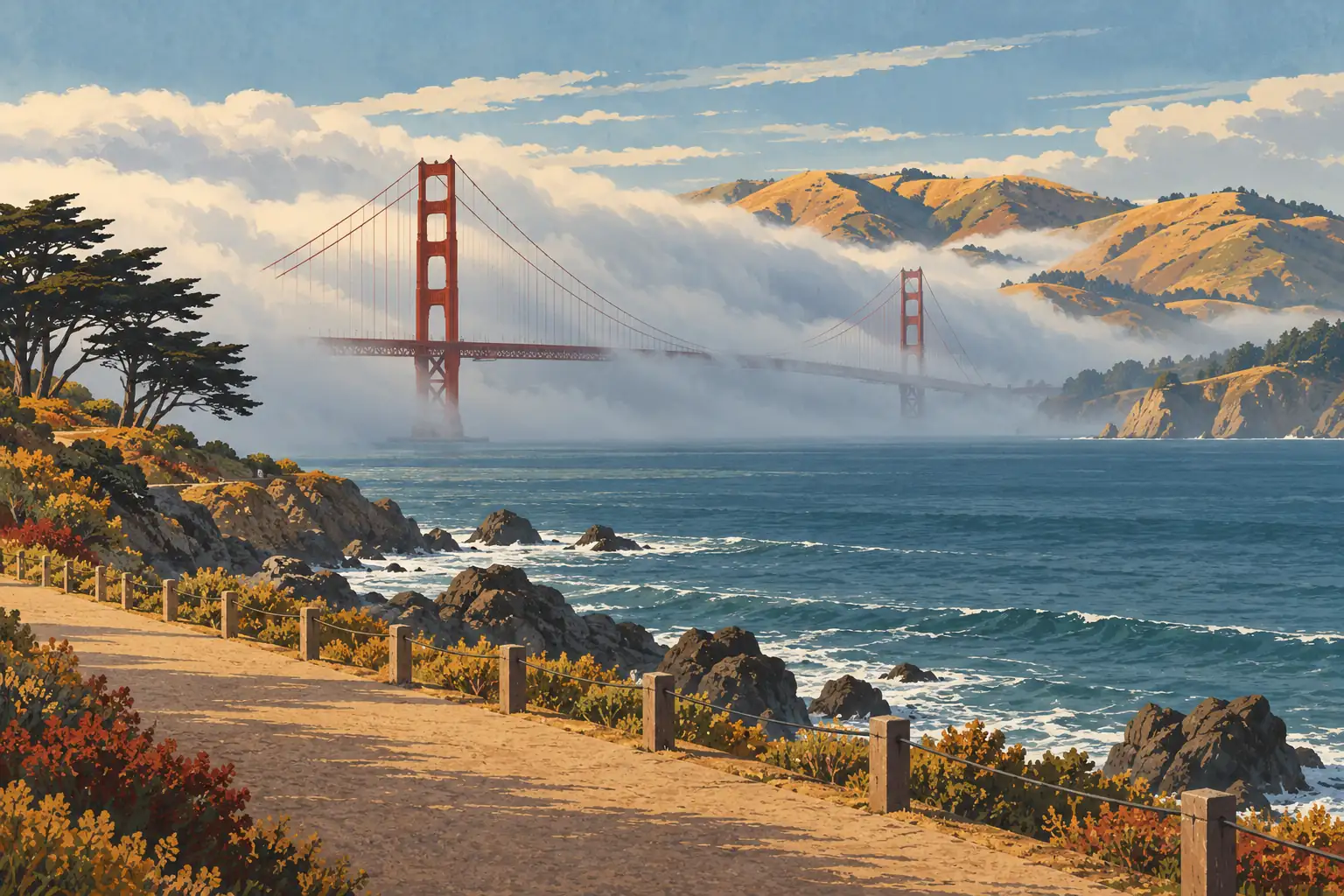
What should you do in San Francisco when the city climbs across fifty hills and June fog erases the Golden Gate first thing in the morning? Plan ahead instead of improvising. Alcatraz sells out weeks in advance, some of the bridge's less crowded viewpoints are worth the detour, and trips to the parks, from Muir Woods thirty minutes away to Yosemite four hours away, deserve attention from the moment you plan your stay. To land at SFO smoothly, this article compares Western U.S. airports based on your planned route.
How Many Days Should You Spend in San Francisco?
It comes up in every road trip conversation. SF is not a city you can check off in a weekend, but it does not require a full week either.
Two days cover the absolute essentials: walking across the Golden Gate, Alcatraz (if booked ahead), a stroll through the Mission District, and one ride on the Powell-Hyde cable car line. It is tight, with no room for museums.
Three days offer the ideal pace for a first visit. Add Haight-Ashbury, Alamo Square, half a day in Golden Gate Park, and the climb to Twin Peaks. This is the road trip format we recommend: enough time to get beyond the standard tourist checklist.
Five days let you include museums, evenings in North Beach, a ferry trip to Sausalito, and Muir Woods on the morning you leave for the parks.
Build two variables into your planning from the start. The fog: June and July are the months of "Karl the Fog," the marine layer that frequently covers the Golden Gate and Twin Peaks (920 feet) in the morning. Viewpoints are better in the afternoon. September and October bring better light and slightly smaller crowds. The hills: SF fits into a square about 6 miles wide, but its roughly fifty hills (100 to 985 feet above sea level, with a maximum grade of more than 30% on Filbert Street) quickly wear out your legs. Plan themed half-days by area instead of repeatedly crossing the city from end to end.
| Length | What you see | Best for |
|---|---|---|
| 2 days | Golden Gate, Alcatraz, Mission, cable car | Park-focused road tripper |
| 3 days | + Haight, Golden Gate Park, Twin Peaks | Couple on a first road trip |
| 5 days | + museums, Sausalito, evenings in North Beach | Family or extended stay |
Golden Gate Bridge: Cross It, Take It In, and Choose Your Viewpoint
The Golden Gate is 8,981 feet long overall, including a 4,200-foot main suspension span. Built in 1937, those are the bridge's official dimensions.
Walking across on the east side (hours are posted on goldengate.org) is free. Biking across on the west side is free too. Driving southbound, the toll is $10.25 with FasTrak ($10.50 by invoice, in effect since July 1, 2026, and revised regularly). There is no toll in the opposite direction.
The real question is not whether to cross it, but where to look at it from. Four viewpoints offer four different perspectives.
Battery Spencer (in the Marin County hills, reachable by car or on foot from Sausalito): a straight-on view of both towers with the bay behind them. It is the iconic photo angle, the one you have seen all your life.
Fort Point (a 19th-century fort beneath the San Francisco end of the bridge): an unusual upward view of the steel structure. Free access and usually quiet in the morning. Our favorite for its distinctive perspective.
Crissy Field East (the beach on the San Francisco side): a view of the bridge from water level along a peaceful coastal trail. Ideal for families and picnics.
Baker Beach (the western side, partly clothing-optional): a backlit view late in the day, with fewer people.
Walking across gives you only a partial view, as the cables obstruct the bay. For the iconic images, get back on land and choose your viewpoint.
Alcatraz: Why You Should Book Three Weeks Ahead
Alcatraz accounts for many of San Francisco's most avoidable disappointments, almost always for the same reason: booking too late.
Tickets are available up to 90 days in advance on cityexperiences.com. In July and August, popular daytime slots often sell out three weeks before the date. The rule is simple: book as soon as your trip is confirmed, not during departure week.
The ticket includes the ferry from Pier 33 and an audio tour, available in French. The tour tells the story of the federal prison (1934-1963) through accounts from guards and former inmates.
There are two options: day tour (recommended for skyline views from the island and the light on the bay) or night tour (more dramatic atmosphere, higher price, Tuesday through Saturday in season). If daytime slots are sold out, the night tour is a genuine alternative, not a second-best choice.
Allow 2.5 to 3 hours total: the ferry ride each way (about fifteen minutes from Pier 33), the island visit, and the return trip. The exact price is available on cityexperiences.com and is revised each season.
Practical tip: book Alcatraz at the same time as your Muir Woods reservation. Both sell out quickly in peak season, and their booking windows often overlap in your itinerary.
Neighborhoods to Explore: Mission, Haight, Lombard, and North Beach
SF is a city of contrasting neighborhoods, best explored on foot or by MUNI. You do not need a car: the streets are narrow, parking is expensive, and the distances are short enough for your legs to do the work.
Mission District: Balmy Alley and Clarion Alley hold one of the country's largest collections of murals, all free to visit. With its Latino atmosphere and Tartine Bakery on 18th Street, this is the city's liveliest neighborhood, best visited in the afternoon and evening.
Haight-Ashbury: the neighborhood of the 1967 Summer of Love, with vintage shops and Victorian homes. Ten minutes away on foot, Alamo Square is worth a stop: the seven homes on the east side, nicknamed the "Seven Sisters" (the term "Painted Ladies" more broadly refers to all of SF's colorful Victorians), with the skyline behind them. These homes date from the late 19th century.
Lombard Street: eight hairpin turns and a 16% grade on this stretch (the natural hill was steeper than 27% before the turns were built in 1922), making for a descent that takes only a few minutes. Visit it along the natural Powell-Hyde route, not as a separate destination.
North Beach and Coit Tower: spend the evening in Little Italy, then climb Telegraph Hill to Coit Tower for the WPA murals inside and panoramic bay views. A good half-day of culture and coffee.
Fisherman's Wharf and Pier 39: sea lions on the docks, Ghirardelli Square, and street performers. An hour is enough. We do not recommend staying here: prices are high and it is far from the lively neighborhoods.
Chinatown: one of the densest Chinatowns outside Asia, completely rebuilt after the 1906 earthquake. A natural stop from the Financial District; allow an hour.
Castro: the first gay neighborhood in the United States, with the Rainbow Crosswalk on Market Street. Thirty minutes is enough as you pass through.
Presidio: access to the Golden Gate from the San Francisco side, the Walt Disney Family Museum for families, and Crissy Field for a walk. Include it with your bridge visit rather than setting aside a separate day.
Car-free outing: the ferry from the Ferry Building to Sausalito (about thirty minutes) offers views of the bridge from the Marin hills. Return by bike across the bridge if you still have the energy.
Golden Gate Park and the Museums
Golden Gate Park covers about 1.6 square miles (1,018 acres), making it one of the country's largest urban parks. Admission is free; the museums inside charge admission.
De Young Museum: American fine art and international art, with an observation tower accessible with your ticket. Our pick for art lovers: the tower offers views of the park and bay that few free high points in the city can match.
California Academy of Sciences: natural history, an aquarium, a planetarium, and a living roof. Best for families; allow half a day. We do not recommend visiting it on the same day as the De Young, as the combination is too dense to be enjoyable.
Exploratorium (Pier 15, outside the park): 650 interactive exhibits, recommended for children and teenagers. Its themed island layout keeps younger visitors engaged without requiring constant explanation.
In the park itself: a bison herd in the western section, the Conservatory of Flowers (a Victorian greenhouse), the Japanese gardens, and bike paths on weekends when some streets are closed to cars.
Cable Cars, MUNI, and BART: Getting Around Without a Car
SF is one of the few major American cities where a rental car is unnecessary in town.
Cable car: three lines are in service. The Powell-Hyde line is the most interesting: it serves Russian Hill, runs along Lombard Street, and descends toward Fisherman's Wharf with bay views. Ride it once, not every day. The line at Powell & Market is long in peak season; boarding at an intermediate station avoids most of the wait.
MUNI: about 50 bus lines, roughly fifteen streetcar lines, and six light-rail lines. Single fares or a day pass cover most of the city.
BART: the regional subway connects SFO to downtown in thirty minutes and serves Oakland (lodging rates 30 to 50% lower, fifteen minutes from SF).
Waymo: in 2026, driverless autonomous taxis are as much an unusual attraction as a practical option for short trips around the city.
A rental car is unnecessary in SF (parking is scarce and expensive) and essential for the parks. The best strategy is to rent a car to leave SF on the morning you head to the parks, rather than when you arrive in the city.
Free Things to Do in San Francisco
SF is one of the most expensive U.S. cities for lodging. The big views, however, cost nothing.
Walk or bike across the Golden Gate: free in both directions, with no reservation.
Alamo Square: open access to the view of the Victorians and the skyline.
Mission District murals: Balmy Alley and Clarion Alley, one of the country's largest concentrations of murals, with free admission.
Crissy Field East: beach, coastal trail, and a view of the Golden Gate from the water. Free access and ideal for a picnic.
Baker Beach: a view of the bridge from the west, with a free walk along the beach.
Golden Gate Park: free admission (the museums inside charge admission).
Pier 39: watch the sea lions from the pier, free of charge.
Twin Peaks (920 feet): drive or walk up for 360-degree views of the city and bay. Free, windy, and best visited in the afternoon on a clear day.
Mission Farmers Market: Saturday morning on 16th Street, free access.
A practical calculation: a MUNI day pass (about $6) and a meal from a Mission taco truck ($12 to $15 per person) let you put together a day for under $25, excluding lodging. The big views cost nothing; lodging is what strains the budget.
Where to Stay in San Francisco for Every Budget
SF's hotel market is one of the most expensive in the United States. In peak season, downtown hotels regularly cost more than $200 a night.
Budget: Oakland (fifteen minutes by BART), Daly City, or Millbrae offer rates 30 to 50% lower with comparable access to downtown and SFO. This is the option we recommend for road trippers whose lodging budget has to last for several weeks.
Midrange: the Mission District or Haight-Ashbury offer good MUNI access and moderate rates compared with downtown. Fisherman's Wharf is expensive, touristy, and far from the lively neighborhoods.
Families: Nob Hill or Union Square offer spacious hotels with direct access to the cable car. Factor in parking costs if you plan to have a rental car from the start of your stay.
Logistics tip: if your stay ends with a trip to the eastern parks, spend your last night near an exit route (I-80 for Yosemite, US-101 for Muir Woods) to avoid crossing the entire city on departure morning.
From San Francisco to the Parks: Muir Woods, Yosemite, and Pinnacles
SF is the natural gateway to Northern California's parks. Muir Woods takes half a day, Pinnacles a full day, and Yosemite at least a weekend. This is the angle that classic SF guides rarely develop.
Muir Woods National Monument, about 30 minutes north
Coast redwoods in a wooded canyon thirty minutes from downtown. It is the easiest excursion from SF and the one least thoroughly covered in general guides.
Since 2018, parking at the monument has required a reservation through gomuirwoods.com. This is not a recommendation; it is a rule. The shuttle from Larkspur (Larkspur Ferry Terminal) is the simplest option for visitors without a car from SF; it runs on weekends and holidays from April through October, with reservations on the same site.
Book parking or the shuttle at the same time as Alcatraz: both sell out in July and August. Once there, allow two hours for the main trail (1.2 miles on flat ground beneath the canopy) or half a day for the higher loops. Before 9 a.m., the forest is cool and light filters between the trunks. It is ideal on the morning you leave SF, before driving toward the coast redwoods of Redwood to the north or Yosemite to the east.
Yosemite, about 4 hours by car
El Capitan, Yosemite Falls, Glacier Point, Tunnel View: California's most visited park, reachable from SF via Route 120 (Tioga Pass, closed from November to May depending on snowfall) or Routes 140 and 41.
Timed entry reservations are required in season through recreation.gov. The recommended minimum is two nights to see the valley without rushing. The four-hour drive is only an estimate: traffic on I-580 leaving SF can add an hour during peak times.
Pinnacles, about 2 hours south
Volcanic formations, talus caves, and California condors: Pinnacles is one of the parks least often mentioned in SF guides, making it a serious alternative to Yosemite for avoiding crowds. No entry reservation is required outside peak season. One day is enough. There is no connecting road between the two entrances, east and west, so choose your side.
The coast to Big Sur via Highway 1
Monterey, Carmel, Big Sur: half a day from SF to Monterey, and a full day to reach Big Sur. Plan it as a southern leg if your road trip continues to Los Angeles.
Our Take: Three Days Minimum, with the Parks in Sight
First road trip as a couple: three days are enough. Book Alcatraz as soon as your date is set (slots often sell out three weeks ahead in summer), walk across the Golden Gate one morning, and spend half a day in Mission and Haight. Keep your promises to yourself instead of trying to see everything.
Family with children: four days let you fit in the Exploratorium (650 interactive exhibits) and Golden Gate Park without rushing. A common mistake is using Fisherman's Wharf as a base: prices are high, the lively neighborhoods are far away, and an hour is enough to see it.
Budget trip: SF's big views are free. Golden Gate, Alamo Square, Mission murals, and Crissy Field East offer four half-days without spending money on attractions. Lodging is the expense to control. Oakland or Daly City via BART can cut the bill by 30 to 50%.
Park-focused road tripper: two nights in the city are enough (Alcatraz + Golden Gate + Mission), with Muir Woods on the morning you leave. The classic mistake is spending five days in SF and running out of time in the parks. Yosemite requires at least two nights on site; Pinnacles needs one.
What we do not recommend: using the cable car as daily transportation. The Powell-Hyde ride is worth doing once, not twice, especially not with a thirty-minute line at Powell & Market. Nor do we recommend staying in Fisherman's Wharf. And do not book Alcatraz during departure week in July: slots have been sold out for three weeks already.
Frequently Asked Questions
Do you really need to book Alcatraz in advance?
Alcatraz tickets are available up to 90 days before your visit on cityexperiences.com. In July and August, popular daytime slots often sell out three weeks ahead. Booking as soon as your trip is confirmed avoids disappointment.
Can you visit San Francisco without a rental car?
Yes, MUNI and BART cover nearly all of the city. A rental car is useful only for the parks, so pick it up on the morning you leave for the parks, not when you arrive in the city.
What is the best season to visit San Francisco?
September and October offer a good balance: less fog than in June and July, mild temperatures, and slightly smaller crowds. "Karl the Fog" frequently covers the Golden Gate and Twin Peaks on June and July mornings.
How long does it take to drive from San Francisco to Yosemite?
About four hours by car from SF, depending on departure time and season. Route 120 over Tioga Pass is closed in winter, so take Route 140 or 41 instead. Leaving before 7 a.m. helps avoid traffic on I-580.
Can you visit Muir Woods from San Francisco without a car?
Yes, by shuttle from Larkspur (Larkspur Ferry Terminal), with reservations required through gomuirwoods.com. Parking at the monument has also required a reservation since 2018, so you cannot park directly on site without booking ahead.