

What to Do in Miami: Beaches, Neighborhoods, and Three National Parks Within Driving Distance
South Beach, Wynwood, Little Havana, and three national parks near Miami: our practical guide to visiting in 3, 5, or 7 days.
By Erika Müller · · 20 min read
Miami is at once a Latin metropolis, an open-air showcase of Art Deco architecture, and the starting point for three of the most distinctive national parks in the United States. You can go from Ocean Drive to an Everglades trail in less than an hour, or head down the Florida Keys to Dry Tortugas, the isolated fort at the end of Florida. Few American cities combine this much urban life and natural landscape within a day's drive, and that dual identity gives a very different meaning to the question of what to do in Miami when you have three days instead of two weeks. To really enjoy it, plan on at least four days.
South Beach and Ocean Drive: Art Deco Between Sand and Neon
Miami and Miami Beach are two separate municipalities, a common source of confusion for French-speaking travelers. Miami Beach covers about 18.5 square miles, much of it water, had roughly 82,000 residents in 2024, and connects to Miami by several bridges. South Beach, the neighborhood packed with pastel facades and neon signs, is only one part of Miami Beach, roughly between Fifth Street and 21st Street.
Ocean Drive runs along the beach for barely 1.2 miles, but every foot of it counts. Hotels from the 1930s and 1940s line the street with rounded bow windows, stucco reliefs, and chrome lettering. Early in the morning, the low light brings out the colors without the crowds, making it the perfect time to explore on foot or by bike. In the evening, the signs light up and patios spill onto the sidewalk. For sunsets over the water, South Pointe Park at the southern tip of the neighborhood offers open views of the bay and the cargo ships entering the port.
Lincoln Road, a few blocks north, is a shady pedestrian mall, ideal for an outdoor coffee break or an evening of shopping without a car. On Collins Avenue, Lummus Park sets up its volleyball courts and outdoor gyms across from the ocean.
Two addresses are worth a stop: Casa Casuarina, Gianni Versace's former home turned hotel and restaurant, whose ornate facade contrasts with the Art Deco buildings next door; and the courtyards of the Art Deco Welcome Center, where you can pick up brochures for a self-guided neighborhood tour.
For families: South Beach gets very busy during peak season, and accommodation prices are high. For less crowded beaches and a quieter atmosphere, Key Biscayne, discussed below, is a much better option with children.
Wynwood and Little Havana: Two Faces of Miami
These two neighborhoods fit easily into the same half-day: Wynwood in the morning for the galleries, then Little Havana at lunchtime and into the afternoon.
Wynwood was an industrial wasteland until the early 2000s. The area's revival began with its walls, as street artists from around the world covered warehouse facades and turned the neighborhood into an open-air museum. Wynwood Walls brings together the most iconic works on a single enclosed block: the outdoor area is free, while the indoor galleries charge admission. Around it, dozens of painted walls spill into the surrounding streets with no ticket required. A few minutes' walk north, the Miami Design District combines luxury boutiques, contemporary art galleries, and ICA Miami, the Institute of Contemporary Art, Miami, whose admission is free.
Little Havana tells a different story. After 1959, successive waves of Cuban exiles settled in this neighborhood west of downtown Miami, bringing their culture, food, and daily customs with them. Calle Ocho, or SW 8th Street, is its main artery. Domino Park, officially named Gomez Park, brings domino players together under the palm trees every day: sit on a bench, watch a game, and order a very sweet Cuban coffee. In small workshops, cigar rollers work by hand in full view of passersby. The neighborhood is lively and lived-in, and you can feel it: this is not a tourist set rebuilt for visitors.
For readers on a second trip to Miami, Little Haiti deserves a mention. Farther north, this emerging neighborhood has a dense Afro-Caribbean street art scene and a growing Creole culture, well outside the usual tourist routes.
From Little Havana, the Everglades are about a 15-minute drive away. Several French-speaking operators, including Miami en français and Miami Off Road, offer a morning in the Cuban neighborhood followed by an afternoon nature excursion, a combination that works well for a full day.
Key Biscayne and the Bay's Urban Parks
Just a 15-minute drive from Downtown Miami, Key Biscayne is an island separated from the city by the bay, with about 3.7 miles of fine sand and two parks that feel completely different from South Beach.
Crandon Park occupies the northern half of the island: a family beach, tennis courts, a golf course, and shaded picnic areas. This is the beach Miami residents choose when they want to swim without the crowds. To the south, Bill Baggs Cape Florida State Park is organized around the Cape Florida Lighthouse, whose spiral staircase has 109 steps up to the lantern room. From the top, the view stretches across Biscayne Bay and, on clear days, you can make out the first reefs of the national park in the distance. Bike paths cross the mangroves between the two parks.
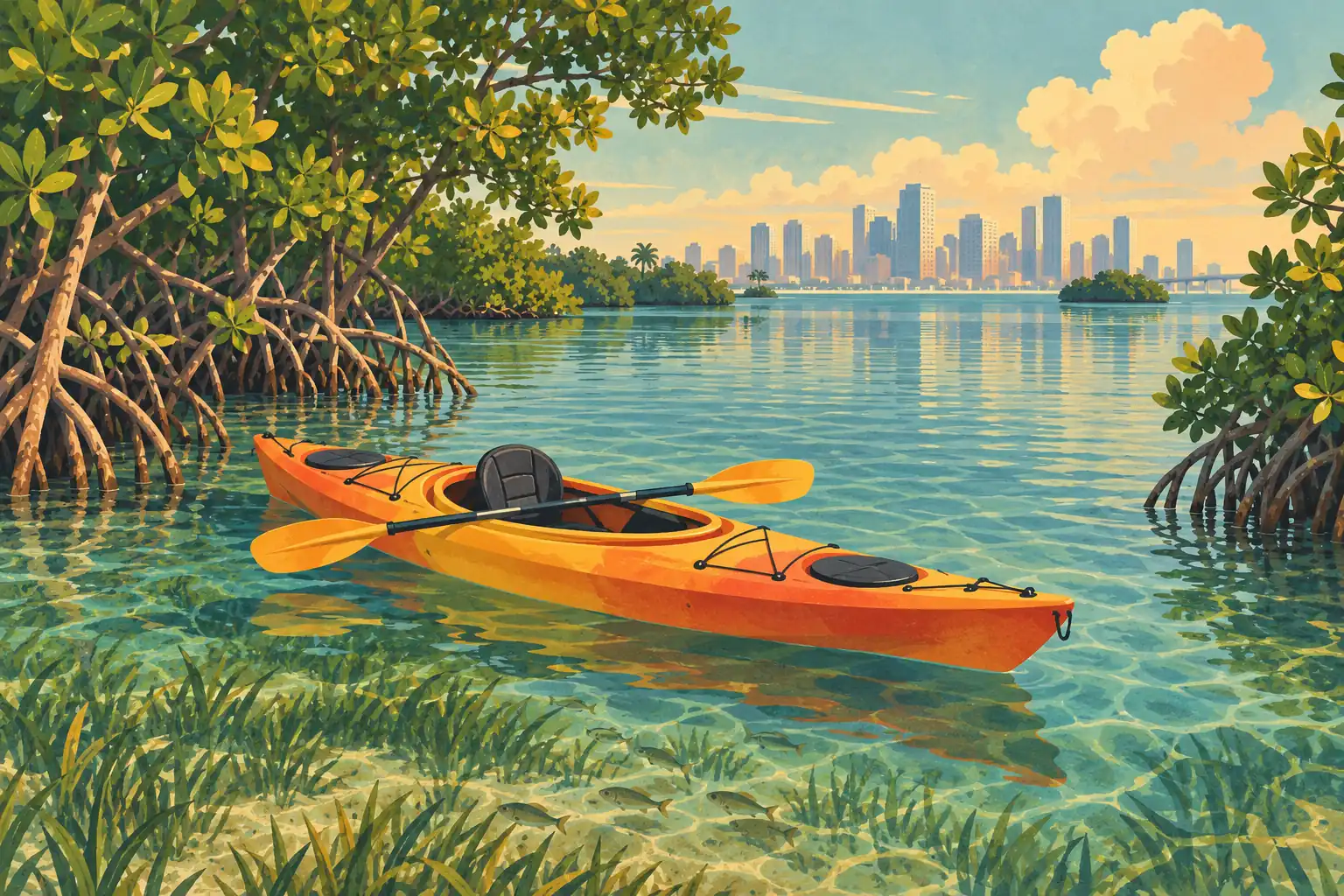
Away from Key Biscayne, Oleta River State Park is worth a half-day. Located north of Miami and less visited, it offers kayaking and paddleboarding on a mangrove river just a few miles from the city's bustle. It is a good outdoor option without having to drive to the Everglades.
From Bayside Marketplace in the heart of Downtown Miami, short cruises cross Biscayne Bay along the artificial islands of Star Island, Palm Island, and Hibiscus Island, where waterfront residences are visible from the water. It is a pleasant way to take in the scale of the bay before heading farther toward the national park.
Coconut Grove, Coral Gables, and Vizcaya: Historic Miami
These three stops fit easily into the same day by car, following the western shore of Biscayne Bay. They are especially appealing to travelers spending five days or more in Miami who want to go beyond the Art Deco, Wynwood, and Little Havana circuit.
Coconut Grove is Miami's oldest neighborhood. The atmosphere is bohemian and leafy: centuries-old banyan trees shade the sidewalks, cafes spill their patios onto the walkways, and the bayfront promenade is pleasant at any hour. Allow half a day to wander. For a first stay in Miami or a three-day trip, Key Biscayne or Wynwood offer a better experience-to-time ratio. Coconut Grove is the right choice on a second visit, or for travelers looking for a leafy break away from the usual tourist routes.
The Vizcaya Museum and Gardens alone justifies coming to this part of town. The villa was built between 1914 and 1916 for James Deering, an executive of International Harvester, by architects F. Burrall Hoffman, Diego Suarez, and Paul Chalfin. The result is Italian Baroque transplanted to the tropics: formal terraced gardens overlooking the bay, fountains, pavilions, and the ocean beyond. It is a cultural experience in its own right and works just as well on a rainy day.
In Coral Gables, two addresses cover the essentials. Venetian Pool is a former limestone quarry converted into a municipal swimming pool in the 1920s. The only pool listed on the U.S. National Register of Historic Places, it remains open for swimming during the season. Fairchild Tropical Botanic Garden spreads across about 83 acres of tropical vegetation, rare palms, cycads, and tree ferns. The Mediterranean-style architecture of the neighborhood, envisioned by developer George Merrick, adds an unusual visual coherence for an American city.
The Everglades: The National Park One Hour from Miami
An hour's drive from South Beach, the city gives way to another world: suburbs become freshwater marshes and mangrove forests. The national park covers about 1.5 million acres, according to NPS data (nps.gov). You will sometimes see figures of more than 2.5 million acres, but those refer to the entire South Florida ecosystem, not the park alone. The Everglades have been on the UNESCO World Heritage List since 1979, a biosphere reserve since 1976, and on the Ramsar List of Wetlands of International Importance since 1987. The site is one of the few places to hold all three major global conservation designations.
From Miami, the main park entrance is through the Ernest Coe Visitor Center, about 37 miles southwest of downtown. Allow an hour by car. There are three ways to visit, each offering a very different experience.
Airboating takes place outside the park, along Route 41, the Tamiami Trail, through private operators. It is spectacular and loud. The areas covered are private lands or tribal reserves next to the park, with no NPS designation.
NPS trails offer a quieter and often more memorable experience. The Anhinga Trail, about 0.9 miles round trip, follows a branch of Taylor Slough. In the dry season, alligators gather a few feet from the path, anhingas dry their wings on low branches, and roseate spoonbills move through the watery vegetation. The Gumbo Limbo Trail crosses dense tropical forest over limestone ground. Pa-hay-okee Overlook offers a panoramic view of the freshwater marshes, the "river of grass" landscape that gives the Everglades their name.
Mangrove kayaking is the most involved option. The Ten Thousand Islands on the western side of the park offer marked routes lasting several days for experienced paddlers. Florida Bay to the south is better suited to beginners on a half-day outing. In either case, booking with an authorized NPS concessioner before departure is recommended.
As for the seasons, December through April is the dry season. Wildlife gathers around the remaining waterholes, visibility is better, and mosquitoes are largely absent. In summer, water levels rise, animals disperse, and mosquitoes make some trails difficult.
The vehicle entrance fee is $35 in 2026, but check nps.gov before leaving. Our Everglades guide covers the trails, campgrounds, wildlife, and seasonal visiting advice.
Biscayne National Park: Reefs, Shipwrecks, and Mangroves 45 Minutes Away
Biscayne is the national park that general-interest guides systematically forget when writing about Miami. That is hard to explain for a park just 45 minutes from Downtown.
The figure that sums up the park: 95% of its area is water. Biscayne Bay, coral reefs, and a fringe of islands make up most of the park. The only land entrance is Convoy Point, on the edge of Homestead east of the city. Admission at Convoy Point is free.
What you do here depends on the water. For snorkeling and diving, Biscayne's coral reefs are among the most accessible in Florida. The park also contains four major shipwrecks grouped under the name Maritime Heritage Trail. Dive buoys mark the sites, all of which are accessible by boat. Underwater visibility is best from June through August, when the bay's waters are calmest and clearest.
Kayaking and canoeing through the bay's mangroves can be done as a self-guided outing from Convoy Point. Marked trails follow the shorelines. To reach the inner islands, Boca Chita Key, with its decorative lighthouse and picnic area, and Elliott Key, the largest island, with a hiking trail and campground, are accessible only by water. You can rent a boat or join an organized tour from Convoy Point.
One useful distinction to keep in mind: Bill Baggs Cape Florida on Key Biscayne is a Florida state park managed by the State of Florida. Biscayne National Park is a federal national park managed by the NPS, with its own regulations and entrance fees.
Our Biscayne National Park guide covers the details of mangrove kayak trips, boat tours to the islands, and seasonal diving conditions.
The Florida Keys Road Trip and Dry Tortugas: Extending Your Journey to the End of Florida
From Miami, the Florida Keys begin about an hour away by car. The Overseas Highway, US-1, links Key Largo to Key West across about 112 miles of roads and bridges over the ocean, with eleven state parks along the way. The drive has few equivalents in the continental United States: bridges stretching over the ocean, distinctive light, and an end-of-the-world atmosphere that grows with every mile. A car is essential, as no public transportation serves the Keys.
Stops worth making:
Key Largo is the gateway to the Keys. John Pennekamp Coral Reef State Park offers snorkeling and diving on the reefs and at the underwater statue "Christ of the Abyss," a bronze replica of an original Italian sculpture installed about 26 feet below the surface. Wreck-diving trips round out the program.
Islamorada is the sportfishing capital of the Keys. Tarpon and bonefish attract anglers from around the world. The atmosphere is more local than touristy.
Bahia Honda State Park offers a beach with shallow turquoise water that is ideal for families. The remains of the former Florida East Coast Railway structure, abandoned after the 1935 hurricane, run along the northern side of the beach. Snorkeling and diving trips leave from the park marina.
Key West brings the road trip to a close. The Ernest Hemingway Home and Museum, a private museum open year-round, attracts nearly every visitor to the city. Fort Zachary Taylor State Park preserves Civil War artifacts and has a coral beach well suited to snorkeling. Duval Street concentrates the bars, shops, and nightlife. Every evening, Mallory Square on the waterfront gathers street performers for a communal sunset that has become a ritual.
Dry Tortugas National Park is the option most Miami guides overlook. The park can only be reached by ferry from Key West, a crossing of about two and a half hours, or by seaplane. Construction on Fort Jefferson began in 1846 and was never completed; it is one of the largest 19th-century masonry fortresses in the United States. Around the fort, tropical reefs among the least visited in the country await divers and snorkelers. In May and June, colonies of brown boobies nest on the walls. Magnificent frigatebirds, Fregata magnificens, glide constantly above the island.
Overnight camping on the island is possible, but spaces are extremely limited and must be reserved through recreation.gov. It is one of the most isolated nights accessible from the continental United States, with a view of stars no longer visible from the coast.
The ferry from Key West costs about $235 to $250 depending on the category in 2026. Check the Yankee Freedom III operator's website before booking. The price includes park admission. Our Dry Tortugas guide covers access, diving conditions, and campground reservations.
For the Keys, the recommended length depends on your goals: two days are enough for Key Largo and Bahia Honda, four days for the full drive to Key West, and you should add another day if you want to visit Dry Tortugas. A car is essential from the moment you leave Miami: renting a car in the United States at MIA airport is the only practical way to organize this route.
The Three National Parks Near Miami: A Comparison Table
Miami is one of the few American cities with three national parks in its immediate sphere of influence. The table below helps you compare the options before deciding.
| Park | Distance from Miami | Transportation | Entrance fee | Signature activity | Best season |
|---|---|---|---|---|---|
| Everglades | ~37 miles | Car | $35/vehicle | Airboat and hiking | Dec. to Apr. |
| Biscayne | ~45 min. | Car | Free at Convoy Point | Snorkeling and kayaking | June to August |
| Dry Tortugas | Key West + ~2 hr. 30 min. | Car + ferry | Included with ferry, about $235-$250 in 2026 | Fort and diving | Nov. to Apr. |
Two notes about fees. The America the Beautiful Pass ($80/year) covers NPS entrance fees at Everglades and Dry Tortugas. Ferry fees to Dry Tortugas remain separate and are not covered by the pass. Biscayne is free at the land entrance, but boat tours to the islands and equipment rentals cost extra through the authorized NPS concessioner.
If you had to choose just one based on the time available, the Everglades offer the most varied experience from Miami, from a half-day to a full day. Biscayne is better for divers and kayakers. Dry Tortugas rewards those willing to take the ferry with an underwater spectacle and a solitude the other two parks cannot offer.
When to Visit Miami: Dry Season, Heat, and Hurricanes
The best window runs from December through April. The dry season brings temperatures of 72 to 82°F, about 250 sunny days a year, and Everglades water levels that concentrate wildlife around waterholes visible from the trails. Dry Tortugas is accessible when the water is calm. Accommodation prices peak during this period, especially from January through March.
Summer, from June through September, pairs intense heat, 95 to 100°F, with high humidity, but it also brings real advantages: smaller crowds in South Beach and the neighborhoods, much lower accommodation prices, and underwater visibility in Biscayne National Park at its best for the year. Late-afternoon tropical showers, intense but brief, are part of the landscape. The Everglades are not ideal for summer planning: wildlife disperses and mosquitoes are abundant.
Hurricane season officially runs from June through November, peaking between August and October. Its practical impact on a Miami trip deserves some nuance. A direct hit on Miami is rare, as the 2024 and 2025 seasons confirmed. The real risks for travelers during this period are possible national park closures, canceled ferries to Dry Tortugas, and flight disruptions. For any trip planned from August through October, travel-cancellation insurance is recommended.
August in particular is often described as the off-season. That is inaccurate. August works well for Wynwood, South Beach beaches outside the midday heat, and especially Biscayne National Park, whose underwater season is at its peak. What to avoid in August: the Everglades for wildlife viewing, and the Keys if a tropical system is approaching.
How Many Days to Plan and How to Get Around
3 days, Miami only. Day 1: South Beach and Ocean Drive in the morning, swimming at Lummus Park in the afternoon, sunset at South Pointe Park. Day 2: Wynwood, with galleries from opening time, Little Havana for lunch and Cuban coffee, then the Miami Design District. Day 3: Key Biscayne in the morning, including the Cape Florida Lighthouse, then the Ernest Coe Visitor Center and Anhinga Trail in the Everglades in the afternoon. The schedule works as long as you do not linger on the way.
5 days. Add Coconut Grove, Vizcaya, and Coral Gables, including Venetian Pool and Fairchild, on day four. On day five, visit Biscayne National Park for a mangrove kayaking trip, or attend a basketball game, with the Miami Heat at Kaseya Center in Downtown. Note: Inter Miami CF has played at Nu Stadium, Miami Freedom Park, outside central Miami, since April 2026.
7 to 10 days. Add the Keys, with at least two days for Key Largo and Bahia Honda or four days for the full route to Key West, plus a day or night at Dry Tortugas.
Getting around. For central neighborhoods, the Metromover is free: 21 stations on three loops cover Downtown, Brickell, and the Omni district. The Metrorail, about $2.25 per ride in 2026, links more distant neighborhoods. For the parks and the Keys, a car is essential. Rent one at MIA airport: the free MIA Mover shuttle connects the terminals to the Rental Car Center in a few minutes.
Our Take: Miami for the Parks as Much as the Beaches
Miami is often reserved for travelers looking for sunshine, a good lifestyle, and parties. We recommend thinking about it differently.
For a first trip to Florida, five nights is the practical minimum, from December through April, with a car from the moment you arrive at MIA. The Everglades, about 37 miles away, and Biscayne National Park, about 45 minutes away, can be done over two days without changing regions or overnight bases. That is a rare concentration of nature for a city of this size.
For diving and underwater nature enthusiasts, two days in the Keys and one night in Dry Tortugas via Key West round out the trip. You will search in vain for this itinerary in most Miami guides. That is the main advantage of including Dry Tortugas: the park is accessible, its reefs are among the least visited in the United States, and a night on the island has no equivalent in the region.
For a tight budget, the winning combination is Biscayne National Park, with free admission, plus the free Metromover and walks through South Beach and Wynwood, with a trip scheduled for June or July. Accommodation prices are cut in half, at the cost of intense heat and a risk of park closures around the Keys.
What we do not recommend: trying to cover Miami, the Keys, and the Everglades in three days. It is physically possible but editorially exhausting. It is better to choose at the time of booking between an extended urban stay and a road trip to the Keys. Trying to do everything in three days means never really doing anything.
For families with children, Biscayne National Park, with kayaking, beaches, and shallow water, and the Everglades, with the Anhinga Trail and alligators a few feet from the path, are the two best nature options from Miami. In terms of value and uniqueness, they beat Orlando's theme parks, which belong to a different trip. Our article on Florida theme parks covers that option separately.
Frequently Asked Questions
Do you need a car to visit Miami?
A car is not essential for the central neighborhoods. The free Metromover serves Downtown, Brickell, and Omni across 21 stations, and the Metrorail connects more distant neighborhoods for about $2.25 per ride. For the Everglades, Biscayne National Park, and the Keys, a car is essential: no public transportation serves these destinations.
Are Miami and Miami Beach the same city?
Miami Beach is not the same municipality as Miami. It is a separate city of about 18.5 square miles, connected to Miami by several bridges. South Beach is a Miami Beach neighborhood between Fifth and 21st Streets. The confusion is common among French-speaking travelers and can complicate both hotel searches and transportation planning.
Can you visit the Everglades from Miami without a car?
You can visit the Everglades from Miami through organized excursions. Several operators offer departures in French, including Miami en français, Destinations Off Road, and Miami Off Road. These trips often combine transportation, a guide, and an activity such as airboating or a guided hike.
What is the best season for Dry Tortugas?
The preferred season for Dry Tortugas runs from November through April, with mild weather, decent underwater visibility, and conditions outside the peak of hurricane season. Summer is still possible, but ferry crossings from Key West depend on the weather, and the heat in the island's full sun is intense.
How many days should you plan for Miami and the Keys?
Seven days minimum is our recommendation for combining Miami and the Keys: four days for Miami and the nearby parks, Everglades and Biscayne, two to three days for the Keys through Key West, and an optional day or night at Dry Tortugas. With fewer than seven days, choose between the two rather than trying to combine them.